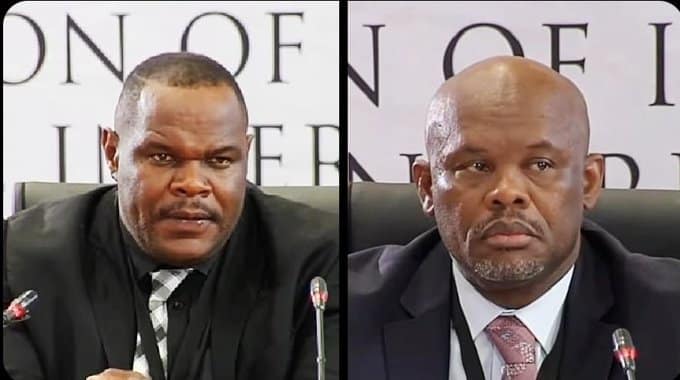
The tension inside the Johannesburg hearing venue of the Madlanga Commission of Inquiry was palpable on Monday afternoon. For weeks, the commission—established to investigate allegations of corruption and malfeasance within the upper echelons of the Gauteng police—had heard a steady stream of testimony. But on this day, the atmosphere shifted from procedural to electric. Sergeant Fannie Nkosi, a dogged investigator from the elite Gauteng organised crime unit, took the stand for the second time and delivered a blistering, point-by-point refutation of evidence given by his former superior, Lieutenant-General Richard Sibiya. In stark and unequivocal terms, Nkosi told the commission that Sibiya had “lied about everything.”
The accusation, delivered without a tremor in his voice, landed like a bombshell in the hearing room. It represented a dramatic escalation in what has become a bitter, high-stakes war of words between a junior officer who has staked his career on exposing wrongdoing and a senior commander fighting to protect his legacy and his liberty.
Nkosi, known within police circles as a meticulous and methodical investigator, was clearly prepared for this moment. He arrived at the commission with a thick binder of documents, case files, and contemporaneous notes—the paper trail he claims proves that Sibiya’s version of events is not just mistaken, but a deliberate and systematic fabrication designed to obstruct the commission’s work and shield himself from accountability.
“The testimony given by General Sibiya is not a matter of different recollections or faulty memory,” Nkosi stated calmly, reading from a prepared opening statement. “It is a complete inversion of the truth. It is a web of lies constructed to protect himself and to discredit those of us who were trying to do our jobs.”
The Core Contradictions: From Cash to Corruption
The Madlanga Commission is investigating a range of serious allegations, including the existence of a “cabal” of senior officers who allegedly manipulated appointments, protected criminal syndicates, and misappropriated funds intended for police operations. Sibiya, who commanded significant resources and influence during his tenure, has sought to portray himself as a reformer who was stymied by rogue elements within his own command.
Nkosi’s testimony directly assaults that narrative. He focused on several key incidents where he claims Sibiya’s actions were not those of a reformer, but of a commander intent on burying cases and shielding powerful interests.
One of the most explosive allegations centered on a specific organised crime investigation that Nkosi was leading. According to his testimony, the operation had reached a critical juncture, with multiple suspects identified and a raid imminent. He testified that Sibiya personally intervened, ordering him to stand down and effectively killing the investigation.
“He called me into his office and told me, in no uncertain terms, that certain people were ‘off limits’,” Nkosi told the commission. “He said I was being ‘too aggressive’ and that I needed to understand the ‘bigger picture’. The bigger picture, I later realised, was protecting his own associates.”
Nkosi further testified about the mishandling of seized cash exhibits—a recurring theme in police corruption scandals. He claimed that Sibiya had instructed him to falsify records related to the seizure of large sums of money during raids, money that subsequently could not be accounted for. When Nkosi objected and raised his concerns through official channels, he alleges that Sibiya retaliated by having him removed from high-profile cases and transferred to a dead-end administrative post.
“He tried to bury me,” Nkosi said, his voice hardening. “He thought if he pushed me into a corner, I would just go away and keep quiet. He underestimated my commitment to the oath I took.”
“I Am the Victim Here” vs. The Evidence
Earlier in the commission’s proceedings, Sibiya had painted a very different picture. In his testimony, he portrayed himself as a disciplined commander who had attempted to root out corruption but was undermined by insubordinate officers who were themselves compromised. He suggested that Nkosi and others who had spoken out were motivated by personal grievances after being passed over for promotion or disciplined for poor performance.
“I am the victim here,” Sibiya had told the commission previously, claiming that a smear campaign was being orchestrated against him to deflect attention from real corruption within the ranks.
Nkosi’s return to the stand was designed to dismantle that defense piece by piece. Under pointed questioning from evidence leaders, he produced detailed logs of meetings, internal memorandums he had written expressing his concerns, and financial records that he argued corroborated his version of events.
Legal experts observing the proceedings noted the significance of Nkosi’s direct, personal attack on Sibiya’s credibility. In a commission of inquiry, where there is no jury and the findings are ultimately presented in a report to the President, the battle for perceived truth is paramount. By labeling Sibiya a liar “about everything,” Nkosi has drawn an indelible line in the sand. The commission must now decide which witness it finds credible.
The Whistleblower’s Burden
Nkosi’s decision to go on the record with such a damning indictment of a senior officer is not without personal risk. Whistleblowers within the South African Police Service have often faced ostracization, threats, and even dismissal. Outside the hearing room, Nkosi was surrounded by a small group of supporters, including representatives from police unions who have championed his cause.
“We stand behind Sergeant Nkosi 100%,” said a union representative who asked not to be named. “He is a brave man. He is doing what every police officer should do: upholding the law, no matter the rank of the person breaking it. The problem is, the system is designed to protect the generals, not the foot soldiers.”
As the commission adjourned for the day, the legal teams for both Sibiya and the commission itself were seen huddling in corners, reviewing the transcripts. Sibiya, who was present in the room during Nkosi’s testimony, sat motionless, his face betraying no emotion. He will likely be given the opportunity to return to the stand to respond to these new, explosive allegations.
The Madlanga Commission was established to get to the truth about police corruption in Gauteng. On Monday, it got a front-row seat to a bare-knuckle fight between two men with wildly different accounts of that truth. The credibility of Sergeant Fannie Nkosi, and by extension, the entire investigation into Lieutenant-General Richard Sibiya, now hinges on whether the commission believes his claims that his former boss has, in his words, “lied about everything.”
About The Author