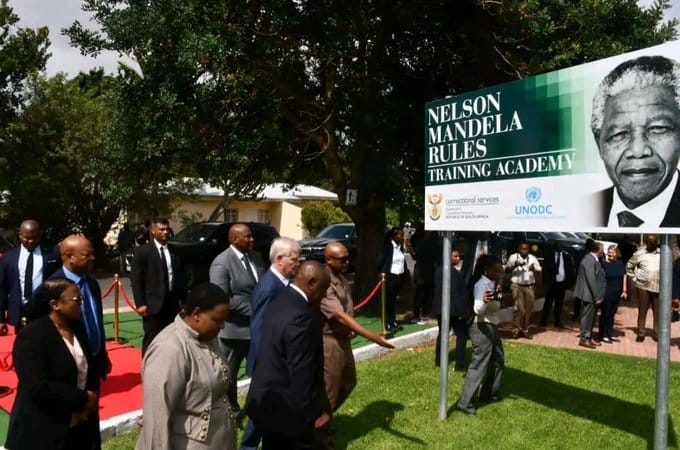
The low mountains of the Drakenstein valley held their shadows close on the morning the President arrived. It was here, thirty-six years ago, that a man walked out of prison and into history. Today, another man walked in, not to be incarcerated, but to consecrate the ground as holy ground—a place where the old alchemy of punishment would be transformed, slowly, painfully, into the harder craft of restoration.
President Cyril Ramaphosa stood at the podium erected before the original prison gates, their white-washed arch gleaming under the winter sun. Behind him, the cells where Nelson Mandela spent his final years of captivity stood silent. Before him sat a congregation of correctional services officials, international diplomats, criminologists, and—most significantly—a small contingent of inmates dressed in the ochre uniforms of the Drakenstein Medium B section. Their presence was deliberate. This was, after all, their story too.
The Architecture of Dignity
The Nelson Mandela Rules Training Academy is not, its architects are careful to note, merely another government building. It is an argument carved into brick and mortar. Where the old prison infrastructure was designed to dehumanize—razor wire as a philosophy, cramped cells as a statement on worth—this facility pivots on a different axis.
Natural light floods the training lecture halls. The cells used for simulation exercises are single-occupancy, with windows positioned at eye level for a seated person, allowing a view of the valley rather than a wall. There is a library, not a book trolley. There is a mental health unit staffed by qualified psychologists, not a single overworked social worker serving three thousand inmates.
“The architecture of a prison is the architecture of a society’s conscience,” Ramaphosa said, removing his reading glasses to survey the room. “If we build cages, we become gaolers. If we build houses of correction, we become educators. If we build spaces that restore dignity, we become, at last, what we have always claimed to be: a free people.”
It was the kind of line that would be clipped and shared on evening broadcasts, but the officials in the front row knew it carried the weight of a damning audit. South African prisons remain dangerously overcrowded, operating at an average of 147% capacity. Awaiting trial detainees, some of whom will spend years in remand before seeing a magistrate, constitute nearly a quarter of the inmate population. Allegations of assault by correctional officers have risen by 18% over the past five years.
The Academy is, in this context, both a rebuke and a roadmap.
The Mandela Standard
The “Mandela Rules”—formally the United Nations Standard Minimum Rules for the Treatment of Prisoners—were adopted by the UN General Assembly in 2015, largely due to South Africa’s persistent advocacy. They mandate, among other provisions, that solitary confinement should be prohibited for juveniles and prisoners with mental disabilities, that restraints should never be used on women during childbirth, and that prison administration should prioritize rehabilitation over punishment.
Yet adoption and implementation are separated by a chasm South Africa knows all too well. The Academy is designed to bridge that gap.
Correctional Services Commissioner Makgothi Thobakgale, standing ramrod straight beside the President, outlined the facility’s mandate with military precision. “Every correctional officer in this country will pass through these doors,” he said. “Not once. Repeatedly. We are not teaching techniques; we are reprogramming a culture. The old ways—the baton, the raised voice, the assumption that a person in a uniform has dominion over a person in a cell—those ways end here.”
The curriculum is ambitious. Officers will undergo modules on de-escalation techniques, trauma-informed care, and the neuropsychology of rehabilitation. They will role-play scenarios where an inmate experiencing a psychotic episode must be calmed rather than restrained. They will sit across from formerly incarcerated individuals who will describe, without bitterness, the precise moment a warder’s cruelty reshaped their understanding of their own humanity.
The Inconvenience of Transformation
Not everyone gathered at Drakenstein was celebrating. Outside the main gate, a small cluster of picketers from the Police and Prisons Civil Rights Union (POPCRU) held placards aloft. Their grievance was not with the Mandela Rules themselves—few would publicly oppose the late President’s legacy—but with the implementation timeline and, more pointedly, the absence of their members from the planning phase.
“You cannot rehabilitate a prisoner with a pamphlet,” said union representative Thabo Makhubu, his voice carrying across the parking lot. “Our members work in facilities where there is one psychologist for every two thousand inmates. Where sewage leaks into cells. Where gangs run the courtyards after sunset. Build all the academies you want. Until you staff the prisons adequately, the rules are just paper.”
The tension is not merely industrial; it is philosophical. The Mandela Rules framework requires a fundamental shift in the correctional officer’s self-conception. They are no longer guards, but case managers; no longer custodians, but social workers with firearms training. This is a difficult transition for a workforce that has historically been underpaid, undertrained, and asked to maintain order in environments designed to breed chaos.
Ramaphosa acknowledged this obliquely in his address. “We ask much of those who wear the green and blue,” he said. “We ask them to be firm but fair, authoritative but compassionate. We ask them to see the person and not the crime. This Academy is our promise that we will not ask these things without providing the tools to achieve them.”
The Drakenstein Symbolism
The choice of Drakenstein—formerly Victor Verster—as the Academy’s home is heavy with intentionality. It was from this facility that Mandela walked on February 11, 1990, his hand in Winnie Madikizela-Mandela’s, his fist raised not in anger but in the quiet certainty of a struggle nearing its end.
The prison has since undergone multiple transformations. It is now a medium-security facility that houses a renowned vineyard program, where inmates cultivate grapes and produce wine under the brand name “Breekland.” The program, now in its fifteenth year, boasts a recidivism rate of less than 10% among its graduates—a statistical anomaly in a system where nearly half of released inmates return within five years.
During the tour that followed the formal proceedings, Ramaphosa paused at the edge of the vineyard. An inmate, a middle-aged man serving a sentence for armed robbery, was pruning back winter canes. The President asked him, without the insulation of aides or protocol officers, whether the work mattered.
The man straightened, clippers in hand. “When I came here, I didn’t think I deserved to see another spring,” he said. “Now I help make the spring happen. That’s different. That’s a different way of being alive.”
Ramaphosa nodded. He did not reach for a grand pronouncement. He simply stood, for a long moment, in the winter light, looking at the man and the vines and the mountains beyond.
The Horizon
The Academy will officially receive its first cohort of trainees in April. Its budget, drawn from the Correctional Services vote and supplemented by international donor funding, is secured for three years. After that, it must prove its worth in the only currency the Treasury recognizes: reduced recidivism, decreased violence, and measurable improvements in rehabilitation outcomes.
Critics note that South Africa has launched similar initiatives before, only to watch them atrophy under bureaucratic neglect and budget cuts. The much-vaunted “white paper” on corrections, released with fanfare in 2005, promised many of the same reforms now being re-announced at Drakenstein. Two decades later, its most ambitious provisions remain unimplemented.
But there is, perhaps, a difference this time. The international human rights framework has hardened. The Constitutional Court has grown impatient, issuing multiple judgments that directly intervene in prison conditions. And the Correctional Services leadership, under Thobakgale, has demonstrated an uncharacteristic willingness to acknowledge failure.
“We have spent thirty years managing a system we knew was broken,” Thobakgale told journalists after the ceremony. “We are now committing to fixing it. It will not happen in one budget cycle. It will not happen under one Commissioner. But it begins here, today, with this building and the people who will pass through it.”
As the presidential motorcade departed, winding back down the valley toward Cape Town, the inmates of Drakenstein returned to their routines. The vineyards would need pruning through the winter. The education block would hold its evening literacy classes. The cells would lock at the usual hour.
But the new Academy stood on the hillside, its windows catching the last of the afternoon light. It was, at this moment, merely a building—empty corridors, unworn lecterns, classrooms waiting for their first lessons. The transformation it promised was not yet real.
It was, however, possible. And in the long, slow work of turning a prison system into a correctional system, possibility is not a small thing. It is, perhaps, the only thing.
About The Author