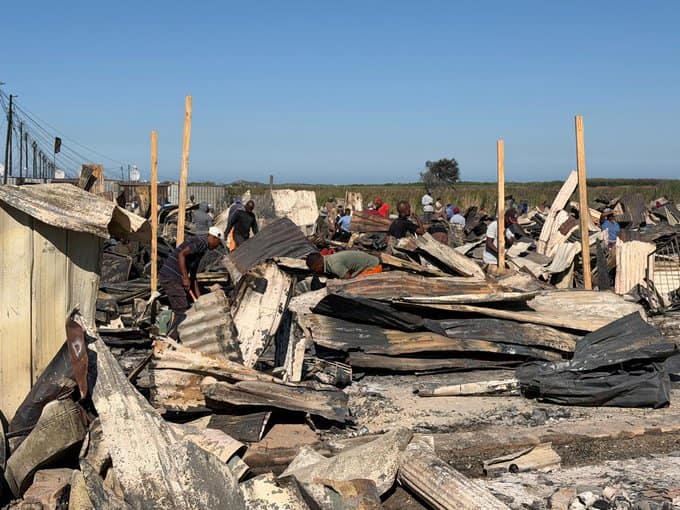
A ferocious and fast-moving fire, fanned by relentless summer winds, tore through the heart of the Masiphumelele informal settlement on Tuesday afternoon, reducing vast swathes of the community to smouldering ash and corrugated iron skeletons. The blaze, which erupted in the densely populated wetlands area around 3:15 pm, unleashed chaos and devastation, leaving an estimated 3,000 to 4,000 residents homeless and destroying well over a thousand homes and informal businesses before a massive, multi-agency firefighting effort could bring it under control late into the night.
Rapid Escalation in a Tinderbox Environment
The fire is believed to have started in the southern section of the settlement, an area crisscrossed with informal electrical connections and built perilously close to dry winter vegetation. Witnesses described seeing flames leap from a single structure and, within minutes, become an unstoppable wall of fire driven by a strong south-easterly wind.
“The wind was the monster,” said resident Andile Nkosi, who watched his home vanish. “It took one shack, then five, then ten. It was jumping across the pathways like it was alive. There was no time to save anything—just the people.”
The settlement’s layout—a maze of tightly packed wooden and corrugated iron structures separated by narrow, often inaccessible alleyways—acted as a perfect conduit for the flames. Firefighters faced a nightmare scenario: limited water access, the risk of live electrical wires snapping in the heat, and panicked residents trying to salvage belongings or locate family members amidst thick, acrid smoke.
A Massive Emergency Response
The City of Cape Town’s Fire and Rescue Service declared a major incident, triggering a full-scale disaster response. Over twenty firefighting vehicles, including water tankers and specialised off-road units, were deployed from stations across the metropole. Crews from neighbouring municipalities, including Overstrand and Stellenbosch, were called in for mutual aid. They were joined by teams from the City’s Disaster Risk Management, the South African Police Service, Traffic Services, and the South African National Defence Force (SANDF), which assisted with crowd control and logistical support.
The Community Medics organisation and other NGOs were on scene treating residents for smoke inhalation and minor injuries. Remarkably, no fatalities have been reported, though several people, including a firefighter, were treated for burns and respiratory distress.
“The priority was life-saving and creating fire breaks to contain the spread,” said City Fire Chief Jermaine Carelse in a late-night briefing. “Our crews worked under extremely dangerous and emotionally charged conditions. The scale of the loss is devastating.”
Scene of Devastation and Resilience
By dawn on Wednesday, the full extent of the devastation was laid bare. Entire blocks of the settlement were completely flattened. Charred remains of bedding, clothing, and furniture littered the landscape. The air hung heavy with the smell of burnt plastic and ash. Residents, many still in their nightclothes, sifted through the ruins in a daze, searching for any salvageable items.
Community halls, churches, and the local library were immediately converted into temporary shelters, with the City and NGOs like the Gift of the Givers and the South African Red Cross Society distributing emergency blankets, food parcels, bottled water, and hygiene packs.
“This is the third major fire I have survived here,” said an elderly woman, Nomathamsanqa Mbeki, at a relief centre. “We rebuild every time, but each time it takes a piece of our spirit. We need proper housing, not just promises after the flames.”
Cause Under Investigation; Calls for Urgent Intervention
The cause of the fire is under formal investigation. While initial speculation points to an unattended cooking fire or faulty electrical connection, authorities have urged the public to await the official findings.
The disaster has reignited urgent calls from activists, community leaders, and opposition political parties for the City and provincial government to accelerate formal housing development and address the critical service delivery issues in Masiphumelele. These include installing proper electricity infrastructure, widening access roads for emergency vehicles, and improving water reticulation.
“This is not just a natural disaster; it is a disaster of planning and neglect,” stated a coalition of housing rights groups in a joint statement. “The chronic overcrowding and lack of services in Masiphumelele have created a permanent state of vulnerability. These communities need permanent, dignified housing solutions, not just disaster management when the inevitable occurs.”
The Road to Recovery
As the emergency response shifts from firefighting to humanitarian relief and damage assessment, the long and arduous task of rebuilding begins. For the thousands displaced, the immediate future holds the profound hardship of lost documentation, disrupted livelihoods, and the trauma of seeing their lives turned to ash.
The Masiphumelele fire stands as a tragic and stark reminder of the precarious existence faced by residents of informal settlements across South Africa, where the combination of poverty, density, and inadequate services means that a single spark can lead to catastrophe.
About The Author