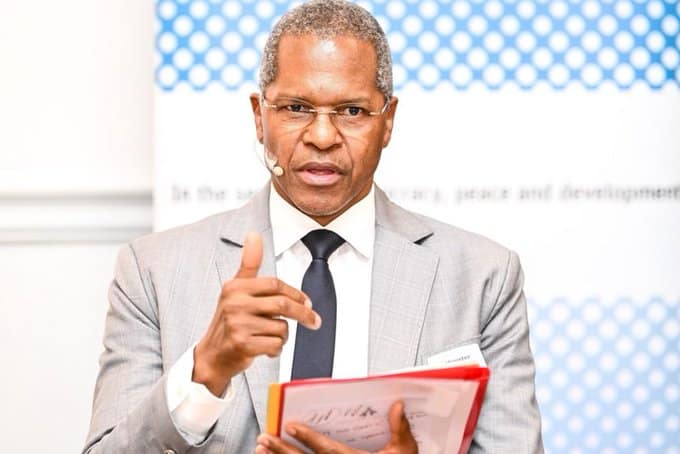
BHISHO – A simmering tension between cultural preservation and the realities of a multicultural society erupted into open political controversy this week as Minister of Cooperative Governance and Traditional Affairs (CoGTA), Velenkosini Hlabisa, issued a scathing condemnation of a coronation ceremony held in the Eastern Cape. The event, which saw a Nigerian national installed as a “king” in a region already rich with its own formalized traditional leadership, has ignited a fierce debate about legality, identity, and respect for South Africa’s indigenous structures.
The controversy began not with a formal announcement, but with the viral spread of vibrant videos and images across social media platforms over the weekend. The footage depicted a lavish ceremony in KuGompo City—the area formerly known as East London—where a man identified as Chief Solomon Ogbonna Eziko was celebrated with traditional Nigerian music, elaborate regalia, and the conferment of the title “Igwe Ndigbo Na East London.” The event was presented as a coronation, marking Eziko as a monarch for the Igbo community residing in the region.
For the hundreds of Nigerian nationals and members of the broader Igbo diaspora who attended, the ceremony was a significant cultural milestone. The Igbo tradition of installing an Igwe (a traditional king or paramount ruler) in the diaspora is a practice seen in various parts of the world, intended to serve as a unifying figure, a custodian of culture, and an arbiter of community disputes for Nigerians living abroad. To them, it was an act of cultural affirmation in a foreign land.
However, to Minister Hlabisa and the South African government, the event represented something far more grave: an affront to the country’s constitutional order. In a strongly worded statement released from Bhisho, the provincial capital, Hlabisa did not mince words. He declared the coronation to be without legal standing, warning that such actions threaten to destabilize the carefully legislated framework governing traditional leadership in South Africa.
“We have noted with serious concern the reported coronation of a foreign national as a ‘king’ within the borders of the Eastern Cape,” Hlabisa said. “This event lacks any legal basis whatsoever. South Africa has a robust legislative framework—namely the Traditional and Khoi-San Leadership Act—that governs the recognition and appointment of traditional leaders. No foreign national can be recognized as a traditional leader in South Africa, nor can any community unilaterally confer such titles without legal recourse to the laws of this country.”
The Minister’s condemnation went beyond mere legal technicalities. He framed the event as a direct challenge to the dignity and integrity of South Africa’s recognized traditional leaders, who derive their authority from generations of lineage, customary law, and formal recognition by the state. Hlabisa emphasized that allowing such parallel structures to take root could lead to confusion, conflict, and a dangerous dilution of the authority vested in legitimate traditional councils.
“Our traditional institutions are not costumes to be worn or titles to be bought,” Hlabisa added. “They are the bedrock of governance in many of our rural communities, with histories that predate colonialism. We cannot and will not allow individuals, regardless of their origin, to create parallel ‘kingdoms’ that undermine the authority of our constitutionally recognized leaders.”
The minister further revealed that his department had been in contact with the Eastern Cape provincial government and law enforcement agencies to investigate the matter fully. He hinted at potential legal consequences for the organizers, suggesting that the coronation might constitute a contravention of the Traditional and Khoi-San Leadership Act, which outlines strict criteria for the recognition and removal of traditional leaders.
The response from the South African public has been deeply polarized, reflecting broader societal tensions regarding immigration, xenophobia, and cultural integration. On one side of the divide, many South Africans, particularly those in the Eastern Cape, voiced outrage. Social media was flooded with comments accusing the organizers of disrespecting the province’s heritage. The Eastern Cape is home to some of the country’s most revered traditional institutions, including the abaThembu and Xhosa kingdoms. Critics argued that allowing a foreign national to assume a “kingship” in a region where the legacy of figures like King Hintsa and Nelson Mandela looms large was an act of profound insensitivity.
“This is a slap in the face to every son and daughter of the soil who understands the blood, sweat, and history behind our chieftaincies,” one user wrote on X (formerly Twitter). “You don’t come to the Eastern Cape, the heart of South African tradition, and crown yourself a king.”
Others, however, defended the event, arguing that the reaction was rooted in xenophobia rather than a genuine concern for legal protocol. Supporters of the coronation pointed out that the installation of an “Igwe” for the Igbo community is a cultural practice that does not seek to usurp South African traditional leadership. Instead, they argued, it is a form of self-governance and cultural preservation for a diaspora community that often faces marginalization and hostility. They noted that similar cultural institutions exist for other foreign nationals in South Africa, and that the backlash appeared disproportionately harsh.
“A Nigerian community celebrating their culture by installing a traditional leader in their own community is not a threat to South African kingship,” a commentator countered. “If a Zulu or Xhosa chief can be installed in Nigeria to serve their diaspora, would they call it illegal? The issue here is not about the law; it is about who is allowed to exist in South Africa.”
The controversy places Minister Hlabisa and the CoGTA department in a delicate position. While his condemnation aligns with the letter of the law and resonates with a constituency wary of perceived foreign overreach, it also risks inflaming anti-foreigner sentiment in a province that has seen its share of xenophobic incidents. The Eastern Cape, despite its rich cultural heritage, also grapples with high unemployment and poverty, creating an environment where foreign nationals are sometimes scapegoated for local hardships.
As the dust settles on the viral videos, the practical implications remain unclear. Chief Solomon Ogbonna Eziko, who has not publicly commented on the minister’s statement, continues to be regarded by his community as the Igwe Ndigbo Na East London. Whether his installation will lead to legal action, a formal investigation, or quietly fade from the headlines remains to be seen.
However, the incident has opened a wider conversation about the intersection of South African customary law and the cultural practices of its immigrant communities. With no formal legal framework for recognizing or regulating the traditional institutions of foreign nationals, the coronation has exposed a legislative gray area. As South Africa continues to grapple with its identity as a multicultural democracy, the question of how to accommodate the cultural practices of its diaspora populations without undermining indigenous institutions is likely to resurface.
For now, Minister Hlabisa has made his position unequivocal. The coronation, in his view, was an illegal act of overreach. But as the social media debate rages on, it is clear that the underlying issues—of belonging, respect, and the ever-evolving definition of who has the right to wear a crown in South Africa—are far from settled.
About The Author