In a bold, late-night operation that underscores her administration’s zero-tolerance approach to urban decay, Tshwane Executive Mayor Nasiphi Moya personally led a multi-departmental raid on a sophisticated criminal enterprise operating out of a downtown sports bar, resulting in a cascade of arrests and exposing a web of illicit activities.
The target was a seemingly unassuming establishment on Bloed Street in the city’s central business district. However, on the night of November 11, it became the epicenter of a major crackdown, culminating in the arrest of four Chinese nationals alleged to be the ringleaders, and approximately 30 undocumented migrant workers.
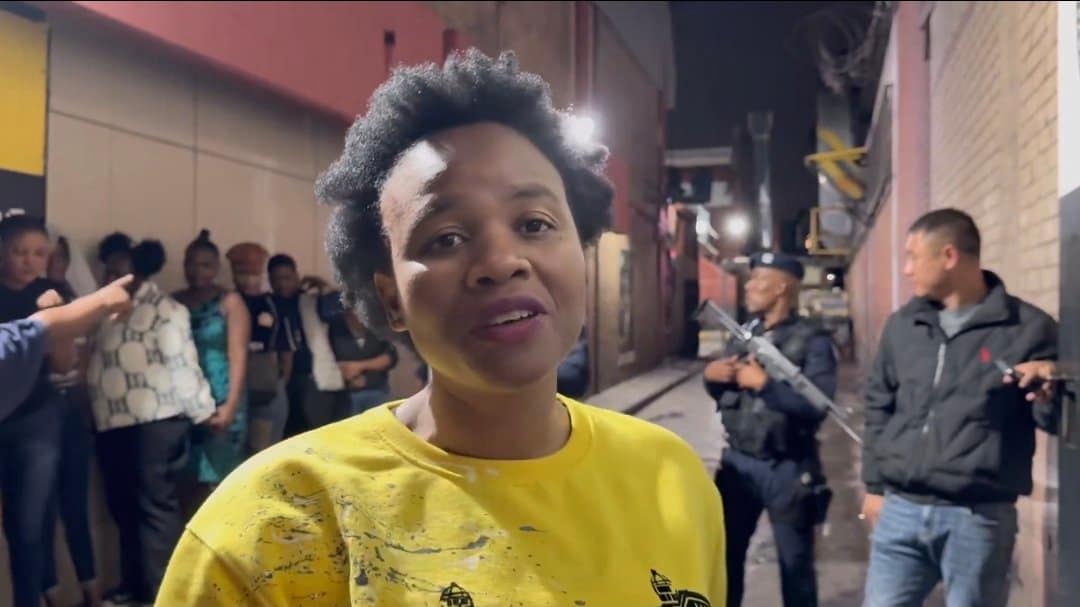
The operation, which began just after 10 PM, was the culmination of weeks of intelligence gathering and covert surveillance. Mayor Moya, who has made reclaiming the city’s streets a cornerstone of her tenure since taking office in October 2024, was present not as an observer, but as the commanding authority, coordinating the efforts of the Tshwane Metro Police Department (TMPD), SAPS, Home Affairs, and city revenue protection services.
“What we uncovered here is not merely a single illicit business, but a brazen hub of criminality festering in the heart of our city,” Mayor Moya stated, addressing media under the stark glare of police floodlights. “This was a one-stop shop for vice, exploitation, and fraud, and it ends tonight.”
A Labyrinth of Illicit Activity
Upon forcing entry into the sports bar, authorities discovered a complex operation designed to evade detection and maximize profit at every turn.
- The Brothel Front: Behind the facade of a lively pub broadcasting international sports, investigators found a network of back rooms that had been systematically repurposed into bedrooms for sex work. These rooms, described as spartan and unhygienic, were being operated as a covert brothel, with evidence suggesting the workers were potentially victims of trafficking and coercion.
- Counterfeit Consumables: The bar itself was found to be serving a range of counterfeit and unlicensed alcoholic beverages. Health officials expressed grave concerns, noting that such illicit liquor often contains dangerous levels of methanol and other toxic substances, posing a significant public health risk.
- Theft of Essential Services: A preliminary inspection revealed that the establishment had illegally bypassed its electricity meter, stealing power directly from the city’s grid. This practice, which costs municipalities millions annually, is a common hallmark of organized criminal operations seeking to eliminate overheads.
- Rooftop Hideouts: Perhaps most telling of the operation’s sophistication, authorities discovered makeshift hideouts on the building’s rooftop. These were believed to be emergency hiding spots for undocumented individuals to evade snap inspections, complete with basic supplies.
Charges and Wider Implications
The four Chinese nationals, whose identities are being withheld pending a formal court appearance, are facing a litany of charges. These include operating a brothel, human trafficking-related offenses for the alleged exploitation of sex workers, contravention of the Immigration Act, violation of the Liquor Act, and theft of electricity.
The approximately 30 undocumented individuals, primarily from neighbouring Southern African nations, were detained by Home Affairs officials for processing and probable deportation. Social services were also called in to assist the potential victims of sexual exploitation found on the premises.
The establishments—both the sports bar and the attached brothel—were immediately shut down and sealed with compliance notices. The city’s revenue protection unit has initiated a full audit to calculate the outstanding revenue for electricity, water, and rates.
A Signal of a New Era for Tshwane
This raid is not an isolated incident but a key part of “Operation Khuthusa,” isiZulu for “Reclaim,” a broader initiative launched by Mayor Moya. The strategy focuses on aggressive by-law enforcement, targeting properties that are hubs for drug dealing, illegal dumping, vandalism of infrastructure, and other quality-of-life crimes.
“This sends an unequivocal message to those who believe they can operate with impunity in our city,” Moya asserted. “We are taking back Tshwane, street by street, building by building. We will not allow our urban core to be cannibalized by syndicates who have no regard for the law, the dignity of people, or the economic well-being of our legitimate businesses.”
The operation has been hailed by city stakeholders as a strong start, though many caution that the true test will be in sustaining this momentum and tackling the deep-rooted networks that enable such complex criminal operations to flourish.
About The Author