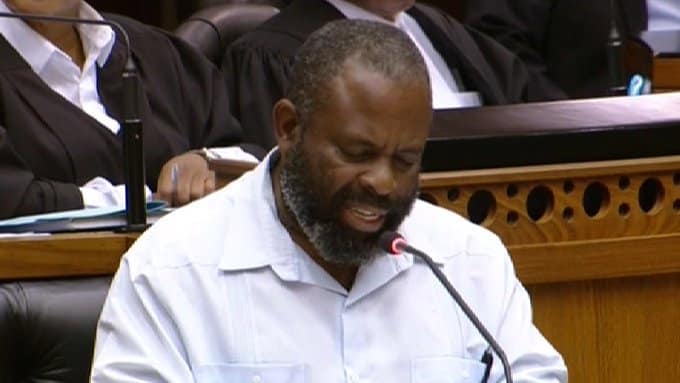
The news of Mosiuoa “Terror” Lekota’s passing has sent a tremor through the landscape of South African politics, severing a living link to the fiery days of the anti-apartheid struggle and the turbulent years of the democratic era. Among the voices rising to remember the man, few carry the weight of personal history and shared political journey as that of his longtime comrade and colleague, Willie Madisha.
Madisha, the former deputy leader of the Congress of the People (COPE) and a stalwart of the labor movement, has paid a deeply personal and emotional tribute to the man he stood beside during one of the most seismic shifts in post-apartheid politics. In his tribute, Madisha did not focus on the titles Lekota held, but on the unyielding moral compass that defined his half-century in public life.
“He never compromised his principles,” Madisha said, his voice thick with emotion. “Terror was a leader who stood firm on his beliefs no matter the cost. He taught us that politics is not about positions or power. It is about what you believe in. And he believed in justice, in fairness, and in the people until his very last breath.”
The bond between Madisha and Lekota was forged in the crucible of political dissent. They were comrades in the United Democratic Front (UDF) in the 1980s, fellow inmates of the apartheid regime, and later, uneasy allies within the African National Congress (ANC). But their most significant partnership came in 2008, when they stood together on a stage in Bloemfontein to announce the formation of COPE, a breakaway party born from the ousting of former President Thabo Mbeki.
That moment was a political earthquake. Lekota, then the ANC’s chairperson, walked away from the party he had joined as a young man, taking with him a significant chunk of the organization’s intellectual and activist base. Madisha, a powerful voice from the trade union movement, was at his side.
“People forget the risk we took,” Madisha recalled, reflecting on that period. “We were not young men. We had families, we had reputations. We could have stayed quiet and kept our seats at the table. But Terror said no. He said if the principles we fought for were being trampled, we had to leave the table. That was him. That was always him.”
The formation of COPE was hailed as a new dawn for South African democracy, a viable opposition that would hold the ANC accountable from a position of shared struggle credentials. Though the party ultimately fractured and failed to realize its early promise, Madisha insists that Lekota’s role in creating it was a principled stand, not a political miscalculation.
“He gave the people of South Africa a choice,” Madisha said. “He showed them that you could dissent without being an enemy. He showed them that loyalty to an organization should never surpass loyalty to the truth. That legacy will outlive any election result.”
Madisha’s tribute also touched on Lekota’s humanity, far from the political stage. He spoke of a man who, despite his fearsome nickname “Terror”—earned on the football field, not the battlefield—was gentle, thoughtful, and deeply committed to mentorship.
“He took young people under his wing. He listened. He didn’t just want followers; he wanted to build leaders,” Madisha said. “He called me his brother, not just his comrade. And that is how I will remember him: as a brother in the struggle, a brother in the party, and a brother in principle.”
As South Africa mourns the loss of one of its most formidable political figures, Madisha’s words serve as a reminder that Lekota’s life was not measured by the offices he held, but by the stands he took. From the dock of a apartheid court, to the floor of the National Assembly, to the podium announcing a new political hope, Mosiuoa Lekota remained, in the eyes of his comrades, unbought and unbossed.
“He has run his race. He has kept the faith,” Madisha concluded, paraphrasing scripture. “Now it is up to us, the ones he leaves behind, to carry that flame. To never compromise. To never sell out. That is the only tribute he would have wanted.”
About The Author