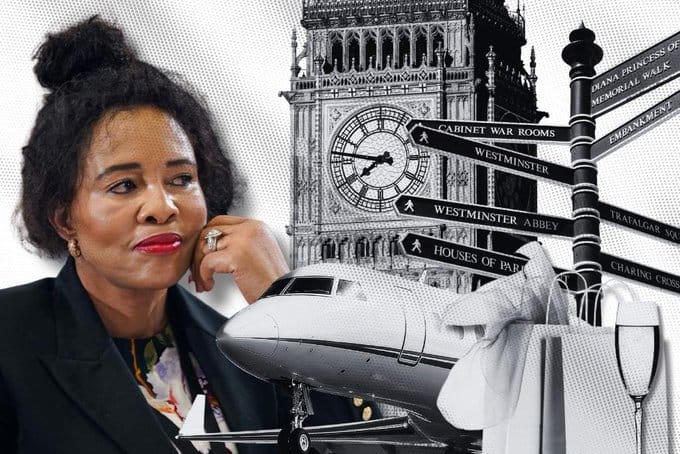
The image was one of unapologetic luxury: a private jet parked on a tarmac, ready to whisk a privileged passenger across the Atlantic for a weekend of high-end shopping. The problem? The passenger was not a mining magnate or a reality TV star. She was Imogen Mashazi, the former City Manager of Ekurhuleni, a public servant entrusted with the finances of one of South Africa’s largest metropolitan municipalities.
On Thursday, February 19, 2026, details of Mashazi’s extravagant July 2022 trip to London emerged, igniting a firestorm of controversy and raising uncomfortable questions about the conduct of senior government officials. The numbers, once laid bare, were staggering: a three-day shopping excursion to the British capital, funded not by personal wealth, but by a private jet charter that cost the public purse nearly R3.5 million. To put that figure in perspective, it exceeded Mashazi’s own annual salary of R3.1 million at the time.
The revelation, first reported by investigative journalists and quickly amplified across social media, painted a picture of breathtaking entitlement. For a woman earning a salary that already placed her in the top echelons of South African earners, the decision to splurge an amount greater than her yearly wage on a single flight seemed, to many, to cross a line from poor judgment into outright larceny.
The Trip: A Three-Day Spree
According to documents and flight manifests obtained by the investigating team, Mashazi’s journey began in July 2022. The destination was London, a city known for its luxury boutiques, exclusive department stores, and as a playground for the global wealthy. The purpose, sources close to the matter suggested, was a personal shopping trip—a three-day spree to acquire high-end goods not readily available in South Africa.
But it was the mode of transport that has drawn the most ire. Instead of booking a commercial flight, which would have cost a fraction of the price—even in business class—Mashazi allegedly arranged for a private jet charter. The cost: just under R3.5 million. The flight, a round trip across the equator, would have consumed tens of thousands of litres of jet fuel, emitted tonnes of carbon, and provided Mashazi with the privacy and comfort of a flying luxury lounge.
The choice of a private jet is what elevates this from a simple case of overspending to a symbol of a dysfunctional culture within certain parts of the public service. It suggests a mindset in which the distinction between public funds and personal privilege has become dangerously blurred. For the average resident of Ekurhuleni, struggling with potholes, load shedding, and rising electricity tariffs, the idea of their city manager soaring over them in a R3.5 million private jet to go shopping is not just offensive; it is infuriating.
The Math: A Salary Spent on a Seat
The most potent statistic to emerge from the scandal is the comparison between the cost of the flight and Mashazi’s salary. At R3.1 million per annum, Mashazi was already one of the highest-paid municipal officials in the country. Her remuneration package placed her in the top 1% of South African earners, a reward for the significant responsibility of managing a budget of billions and overseeing services for millions of people.
Yet, in a matter of days, she authorized or facilitated expenditure equivalent to an entire year’s pay, simply to get to and from a shopping destination. The optics are devastating. It implies a sense of impunity, a belief that the rules of financial prudence that bind ordinary citizens and junior officials do not apply to those at the very top.
“Why does a city manager need a private jet to go shopping?” asked a political analyst on a national news broadcast. “If she wanted to go to London, she could have flown commercial like every other senior executive in the country. The fact that she chose a private jet—at that cost—suggests either a profound lack of judgment or a deep-seated belief that she was entitled to it. Either way, it’s a damning indictment.”
The Fallout: A City Asks Questions
The revelations have landed like a bombshell in Ekurhuleni. Mashazi, who no longer holds the position of City Manager, is now under intense scrutiny. Opposition parties in the municipal council have called for a full forensic investigation into the expenditure, demanding to know who authorized the payment, which budget line it came from, and what consequences will follow.
“The people of Ekurhuleni are suffering,” said a local councillor from an opposition party. “We have clinics without medicine, roads without maintenance, and communities without proper sanitation. And while they struggle, their money was used to fly a senior official to London in a private jet to buy handbags? This is not just corruption; this is contempt for the poor.”
The DA, the official opposition nationally, has called for Mashazi to be criminally charged, arguing that the misuse of public funds on such a scale constitutes theft. “If an ordinary person stole R3.5 million, they would go to jail for a very long time,” a DA spokesperson said. “Why should a former city manager be treated any differently?”
The Defense: Was It Authorized?
As the scandal snowballs, questions are being asked about the approval process. It is highly unlikely that a City Manager could simply sign off on a R3.5 million flight without some form of oversight. Did the council or the mayoral committee approve the trip? Was it disguised as an official business visit? If so, what possible official business could justify a private jet to London?
Initial reports suggest that the trip may have been linked to “investor relations” or “city marketing,” though no concrete evidence of any official meetings or business conducted during the three-day trip has emerged. The fact that it was a weekend suggests it was purely personal.
Mashazi has not yet publicly commented on the allegations. Attempts to reach her for comment have been unsuccessful. Her legal team, however, is expected to issue a statement in the coming days, possibly arguing that the expenditure was approved through proper channels and that she was acting within the scope of her duties.
A Pattern of Excess?
The Mashazi scandal does not exist in a vacuum. It feeds into a broader narrative of elite extravagance in South Africa’s public sector. From VBS Mutual Bank looting to countless tender scandals, the country has become wearily familiar with stories of public officials living like royalty while the populace struggles.
What makes this case particularly resonant is the sheer, almost cartoonish excess of it. A private jet. A shopping trip. A cost exceeding a year’s salary. It is a story that is easy to understand and impossible to defend. It is the kind of tale that confirms every cynical suspicion that ordinary South Africans have about their leaders: that they are in it for themselves.
As the forensic investigators sharpen their pencils and the political parties sharpen their knives, one question hangs in the air: Who paid for Imogen Mashazi’s R3.5 million ride, and will they ever have to pay it back? For the residents of Ekurhuleni, still waiting for the potholes to be fixed, the answer cannot come soon enough.
About The Author