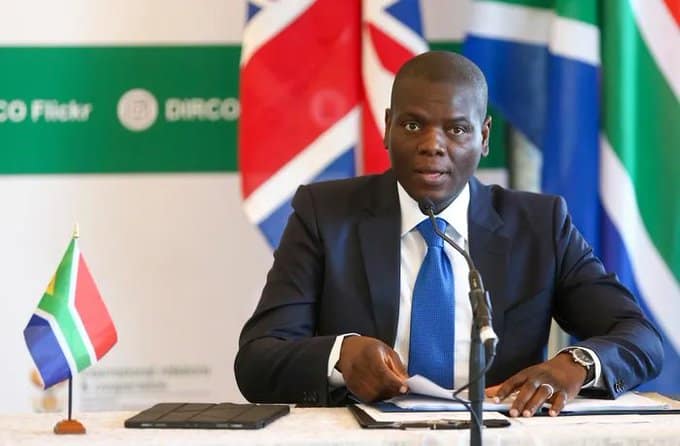
In a robust defence of South Africa’s diplomatic standing and a pointed critique of Western unilateralism, International Relations and Cooperation Minister Ronald Lamola has delivered a firm rebuke to United States officials for their recent sharp criticism of the country’s 2023 G20 presidency, labelling their claims as “factually incorrect” and fundamentally at odds with the forum’s founding principles.
The statement, issued on Thursday, comes amid simmering tensions following the transition of the G20 chair from South Africa to the United States for 2026. While Lamola formally extended congratulations to Washington on assuming the presidency, his core message was one of unambiguous pushback against what Pretoria perceives as a deliberate mischaracterisation of its role and an attempt to dictate terms within a consensus-driven body.
“The G20 is a forum for cooperation, not coercion,” Lamola stated. “No single nation can unilaterally determine the participation or diminish the contributions of another. Recent commentary from certain US quarters, which seeks to misrepresent South Africa’s presidency, is not only factually incorrect but also undermines the very spirit of multilateralism and fair global dialogue that the G20 is meant to embody.”
While the minister’s statement did not cite specific US officials by name, diplomatic sources indicate the rebuke is directed at recent testimony before a US congressional committee and background briefings by State Department officials. These critiques allegedly framed South Africa’s tenure as obstructive, particularly regarding discussions on Ukraine, and overly focused on advancing a “narrow” BRICS-aligned agenda at the expense of broader G20 unity.
Lamola countered by reframing South Africa’s presidency as a necessary corrective, championing long-marginalised voices. “Our focus was irrevocably on lifting the developmental aspirations of Africa and the Global South onto the main stage of global economic governance,” he asserted. “To characterise the advocacy for the inclusion of the African Union, for tangible climate financing commitments, and for equitable vaccine access as ‘divisive’ is to misunderstand the historical and persistent imbalances the G20 was created to address.”
The minister’s intervention serves multiple strategic purposes. Domestically, it projects strength and sovereignty ahead of an election year, countering opposition criticism of foreign policy ambiguity. Internationally, it solidifies South Africa’s position as a leading voice of the Global South, unwilling to have its diplomatic record rewritten by a Western power.
Analysts see the exchange as a microcosm of a broader geopolitical contestation within multilateral forums. “This is less about past grievances and more about setting the tone for the US presidency,” said Dr. Sizo Nkala, a foreign policy researcher. “Lamola is drawing a line in the sand, signalling that while South Africa will engage constructively, it will not be passive or accept narratives that diminish its agency or the collective priorities of the developing world.”
The statement concludes by emphasising a preference for unity over division, subtly turning the spotlight back on the incoming chair. “As the United States assumes its responsibilities, we urge a presidency that builds bridges, respects diverse perspectives, and advances the sustainable development goals for all, not a few,” Lamola said.
The diplomatic salvo ensures that South Africa’ approach to the upcoming G20 Sherpa meetings in Washington will be closely watched, framed not as a return to business as usual, but as a continued negotiation over the very nature and priorities of the world’s premier economic forum.
About The Author