The wood-paneled committee room in Parliament, Cape Town, hummed with a tense anticipation. What began as an inquiry into systemic vulnerabilities had morphed, through a series of explosive revelations, into a potential seismic event for South Africa’s criminal justice system. The Parliament’s Ad Hoc Committee, tasked with investigating allegations of criminal networks infiltrating the SAPS, was now staring down a list of witnesses that threatened to shake the very foundations of state security.
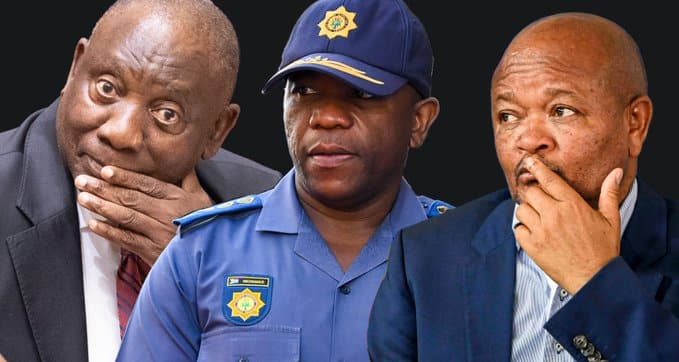
At the heart of the looming storm sat two names: KwaZulu-Natal Police Commissioner, General Nhlanhla Mkhwanazi, and a possible witness whose mere suggestion sent political ripples across the country—President Cyril Ramaphosa.
The Spark: Mkhwanazi’s Calculated Detonation
The committee’s work had been methodical, but it was Mkhwanazi’s initial, confidential briefing—leaked in devastating fragments to the media—that became the catalyst. The KZN Top Cop, a figure respected for his operational bluntness, did not merely suggest corruption; he presented the committee with an alleged blueprint of compromise. He spoke of a “symbiotic ecosystem” where high-ranking SAPS officials, in league with political fixers and intelligence operatives, acted not as gatekeepers but as facilitators for syndicates dealing in narcotics, precious metals, and illicit firearms.
His allegations were granular: specific posts at the Hawks and Crime Intelligence being “curated” for pliable officers; procurement contracts for surveillance gear and firearms being diverted to fronts linked to known crime families; and a sophisticated “early warning system” that tipped off syndicates about imminent raids. Most chillingly, he alleged that this network operated under a “political umbrella,” where their influence was brokered in backrooms, protecting them from prosecution and ensuring promotions for compliant officers.
The Fallout: A Committee Under Fire
The leak triggered political fury. Opposition members demanded the committee’s scope be expanded immediately, insisting that if the “political umbrella” reached as high as suspected, the investigation could not stop at the SAPS head office in Pretoria. There were heated exchanges, with some ANC committee members accusing others of a “witch hunt” and of using the platform to settle internal party scores. Civil society organisations, meanwhile, rallied outside Parliament, their placards asking: “Who Polices the Police?”
Chairperson Thando Mfazo found himself navigating a minefield. The committee’s deadline of 20 February, once a distant marker, now seemed impossibly close. To credibly address Mkhwanazi’s claims, they needed testimony from those who could either corroborate or dismantle them. This meant calling in serving and former National Commissioners, heads of the Hawks, and Crime Intelligence. But the shadow looming over all these was the allegation of political protection.
The Ramaphosa Question: A Constitutional Conundrum
This is where the probe entered unprecedented territory. Mkhwanazi’s testimony pointed to a period spanning multiple administrations and political transitions. Committee legal advisors presented a contentious opinion: to understand the failure of oversight and the alleged political meddling over time, they might need to call the one person who has overseen the security cluster for the past several years—the President.
The debate was furious. Some argued that summoning a sitting President to a parliamentary committee, while legal, was a grave step, reserved for matters of extreme national import. Others countered that the systemic collapse of a primary state institution, the police, met that threshold. The question swirled: Would Ramaphosa testify voluntarily to clarify his role and his government’s actions, or would he wait for a formal, politically-charged summons? His office issued a terse statement: “The President has always supported the strengthening of state institutions and will consider any formal request from Parliament through the appropriate channels.”
The Stakes: More Than Just Testimony
As the nation waits, the implications are vast. For General Mkhwanazi, his upcoming public testimony is a career-defining gamble. He will speak not just to a committee, but to powerful enemies whose identities he has hinted at. His security detail has reportedly been strengthened.
For President Ramaphosa, potential testimony is a double-edged sword. It offers a platform to assert his commitment to reform and to distance himself from alleged past networks. Yet, it also opens him to relentless questioning about what he knew, when he knew it, and why, under his watch, such a “symbiotic ecosystem” could allegedly persist.
For the public, the “SAPS Probe” has become a litmus test for the nation’s democracy. It asks whether the state can self-correct, or whether the fusion of crime, politics, and policing is now irreversible. Ordinary South Africans, besieged by gang violence, kidnappings, and extortion, watch not for political theatre, but for a sign—any sign—that the long-promised “new dawn” can pierce the deep shadows where criminal networks and state power allegedly meet.
The committee room in Cape Town is now more than a venue for inquiry; it is a crucible. The testimonies of Mkhwanazi, and potentially Ramaphosa, will pour molten truth into it. What emerges by the 20th of February—whether a hardened resolve for cleansing or a misshapen cover-up—will define the integrity of South Africa’s law enforcement for a generation. The nation holds its breath.
About The Author