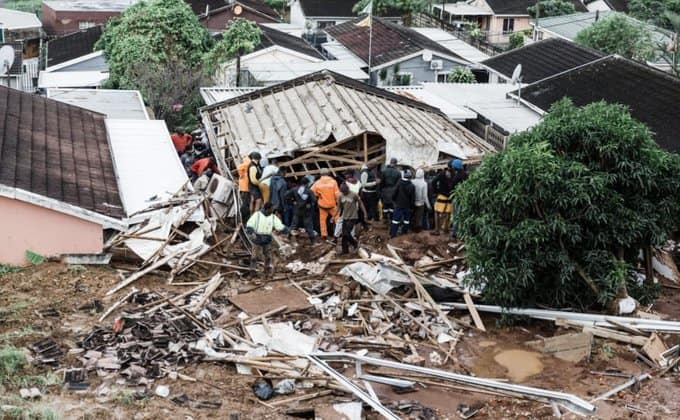
What began as a bank of brooding clouds on the horizon on Thursday afternoon swiftly transformed into a roaring, hail-spitting beast that tore the very fabric of communities apart. The severe thunderstorms that ravaged northern KwaZulu-Natal were not merely weather events; they were architects of a stark, new reality for hundreds in the Amajuba and Umzinyathi districts.
The air, heavy with the ozone scent of impending rain, gave way to a deafening orchestra of howling winds and the relentless, punishing drumbeat of hail—some stones reported to be the size of golf balls. For forty terrifying minutes, nature’s fury was unchecked.
A Landscape Transformed
In the aftermath, the daylight revealed a scarred land. The picturesque rolling hills of Utrecht now bear the wounds of a violent tantrum. Entire roofs lie twisted in neighbours’ yards, as if tossed by a careless giant. Centuries-old trees, once steadfast sentinels of family farms, have been uprooted, their massive root systems clawing helplessly at the sky. Streets in parts of Dannhauser are transformed into chaotic obstacle courses of downed power lines, shattered signage, and the splintered remnants of outbuildings.
But the most profound devastation is deeply personal. In the township of eMalahleni outside Newcastle, the storm’s path is measured in lifetimes lost to the wind. The home of Gogo Ndlovu (78), a cornerstone of the community for five decades, is now a crumpled pile of cinder block and corrugated iron. Neighbours, themselves reeling, helped pull her and her grandson from what was left of the front room. They now huddle under a communal tent, their worldly possessions reduced to a single, salvaged suitcase and a framed family photo, miraculously intact.
“The sound was like the world was ending,” Ndlovu whispered, her voice trembling. “The roof went first, then the walls sighed and fell. We have only the clothes on our backs. But we have each other. That is what the storm could not take.”
The Human Cost and the Humanitarian Response
The initial assessments paint a dire picture. Over 250 homes have been severely damaged or completely destroyed across the two districts. Emergency services, working through the night, confirm at least three fatalities and dozens of injuries, ranging from lacerations caused by flying debris to trauma. Hundreds of families, like Gogo Ndlovu’s, are displaced, seeking refuge in local community halls, churches, and with neighbours whose walls remained standing.
The humanitarian machine is grinding into action, but the scale of the disaster presents immense challenges. Gift of the Givers, the SA Red Cross Society, and municipal disaster management teams have converged on the area. Their immediate focus is a triage of crises: providing temporary shelter, blankets, and warm meals to the displaced; delivering emergency medical care; and restoring access to clean drinking water, as many pipes have been damaged and reservoirs contaminated.
“The needs are immense and immediate,” said Thandeka Mhlongo, a coordinator with Gift of the Givers, as she directed the unloading of bottled water from a truck. “We have a critical shortage of building materials, waterproof tarpaulins, and basic hygiene packs. The emotional trauma is also a deep wound that will need long-term care.”
Infrastructure in Tatters, Economy Battered
Beyond the homes, the storm has crippled the region’s infrastructure. Provincial authorities report widespread power outages affecting thousands, with Eskom teams warning that full restoration could take days, even a week, due to the extensive damage to substations and lines. Several key roads remain partially blocked, hampering the delivery of aid.
The economic blow is equally severe. Farmers in the fertile Umzinyathi region stare in despair at fields of maize and sugarcane flattened into a muddy pulp. Hail has shattered greenhouses and damaged orchards, wiping out a season’s labour and income in minutes. Small businesses—spaza shops, taxi ranks, and street vendors—see their livelihoods literally crushed under the weight of collapsed structures.
A Community’s Unyielding Spirit
Yet, amid the ruins, the defining story is not one of despair, but of a resilient spirit rising from the rubble. By dawn on Friday, before the official aid convoys had fully mobilized, the true first responders were already at work: the people themselves.
In Dannhauser, a chain of volunteers formed, passing salvaged bricks hand-to-hand to clear a pathway. In Newcastle, a local mosque opened its doors to all faiths, offering hot tea and a safe space to sleep. Young men with bakkies turned their vehicles into impromptu ambulances and transport for the elderly.
Sipho Khumalo (42), a mechanic whose workshop lost its roof, was instead using his tools to help pry a family’s belongings from their collapsed home. “Today it is my neighbour,” he said, wiping sweat and rain from his brow. “Tomorrow, it may be me who needs the help. This is how we survive. This is ubuntu. The storm was strong, but we are stronger together.”
The Long Road Ahead
As the initial shock subsides, the daunting scale of recovery comes into focus. Provincial Disaster Management has declared the region a disaster area, paving the way for state aid. An urgent call has gone out for donations—building materials, canned food, blankets, clothing, and monetary contributions to trusted organisations.
Meteorologists warn that while the immediate severe weather has passed, the volatile summer pattern persists. For the people of Amajuba and Umzinyathi, the storm of December 26th has passed, but the struggle is just beginning. They face the Herculean tasks of rebuilding homes, healing trauma, and restoring a sense of normalcy.
But as the community works, brick by salvaged brick, to rebuild what was lost, they are forging something new from the wreckage: a powerful testament to the unbreakable bonds of community in the face of nature’s awesome, unforgiving power.
About The Author