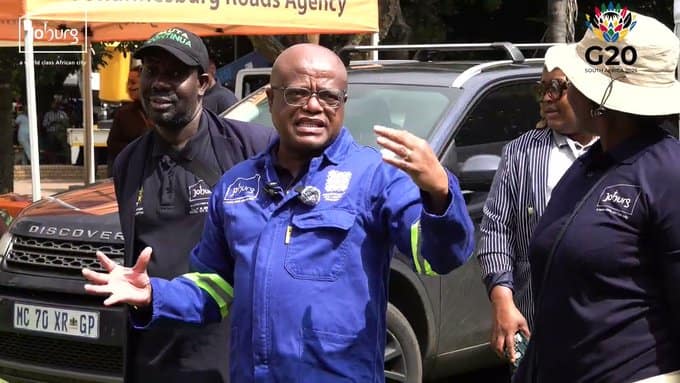
Johannesburg Executive Mayor, Dada Morero, has framed the city’s persistent and crippling water crisis as the direct consequence of its own success, citing a decade of “rapid and unprecedented” growth that has pushed ageing, under-invested infrastructure to a catastrophic breaking point. The statement, made during a tense press briefing at the Metro Centre, comes as swathes of the city endure another punishing week of dry taps, forcing residents and businesses into a grim routine of overnight storage, frantic searches for tankers, and disrupted lives.
A City Outpacing Its Lifelines
“Over the last ten years, Johannesburg has not just grown; it has transformed, expanded, and accelerated at a pace that our foundational systems simply were not designed to match,” Mayor Morero stated, pointing to a confluence of pressures. He highlighted the sustained population influx from other provinces and neighbouring countries, the vertical expansion of high-density residential towers in inner cities and suburbs like Sandton and Rosebank, and the continued development of new formal and informal settlements on the city’s periphery.
“Every new housing estate, every new apartment block, every new business park adds demand to a network that is already operating on borrowed time,” Morero explained. “The pipes in the ground, the reservoirs on the hills, many of them are decades old. They were built for a smaller, less dense Johannesburg. We are playing a constant, expensive game of catch-up.”
Beyond Growth: A Nexus of Crises
While positioning rapid urbanization as the primary stressor, the Mayor’s briefing also implicitly acknowledged a web of interconnected failures:
- Aging Infrastructure: The city’s water network suffers from catastrophic levels of non-revenue water—estimated near 40%—due to chronic leaks from old, brittle pipes and rampant theft through illegal connections. This means almost half the purified water never reaches a billed customer.
- Maintenance Backlog: Years of deferred maintenance, exacerbated by budget constraints, procurement inefficiencies, and alleged mismanagement, have created a ticking time bomb. A major pipe burst now triggers a cascade of failures as pressure drops expose other weak points in the system.
- Power Dependence: Johannesburg Water’s systems are critically reliant on consistent electricity to pump water from purification plants (like the Eikenhof pump station) and across vast elevation changes. Eskom’s load shedding and local substation failures directly cause pumping halts, leading to prolonged outages even when dams are full.
- Financial Viability: The entity faces a debt crisis, with billions owed to its bulk supplier, Rand Water. This strained relationship affects coordination and can limit bulk supply during peak crises.
Resident Fury: “Growth is Not an Excuse”
The Mayor’s explanation has been met with fierce criticism from residents, civic organizations, and opposition parties. Many argue that growth is a predictable, manageable factor and that the crisis stems from a failure of governance, planning, and execution.
“Growth is not a surprise; it’s a demographic fact. A competent municipality plans for it,” declared Philip Nkosi, a community activist from Brixton, where some areas have been without reliable water for over two weeks. “Where was the infrastructure planning? Where is the revenue from all these new ratepayers going? This isn’t about growth; it’s about gross negligence and a lack of political will to fix the basics.”
The DA’s shadow MMC for Environment and Infrastructure Services, Nicole van Dyk, accused the ANC-led administration of using growth as a “smokescreen.” “They have had 20 years to invest, upgrade, and maintain. Instead, they have allowed corruption, cadre deployment, and incompetence to drain Johannesburg Water dry. The mayor’s statement is an admission of long-term failure, not an explanation.”
A Path Forward or a Deeper Crisis?
Mayor Morero outlined a multi-pronged response, including accelerated pipeline replacement projects, the installation of smart pressure management systems to reduce bursts, and pursuing public-private partnerships for major infrastructure upgrades. He also reiterated calls for residents to reduce consumption.
However, skepticism remains high. The proposed solutions are expensive, long-term, and depend on a level of institutional stability and funding that Johannesburg Water has struggled to demonstrate. In the immediate term, the city remains terrifyingly vulnerable to the next pipe burst, the next extended blackout, or simply the next day of high demand.
The water crisis in Johannesburg has evolved from an intermittent inconvenience into a fundamental threat to the city’s economic stability and social fabric. Mayor Morero’s diagnosis places the blame on the city’s vibrant growth, but for millions of residents, the fault lies not in the city’s success, but in the hands of those who were entrusted to manage it. The question now is whether this acknowledgment is the first step toward a real solution, or merely a new talking point in an ever-deepening emergency.
About The Author