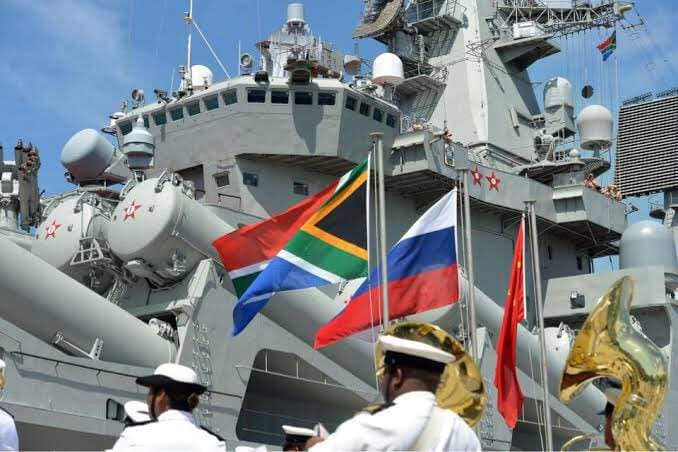
The sleek grey hulls of the Iranian destroyer Dena and its support vessel, the Makran, cut a deliberate path through the choppy waters of the South Atlantic. They were far from home, but their destination—Simon’s Town, the historic South African naval base near Cape Town—signaled a voyage of profound geopolitical significance. This 103rd flotilla of Iran’s Navy was not on a routine port call; it was sailing into history as Tehran’s inaugural participation in a BRICS naval exercise as a full member of the bloc.
The multinational drills, codenamed “Operation Ubuntu,” a term invoking shared humanity, had been carefully choreographed. Originally slated for November 2025, the maneuvers were postponed, officially due to “logistical considerations” linked to South Africa’s hosting duties for the G20 summit. This delay, however, only served to heighten the anticipation and the controversy.
For Iran, the moment was symbolic redemption. “Our presence in the Atlantic and Indian Oceans is a right, not a privilege,” declared Iranian Navy Rear Admiral Shahram Irani. The flotilla, which had already conducted drills with Saudi Arabia and Oman in a testament to shifting regional dynamics, now aimed its bows toward a grander stage. The exercises, focused on anti-piracy maneuvers, maritime security, and joint tactical operations, were a tangible manifestation of Iran’s long-sought strategic depth, a move to project power and partnership beyond the confines of the Persian Gulf and the watchful eyes of Western fleets.
In South Africa, the arrival of the warships ignited a fierce domestic debate, held against the backdrop of Table Mountain. The government, steadfast in its “non-aligned” foreign policy, framed the event as routine multilateral cooperation. “BRICS is a family of nations committed to a multipolar world. These exercises are about enhancing interoperability for humanitarian and security purposes at sea,” stated a senior official from the Department of International Relations and Cooperation. For President Cyril Ramaphosa’s administration, it was a pillar of South-South solidarity and an assertion of sovereign choice.
But critics saw a dangerous flirtation. Former Democratic Alliance leader Tony Leon was unequivocal: “Hosting the naval forces of states under international sanction and in direct opposition to Western democracies is not neutrality; it is a pivot. It will corrode our relationships with key trading partners and jeopardize the benefits of the African Growth and Opportunity Act.” His warnings echoed in the halls of the U.S. Embassy in Pretoria, where officials privately conveyed “deep concern” to their South African counterparts.
The exercises also cast a stark light on the state of the South African National Defence Force (SANDF). Analysts noted that the hosting role was as much a diplomatic statement as a practical challenge for a navy grappling with aging frigates and chronic budget shortages. “It’s a paradox,” noted Cape Town-based security analyst Faith ka-Manzi. “We are showcasing our strategic partnerships while our own naval readiness is at a low ebb. This is as much about signaling intent as it is about actual warfare capability.”
The broader context simmered beneath the surface of the tactical drills. The maneuvers coincided with persistent tensions between South Africa and the U.S. over Pretoria’s case against Israel at the International Court of Justice and its perceived closeness to Moscow following the Ukraine invasion. For Washington, the sight of Russian, Chinese, and Iranian vessels exercising with a purported strategic partner was a jarring image, a live-action map of a fragmenting global order.
On the docks of Simon’s Town, a different scene unfolded. Russian Admiral Gorshkov-class frigates, Chinese Type 052D destroyers, and South African Valour-class frigates lined up alongside the Iranian contingent. Sailors in different uniforms exchanged patches and cautious smiles, while officers huddled over digital maps in temporary command centers. The exercise scenarios played out in the fertile fishing grounds off the Cape of Good Hope—a critical chokepoint in global trade.
Back in Tehran and Moscow, state media broadcast the exercises as a triumph of emerging alliances. In Washington and Brussels, security briefings analyzed every ship movement and communication intercept. And in the cafes and townships of South Africa, citizens debated the cost and meaning of their nation’s diplomatic balancing act.
As the flotillas dispersed after the final debrief—the Iranian ships turning north for the long journey home—the ripples of “Operation Ubuntu” spread far wider than the drills themselves. The event was more than a military exercise; it was a powerful, floating emblem of a world in recalibration. It demonstrated Iran’s successful integration into a key alternative bloc, underscored South Africa’s precarious but deliberate walk on the global tightrope, and proved that in the 21st century, naval diplomacy is conducted not just in war, but in the potent, ambiguous waters of peacetime alliance-building. The waves created off the Cape would be felt in corridors of power from the Pentagon to the Kremlin for months to come.
About The Author