The morning light filtered through the high windows of the Madlanga Commission hearings in Pretoria, casting long shadows across the polished wood paneling. In the rows of folding chairs arranged before the inquiry panel, lawyers and officials sat shoulder to shoulder, their briefcases open, their expressions carefully neutral. But beneath the professional calm, a current of anticipation ran through the room. Today, the carefully constructed defenses of one of Gauteng’s most embattled municipalities were about to meet their forensic dismantling.
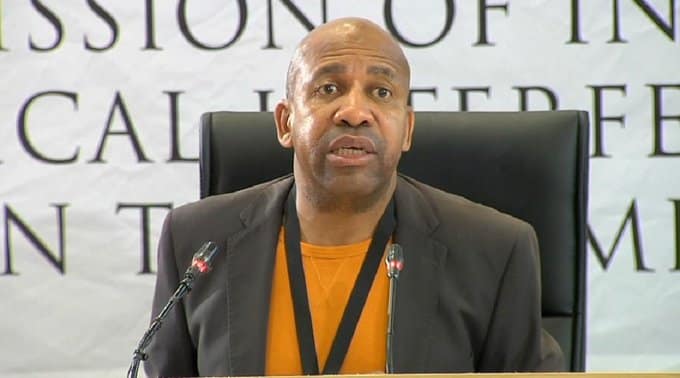
Thuso Keefelakae adjusted his spectacles and leaned toward the microphone. His voice, when it came, carried none of the theatrical indignation that had characterized earlier testimonies. He did not gesture broadly or raise his pitch. He simply spoke, steadily and precisely, as a man who had spent decades examining the spaces between what institutions claimed and what they actually did. The City of Ekurhuleni’s legal representative had just completed its submission: that the municipality had been unable to proceed with disciplinary action against suspended EMPD Deputy Police Chief Julius Mkhwanazi because the matter was simultaneously under criminal investigation by IPID itself. To proceed, the city argued, would risk prejudicing the criminal case. They had waited, they claimed, for IPID to complete its work. They were still waiting.
Keefelakae did not hesitate.
“That excuse holds no water,” he said. The words landed in the chamber like stones dropped into still water. “There is absolutely no legal impediment preventing the employer from taking internal disciplinary steps while a criminal investigation is ongoing. These are parallel processes. They do not exclude one another. To suggest otherwise is not a misunderstanding of the law. It is a delay tactic. And it is baseless.”
The City of Ekurhuleni’s representative shifted in his seat. Papers were shuffled. A glass of water was lifted, sipped, replaced. But no rebuttal came. Because there was, in truth, no rebuttal to offer.
The saga of Julius Mkhwanazi had festered in Ekurhuleni’s corridors for nearly two years. He had been appointed Deputy Chief of the Ekurhuleni Metropolitan Police Department with a mandate to professionalize a force dogged by allegations of corruption and brutality. Instead, he had become the subject of an IPID investigation himself. The precise nature of the allegations remained, at the commission’s insistence, sealed in evidentiary files. But the outline was known to those who followed municipal affairs: misuse of resources, irregular appointments, the subtle alchemy by which public trust is converted into private gain. He had been suspended, yes. But suspension, the residents of Ekurhuleni had learned, was not accountability. Suspension was a waiting room. And Mkhwanazi had been waiting, on full pay, for 647 days.
During those 647 days, the City had issued exactly 0 formal disciplinary charges. They had convened exactly 0 internal tribunals. They had produced exactly 0 findings of misconduct. Each time the question arose—in council meetings, in media briefings, in the anxious whispers of junior officers who watched their suspended deputy collect his salary while they worked double shifts—the answer was the same. We are awaiting the outcome of the IPID investigation. Our hands are tied. The law prevents us from acting.
Keefelakae’s testimony revealed this claim for what it was: a shield, not a restraint. He walked the commission through the relevant jurisprudence with the patience of a professor addressing a particularly slow seminar. The South African courts had ruled repeatedly, definitively, on this very question. In MEC for Health, Eastern Cape v Kirland Investments, the Constitutional Court had affirmed that internal disciplinary proceedings and criminal prosecutions could proceed simultaneously. In National Education Health and Allied Workers Union v University of Cape Town, the Labour Appeal Court had held that an employer’s duty to maintain discipline was not suspended by the existence of a parallel criminal investigation. The principle was so well established that it appeared in basic labour law textbooks. It was taught to first-year human resources students. It was, Keefelakae implied without quite saying, the kind of basic legal knowledge one would expect a major metropolitan municipality to possess.
Unless, of course, one preferred not to possess it. Unless ignorance, strategically maintained, served a purpose.
The commission’s chair, Justice Madlanga, leaned forward. “Are you suggesting, Director Keefelakae, that the City of Ekurhuleni deliberately misrepresented the legal position in order to avoid taking disciplinary action against a senior official?”
Keefelakae paused. It was a moment heavy with institutional consequence. To accuse a municipality of deliberate misrepresentation was to cross a line from evidence-giving into something more confrontational. But he had not spent thirty years in public service to flinch at the truth.
“I am suggesting,” he said carefully, “that the City’s legal representatives are either incompetent or they are being disingenuous. Neither possibility reflects well on an institution that is responsible for the safety and security of over three million residents.”
The silence that followed was not empty. It was filled with the accumulated weight of every case in which the state had deferred accountability until the memory of the offense had faded, every investigation that had languished in interdepartmental transit, every suspended official who had returned to work not because they were exonerated but because everyone had simply tired of waiting. The silence was heavy with the scent of a strategy so old it had worn grooves into the machinery of governance: delay, obfuscate, outlast. And now, in this chamber, someone had finally named it.
Outside the commission, in the corridors where officials gathered to smoke and refresh their coffee, the reaction was swift and combustible. Representatives from the City of Ekurhuleni huddled in urgent conversation, their voices low but their gestures sharp. A junior legal advisor was dispatched to make calls. A senior official, who had sat through Keefelakae’s testimony with arms crossed and jaw clenched, was overheard muttering that IPID was “overstepping its mandate” and “making sweeping statements without full context.” But when a journalist asked what, precisely, Keefelakae had gotten wrong, the official declined to specify. The statement, he said, would come later. It is still, at the time of this writing, yet to arrive.
Within hours, the political response began to crystallize. The Democratic Alliance, which governs Ekurhuleni through a coalition arrangement, issued a carefully worded statement reaffirming its commitment to accountability and noting that the City was “reviewing the testimony and will respond through proper channels.” The Economic Freedom Fighters, ever alert to opportunities for rhetorical combat, demanded Mkhwanazi’s immediate dismissal and the suspension of the City Manager. ActionSA called for a full forensic audit of the EMPD’s senior appointments. The African National Congress, in opposition in Ekurhuleni, suggested that the City’s paralysis was evidence of a systemic rot that only provincial intervention could cure.
But for all the political maneuvering, the heart of the matter remained precisely where Keefelakae had placed it: in the legal fiction the City had constructed to justify its inaction. And as the day wore on, that fiction began to unravel with gathering speed.
Former EMPD officers, long silenced by fear of retaliation, began to speak. One, who requested anonymity, described a culture in which senior officials were effectively untouchable. “We had a case where a high-ranking officer was caught on camera accepting a bribe,” he said. “The evidence was handed over. Nothing happened. We were told the case was ‘complex’ and required ‘further investigation.’ That was three years ago. The officer still works there. He was promoted last December.” Another described the demoralization of junior officers who witnessed the impunity of their superiors and drew the obvious conclusion: that the rules applied only to those who could not afford to bend them.
In the suburbs of Ekurhuleni, where residents had long complained of EMPD inefficiency and occasional brutality, the news of Keefelakae’s testimony was met with grim vindication. “We’ve been saying for years that the City protects its own,” said Thabo Mokoena, a community activist in Tembisa. “They give us speeches about zero tolerance, but when one of their own is accused, suddenly the law prevents them from doing anything. It’s not the law that’s the problem. It’s the will.” Mokoena ticked off the names of other EMPD officials who had been suspended and quietly reinstated, whose disciplinary files had disappeared into administrative limbo, whose cases had been “awaiting IPID” for so long that no one could remember the original allegations. “This is not about Mkhwanazi anymore,” he said. “This is about whether we have a police service that is accountable to the public or a protection racket that is accountable to itself.”
Back at the commission, Keefelakae was not finished. He had dismantled the City’s legal excuse, but he had also, inadvertently, exposed something larger: the systematic confusion of criminal investigation with disciplinary process that had become endemic across South African public service. It was not only Ekurhuleni, he testified, that used the existence of an IPID probe as a reason to delay internal action. It was municipalities, provincial departments, even national government entities. The pattern was so consistent, so pervasive, that it could not be explained by isolated errors or honest misunderstandings. It was a deliberate tactic, honed over decades, refined through repetition, deployed whenever a senior official fell under scrutiny and their political protectors needed time.
“The irony,” Keefelakae said, “is that this delay strategy often undermines the very criminal investigations it claims to respect. Witnesses forget. Documents are lost. The public loses confidence in the entire system of accountability. And the official, if they are eventually charged, has had months or years to align their story, to destroy evidence, to intimidate potential witnesses. Far from protecting the integrity of the criminal process, these delays actively subvert it.”
He did not need to add that Mkhwanazi had been suspended for 647 days. Everyone in the room was already counting.
The question that hovered over the proceedings, unasked but inescapable, was why. Why would a municipality risk the reputational damage of shielding a senior official under criminal investigation? Why would they sit idle for nearly two years, paying a suspended deputy chief his full salary, while the public demanded action and the evidence gathered dust? The easy answer was corruption: that Mkhwanazi had allies in senior positions who protected him from consequence. The slightly more complex answer was institutional capture: that the EMPD’s senior ranks had become so insulated from external oversight that they effectively policed themselves. But the most unsettling answer, the one that lingered in the chamber long after Keefelakae had stepped down from the witness stand, was simpler still.
Perhaps the City of Ekurhuleni was not protecting Mkhwanazi at all. Perhaps they were protecting the principle his case had come to represent: that senior officials were entitled to a presumption of impunity so robust that even credible criminal allegations could not disturb their peace. To discipline Mkhwanazi would be to admit that no one was above the rules. And that was an admission, some officials seemed to believe, that would open a door that could never be closed again.
By late afternoon, the commission adjourned. Keefelakae gathered his documents and walked through the marble corridors toward the exit. He did not linger to accept congratulations or explain his testimony further. He had said what needed to be said. What happened next was not his responsibility. It was the responsibility of the City of Ekurhuleni, which now had to explain why it had spent 647 days hiding behind a legal argument that its own lawyers must have known was untenable. It was the responsibility of the EMPD, whose rank-and-file officers had watched their suspended deputy chief collect his salary while they worked understaffed shifts in high-crime precincts. It was the responsibility of the political parties who had allowed this paralysis to persist, and of the voters who would, in time, render their judgment.
But it was also, in some measure, the responsibility of every South African who had ever accepted the explanation that accountability must wait for investigations that never seem to conclude. Keefelakae had done more than correct a legal error. He had named a cultural one: the willingness to defer consequence until the urgency of the moment had passed, the willingness to accept delay as a substitute for resolution, the willingness to believe that a system so manifestly broken could somehow, miraculously, heal itself without intervention.
As the sun set over Pretoria, the offices of the Ekurhuleni Metropolitan Police Department prepared for another night shift. Officers reported for duty, collected their vehicles, and dispersed into the sprawling expanse of the East Rand. Some of them knew that their suspended deputy chief had been the subject of testimony at a commission hundreds of kilometers away. Most did not. It was, for them, an ordinary Tuesday. The streets of Tembisa and Vosloorus and Kempton Park required their attention. The shift logs had to be completed. The reports had to be filed.
And somewhere, in a house whose address was not publicly listed, Julius Mkhwanazi waited. He had waited 647 days. He could wait longer. He had, after all, every reason to believe that the system would continue to protect him, that the investigations would continue to be deferred, that the City would continue to insist that its hands were tied. The Madlanga Commission had heard powerful testimony. The legal fiction had been exposed. The political pressure was mounting. But Mkhwanazi had spent enough years in the EMPD to know that exposure and consequence were not the same thing. The City had not disciplined him yet. The criminal investigation had not charged him yet. The system, for all its public commitments to accountability, had not yet required him to answer for anything.
Thuso Keefelakae had called the City’s excuse baseless. He had called it a delay tactic. He had called it a violation of public trust. And he was, by every measure of law and logic, entirely correct.
But the City of Ekurhuleni had not yet called it indefensible. And until they did, the waiting continued—for Mkhwanazi, for the commission, for the residents who watched their police service drift further from accountability with each passing day. The water had been held. The question was whether anyone was willing to drink.
About The Author