The South African government has declared a National State of Disaster in response to catastrophic flooding that has laid waste to vast areas of five provinces over consecutive weeks. The move, announced by the National Disaster Management Centre, unlocks urgent emergency powers and funding to coordinate a response to what officials are calling “one of the most widespread and devastating flood events in recent memory.”
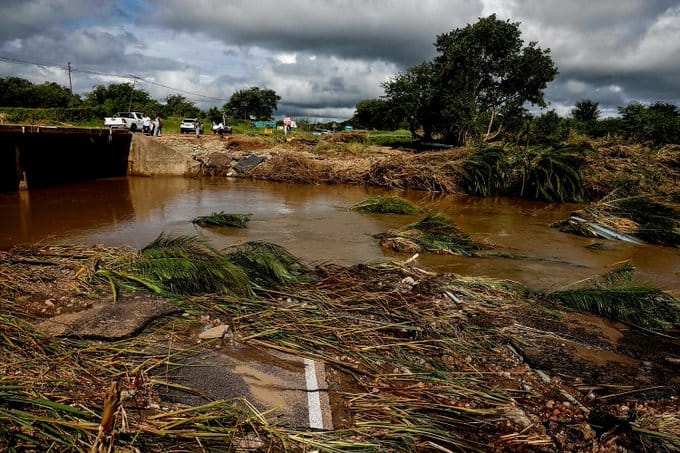
The provinces of Limpopo, Mpumalanga, KwaZulu-Natal (KZN), the Eastern Cape, and the North-West are reeling from the cumulative impact of relentless torrential rains, gale-force winds, frequent and deadly lightning strikes, and severe flooding. The disaster has left a trail of destruction: submerged townships, collapsed bridges, washed-away roads, ruined farmlands, and heartbreaking loss of life.
“The scale of the disaster requires a massive, coordinated response beyond the capacity of individual provinces,” said a senior official from the Department of Cooperative Governance and Traditional Affairs (COGTA). “This declaration enables us to mobilize all arms of the state, from the South African National Defence Force (SANDF) for logistics and evacuations, to the rapid release of funds for humanitarian relief and infrastructure repair.”
A Nation Under Water: Scenes of Destruction Across Provinces
The crisis has unfolded as a series of intense weather systems, supercharged by broader climatic patterns, have pummeled the country. In KwaZulu-Natal, still rebuilding from the historic 2022 floods, communities are facing a terrifying sense of déjà vu. Rivers have again burst their banks, with the uMngeni and Mfolozi among those inundating settlements and displacing thousands. Major highways, including the N2 and N3, have experienced closures due to mudslides and washouts, severely hampering the movement of goods and aid.
In Limpopo and Mpumalanga, the agricultural heartland has been particularly hard-hit. Citrus and maize fields now lie under lakes of stagnant water, dealing a potentially crippling blow to the season’s harvest and the national food supply chain. Rural villages have been cut off, with access roads rendered impassable. The Kruger National Park reported significant damage to tourist roads and infrastructure, with several camps temporarily evacuated.
The Eastern Cape has seen coastal communities battered by storm surges and winds, while inland areas grapple with swollen rivers. In the North-West, flash flooding turned seasonal rivers into raging torrents, sweeping away livestock and damaging informal settlements on the outskirts of major towns.
Humanitarian Crisis Unfolds
The human cost is mounting daily. Preliminary reports indicate dozens of fatalities, with many more injured or missing. Thousands of homes—from formal structures to informal dwellings—have been destroyed or severely damaged, leaving families homeless as the Southern Hemisphere winter approaches. Emergency shelters have been established in community halls and schools across the affected provinces.
“We have lost everything—the water took our house, our clothes, our papers,” said Thandiwe Ndlovu, a mother of three sheltering in a community center in eThekwini. “We are alive, but our hearts are broken. We are cold and we don’t know what to do next.”
Beyond shelter, the immediate concerns are for clean drinking water, as water treatment plants have been compromised; food security; and the prevention of waterborne disease outbreaks like cholera.
Mobilizing a National Response
The declaration of a National State of Disaster triggers the implementation of the National Disaster Management Plan. Key actions will include:
- Search, Rescue, and Evacuation: Coordinated efforts led by disaster management teams, with SANDF support for airlifting stranded residents.
- Humanitarian Aid: Large-scale distribution of blankets, food parcels, water purification tablets, and medical supplies through a joint effort involving government, the South African Red Cross, and NGOs.
- Infrastructure Assessment and Repair: Engineers from the Department of Public Works and SANDF will be deployed to assess critical infrastructure, with a focus on restoring road links, electricity, and water supply.
- Funding: The National Treasury will work to expedite the release of emergency funds from the contingency reserve, while also appealing for international aid and private sector support.
A Stark Climate Warning
Scientists and environmental activists are pointing to the disaster as a stark manifestation of climate change. “The increased frequency and intensity of these extreme weather events are exactly what climate models have predicted for this region,” noted climate scientist Dr. Portia Nkosi. “Our infrastructure and settlement patterns are not designed for this new normal. This is not just a disaster response moment, but a critical moment for climate adaptation planning.”
As rescue operations continue and the nation begins to assess the full, staggering financial cost of the damage, the focus remains on the immediate needs of the displaced and the grieving. The road to recovery for these five provinces will be long and arduous, a collective national challenge borne from the relentless force of the skies.
About The Author