In South African football, certain moments are frozen in time. The shuddering impact of the challenge, the anguished cry, the sight of a legend being carried off the pitch—these were the indelible images from that fateful Carling Knockout Cup clash in 2023 between Kaizer Chiefs and Mamelodi Sundowns. For two years, the narrative surrounding Bongani Zungu’s tackle on Bernard Parker had been one of public apology and public forgiveness. That fragile peace was shattered this week, not with a spoken word, but with the cold, hard proof of digital receipts.
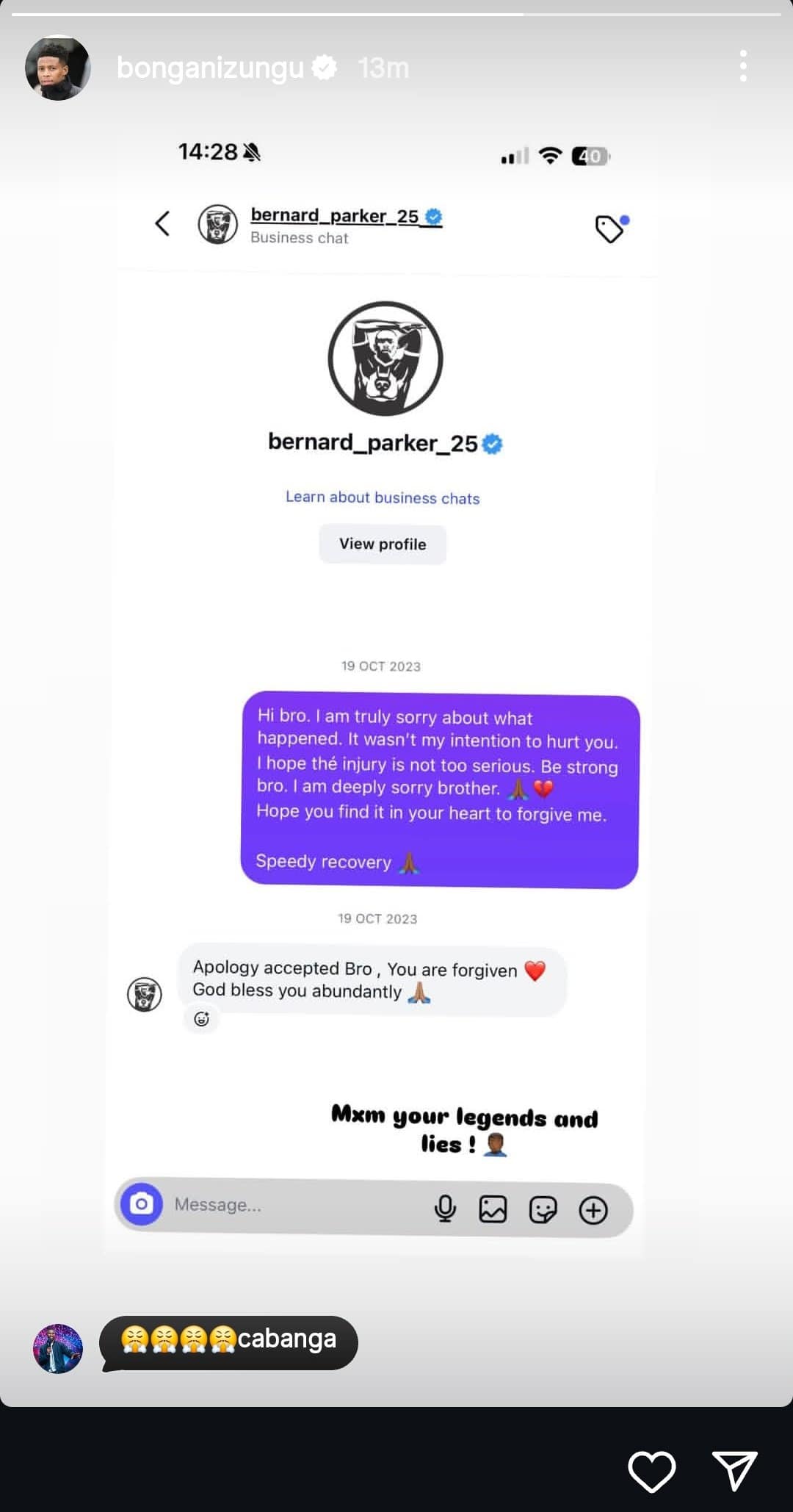
On October 21, 2025, the former Mamelodi Sundowns midfielder, in a move that sent the football world into a frenzy, took to his Instagram stories to refute a growing narrative directly. He posted a series of screenshot conversations, time-stamped from the very day of the incident in 2023, showing a private, immediate apology sent to Bernard Parker.
The evidence was stark and simple: a message from Zungu reading, “Hi Bernard sorry about today wishing you a speedy recovery bro,” to which Parker had replied, “Thank you Bongani. God bless.”
The Unraveling of a Narrative
This digital evidence was Zungu’s direct response to a recent media tour by the now-retired Parker. In a series of candid interviews promoting his post-football ventures, Parker had revisited the career-shortening injury. He expressed a deep-seated hurt, claiming that beyond the initial, fleeting message, Zungu had provided no follow-up support, no hospital visit, and no substantive contact. Parker framed the text as a mere formality, an “insufficient” gesture that did little to ease the physical and psychological trauma of his recovery, effectively painting Zungu as indifferent once the public spotlight had faded.
This new account stood in direct contradiction to the scene Parker himself had set in the immediate aftermath of the incident in 2023. Back then, before the cameras, he had been the picture of grace, stating he had “forgiven” Zungu and urging fans to do the same, a move that had drawn widespread praise for his maturity.
Zungu’s decision to publish the private exchange was a nuclear option. It was a clear message: the record needed to be set straight. The unspoken accusation hanging over his head—that of a hollow, insincere apology—was one he was no longer willing to bear.
A Nation of Football Fans Divided
The fallout was instantaneous and volcanic. Social media platforms became a digital battlefield, with fans, pundits, and former players choosing sides in a fierce debate over accountability, forgiveness, and the nature of an apology.
Team Zungu argued that the midfielder had done what was morally required in the immediate aftermath. “What more did people want? He apologized privately, immediately. Bernard accepted it. Case closed. Why is he changing the story now? Zungu was right to show the receipts!” wrote one supporter on X (formerly Twitter).
Team Parker countered with emotional force, arguing that the true measure of remorse extends beyond a single text message. “A text is easy. Where was the human decency to check on a colleague in the hospital? To call? To see how his recovery was going? Parker is talking about the loneliness and pain of the process, and a one-line text doesn’t cut it,” argued another, capturing the sentiment of those who felt Zungu’s actions, while technically an apology, lacked the depth of genuine contrition.
The debate highlighted a deeper, recurring tension in the Premier Soccer League (PSL) regarding accountability for on-field incidents that have off-field consequences. For every call for players to “be men” and settle issues privately, there is a competing demand for public accountability and tangible acts of restitution.
The Unanswered Questions
The screenshots, for all their conclusive power, have not ended the conversation; they have simply changed its terms. They prove an apology was offered and acknowledged, but they cannot measure its sincerity or its sufficiency in the face of a long and painful recovery.
The episode leaves several haunting questions in its wake. Was Parker’s initial public forgiveness a performance of expected sportsmanship, masking a private hurt that has only festered with time? Was Zungu’s private message a genuine expression of guilt, or merely the minimum required to placate public opinion? And at what point does the burden of a mistake, however unintentional, truly end?
For now, the two men are locked in a stalemate built on conflicting interpretations of the same event. Bongani Zungu has provided his evidence. Bernard Parker has voiced his pain. And the court of public opinion remains in session, more divided than ever, proving that some wounds, even those believed to be long healed, can be reopened with a single post.
About The Author