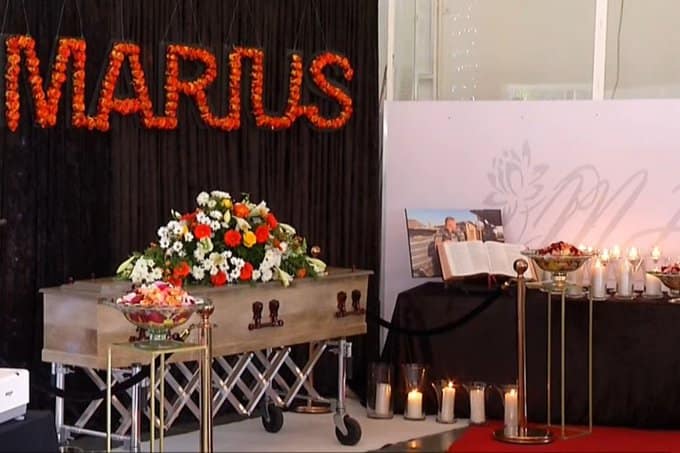
The air in the chapel at Medley House funeral home was thick with a grief made heavier by outrage, a mourning mixed with dread. On a grey Wednesday morning, the 17th of December 2025, South Africa laid to rest not just a man, but a stark and terrifying symbol of the price of truth. Marius van der Merwe, the 44-year-old contractor whose testimony before the Madlanga Commission had peeled back a layer on a shadowy world of state corruption, was buried under the weight of a nation’s horrified gaze, just twelve days after he was executed in his own driveway.
The sombre gathering drew a tapestry of mourners bound by loss and a shared, chilling understanding. His widow, Elana van der Merwe, sat shrouded in black, her face a mask of devastation, flanked by their two shell-shocked children. They were surrounded not only by family and friends from their tight-knit Brakpan community but also by a contingent of faces marked by a different kind of solidarity—fellow witnesses, their lawyers, and civil society activists. Their presence was a silent, powerful rebuke to the assassins’ bullets.
“He was not a politician. He was not a general. He was a husband, a father, a man who fixed things for a living,” declared family pastor Reverend Daniel Fourie, his voice trembling with emotion. “But when he saw something broken in the heart of our country, he chose, in his quiet way, to try and fix that too. For that act of conscience, he paid with his life in the most cowardly way imaginable.”
Van der Merwe, known to the public only as the guarded pseudonym “Witness D” during his testimony in October, had stepped out of anonymity to provide the commission with meticulous, technical details. A former logistics and procurement subcontractor for several security-sensitive state entities, his evidence was a forensic blueprint of alleged corruption. He spoke of inflated invoices, covert payments routed through shell companies, and the deliberate procurement of substandard equipment for critical police and intelligence operations—a ledger of betrayal that pointed to a network of officials and businessmen allegedly siphoning public funds while compromising national security.
His testimony, delivered in a calm, methodical tone, was considered a cornerstone of the commission’s investigation into Lieutenant-General Nhlanhla Mkhwanazi’s explosive allegations. It provided the how—the mechanics of the graft that others had described in broad strokes.
Then, on the evening of Friday, 5 December 2025, the theoretical dangers of his courage became horrifically real. As he returned home with his family to their quiet, tree-lined street in Brenthurst, Brakpan, a silver Volkswagen Polo with tinted windows pulled alongside. Two armed men emerged, their movements clinical. Ignoring his wife’s screams and in full view of his children, they fired multiple rounds at close range, killing Van der Merwe instantly, before fleeing into the night. The hit was professional, swift, and designed to send a message far beyond the crime scene tape.
That message hung heavy over the funeral service. Jeremy Michaels, the spokesperson for the Madlanga Commission, attended in an unofficial capacity, a grim presence in the pews. While he did not speak, the commission’s earlier statement—vowing it “will not be intimidated”—was echoed by others.
A close friend, Johan Pretorius, who had worked with Van der Merwe for years, addressed the congregation with a fiery defiance. “They thought by killing Marius they would bury the truth with him,” Pretorius said, his jaw set. “But they have only given it a louder voice. They have turned a detailed witness statement into a national outcry. Every person here, every South African watching, is now a witness to what happens when you speak up.”
The tragedy has ignited a fierce debate about the state’s failure to protect those who stand before its commissions of inquiry. Questions are raging about whether Van der Merwe had requested protection and, if so, why it was deemed insufficient. Civil society groups have announced plans for vigils and marches, demanding not just justice for one man, but a systemic overhaul of witness protection programmes.
As the final hymn faded and the casket—draped not in the national flag, but in a simple, dark cloth—was carried out, a profound silence fell, broken only by the gut-wrenching sobs of his family. Marius van der Merwe was buried as a husband and father. But to a country grappling with the corrosive power of corruption, he was interred as something more: a martyr for accountability, and a terrifying test of whether South Africa’s institutions are strong enough to defend the brave few who step into the light, or if the shadows still hold the ultimate power.
About The Author