For years, it was the policy that everyone ignored. Buried in the fine print of municipal regulations and national police standards was a clear, unambiguous requirement: every metro police officer must be vetted annually. Their financial records were checked. Their criminal histories were scanned. Their links to criminal syndicates are being investigated. It was the law. And for years, in Ekurhuleni, it was simply not done.
That era of neglect ended this week. In a sweeping move triggered by the explosive revelations of the Madlanga Commission of Inquiry, the City of Ekurhuleni has launched a large-scale vetting drive targeting more than 3,500 officers in the Ekurhuleni Metropolitan Police Department (EMPD). The operation, described by officials as the most comprehensive integrity review in the department’s history, aims to root out corrupt elements who have no place in law enforcement.
The decision to act was not born of sudden enlightenment. It was forced by the testimony emerging from the Madlanga Commission, which has been probing deep-seated corruption and political interference within the EMPD and the broader municipal administration. Week after week, witnesses have taken the stand to describe a police force infiltrated by criminal networks, where officers protected illegal mining operations, took bribes to look the other way, and faced no consequences as long as they remained loyal to the right people.
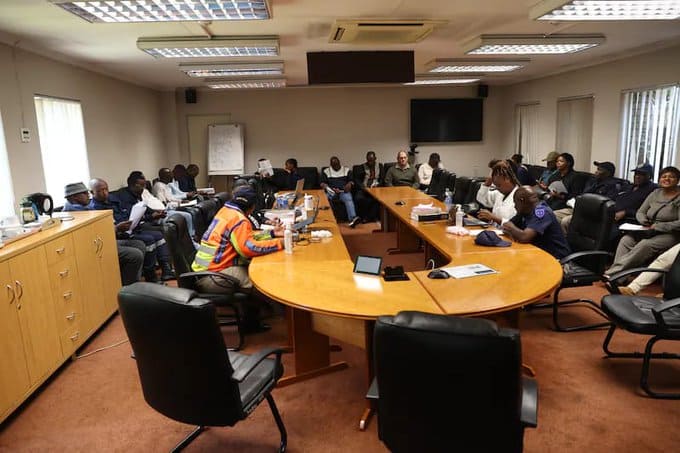
“The commission has pulled back the curtain on a rot that has been festering for years,” said Executive Mayor Nkosindiphile Xhakaza, announcing the vetting drive at a press conference in Germiston. “We have seen evidence of officers who should never have been allowed to wear the uniform. We have seen a culture of impunity that made a mockery of our laws. That ends now.”
The scale of the task is daunting. More than 3,500 officers must undergo intensive background checks. Their financial histories will be scrutinized for unexplained wealth. Their associations will be examined. Their service records will be reviewed for patterns of misconduct. It is a logistical nightmare, requiring coordination between the municipality, the South African Police Service’s Criminal Record Centre, the State Security Agency, and the Financial Intelligence Centre.
But officials insist they have no choice. The alternative—allowing the current situation to continue—is unthinkable.
The vetting process, which should have been happening annually, was systematically ignored for years. Sources within the municipality suggest that the failure to vet was not merely a matter of negligence, but a deliberate strategy to protect compromised officers. If you never look, you never find. And if you never find, you never have to act.
That calculation has now been upended by the Madlanga Commission’s findings. Testimony has revealed that some officers were appointed despite having criminal records. Others were promoted despite evidence of corruption. In at least one case, an officer accused of protecting an illegal mining syndicate was found to have accumulated assets far beyond his legitimate income. None of this was caught because none of it was checked.
For the rank-and-file officers who do their jobs honestly, the vetting drive is a welcome development. “The bad apples give us all a bad name,” said one EMPD officer, speaking on condition of anonymity. “When we go into communities, people don’t see a police officer. They see someone who might be on the take. They don’t trust us. And why should they? If this vetting cleans out the rot, maybe we can start to rebuild that trust.”
The process will not be quick. Vetting 3,500 officers requires time, resources, and expertise. The city has brought in external specialists to assist, ensuring that the process is independent and thorough. Officers who are found to have lied on their application forms, concealed criminal records, or accumulated wealth through corrupt means will face disciplinary action, which could include dismissal and criminal charges.
But the vetting is only one part of a broader reform agenda. The city is also reviewing its recruitment practices, tightening oversight of promotions, and implementing a new code of conduct for officers. The goal, officials say, is to create a police service that is not only effective but worthy of the public’s trust.
For the communities policed by the EMPD, the news of the vetting drive has been met with cautious optimism. In areas like Vosloorus, Katlehong, and Daveyton, residents have long complained of police complicity in crime. They tell stories of officers who demand bribes at roadblocks, who tip off criminals about impending raids, who seem to work for the syndicates rather than against them.
“We have been saying this for years,” said a community leader in Thokoza. “The police know who the criminals are because they work with them. If this vetting finally does something about that, maybe we can start to feel safe. But we will believe it when we see it. We have been disappointed before.”
The Madlanga Commission continues its work, with more witnesses scheduled to testify in the coming weeks. Its final report, expected later this year, is likely to recommend further reforms and, potentially, criminal prosecutions. For the City of Ekurhuleni, the vetting drive is a first step—a signal that the era of looking the other way is over.
As Mayor Xhakaza put it: “We cannot change the past. But we can decide the future. And the future of this city will be built on integrity, accountability, and trust. That starts with the people we entrust to keep us safe. They will be vetted. They will be held accountable. And if they are found wanting, they will be removed.”
In the EMPD’s offices, the files are being pulled. The background checks are beginning. And 3,500 officers wait to learn if they will pass the test. For some, it will be a routine confirmation of their integrity. For others, it will be the beginning of the end.
About The Author