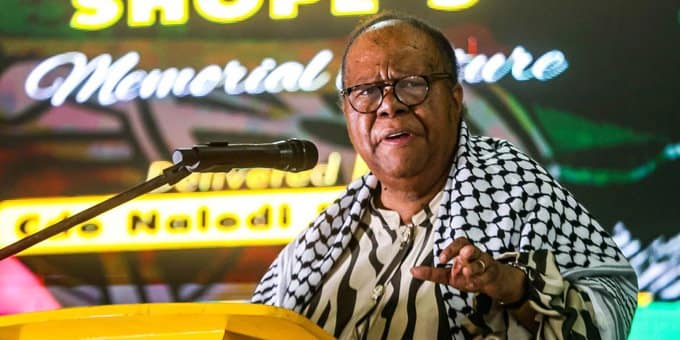
In a move that has sent ripples through international diplomatic circles, the United States has abruptly revoked the visa of South Africa’s Minister of International Relations and Cooperation, Naledi Pandor. The decision, communicated via a stark email from the U.S. Consulate, has been met with condemnation and suspicion, raising questions about the state of U.S.-South Africa relations and the influence of pro-Israel lobbying groups on American foreign policy.
The Cold Notification
Minister Pandor confirmed the development during a press briefing in Pretoria, her demeanor a mixture of professional calm and clear frustration. She revealed that the official notification cited a specific section of U.S. immigration law that grants the government broad authority to cancel visas without stating a cause.
“The email was clear,” Pandor stated, her voice measured. “Under this particular provision, no reasons need to be provided by the United States. It is a sovereign decision, but one that is unusual when applied to a sitting foreign minister of a nation with which the U.S. maintains diplomatic ties.”
The revocation effectively bars Pandor from traveling to the United States for any purpose, including attending critical meetings at the United Nations in New York, a key platform for South African foreign policy.
The Shadow of a Lobby
While the U.S. State Department has maintained a strict “no comment” policy on individual visa cases, Pandor did not hesitate to point to what she believes is the underlying motive. “I am aware of a concerted lobby that has been writing to the U.S. government, vehemently opposing my entry,” she disclosed.
She specifically linked this campaign to her unwavering and vocal stance on human rights, particularly her criticism of Israel’s policies towards Palestinians. During her tenure, South Africa, under Pandor’s guidance, has been one of the most prominent voices in the Global South condemning the occupation and advocating for Palestinian statehood. The country has drawn parallels between the Palestinian struggle and its own history under apartheid, a comparison that infuriates the Israeli government and its allies.
One name emerged from the shadows: Lawrence Nowosenetz, a former senior figure in the South African Jewish Board of Deputies. Nowosenetz is alleged to have been a central figure in the letter-writing campaign, petitioning U.S. officials to deny Pandor entry due to her “anti-Israel alignment.” Attempts to reach Nowosenetz for comment have so far been unsuccessful.
A Tenure Defined by Principle and Controversy
To understand the gravity of this move, one must look at Pandor’s record. She has been a formidable and principled voice on the world stage, unafraid to challenge Western powers. Her diplomacy has often positioned South Africa as a leader of the Non-Aligned Movement’s modern iteration, seeking a multipolar world order.
Under her leadership, South Africa:
- Championed the Palestinian Cause: She repeatedly labeled Israel’s actions in Gaza as “a form of genocide” and pushed for international legal accountability.
- Strengthened BRICS Ties: She has been instrumental in deepening South Africa’s integration with the BRICS bloc (Brazil, Russia, India, China, South Africa), a grouping seen in Washington as a strategic competitor.
- Maintained a Stance on Russia: Despite pressure from the West, South Africa has maintained a non-aligned position on the Ukraine war, hosting Russian and Chinese naval exercises and resisting outright condemnation of Moscow.
This independent streak has clearly rankled powerful interests in the United States, where bipartisan support for Israel remains a cornerstone of foreign policy.
Reactions and Fallout
The reaction from South Africa has been one of unified outrage. The governing African National Congress (ANC) released a statement calling the visa revocation “a provocative and unfriendly act” that “smacks of political intimidation.”
“To treat a respected leader like Minister Pandor in this manner is an insult not just to her, but to the entire nation of South Africa,” said an ANC spokesperson. “It suggests that any country that dares to pursue an independent foreign policy, critical of U.S. interests, will be punished.”
Political analysts are weighing the long-term consequences. “This is a significant escalation,” said Dr. Sipho Dlamini, a professor of International Relations at Wits University. “Previously, disagreements were handled through diplomatic channels. Revoking a visa is a public, punitive measure. It signals a deep fracture and will likely push South Africa closer to the BRICS and Global South camp, further straining its relationship with the West.”
The U.S. silence on the matter is deafening. Without an official explanation, the vacuum has been filled with speculation and anger, cementing the perception that the decision was a political capitulation to domestic lobbying pressure.
As the diplomatic standoff deepens, the revoked visa of Naledi Pandor has become more than a travel document; it is a potent symbol of a widening geopolitical rift and a test of South Africa’s resolve to speak its truth to power, even when that power chooses to slam its doors shut without a word.
About The Author