The sweltering Tamil Nadu sun beat down on the public road in Karur district, baking the thousands of hopeful faces who had come for a glimpse of their hero. They had been told Vijay, the actor-politician who commanded the screen and was now capturing the political arena, would arrive by noon. By 11 a.m., the crowd had already begun to swell, a sea of humanity fueled by devotion and anticipation.
But noon came and went. The sun climbed higher, the heat grew more oppressive, and the crowd, promised a midday appearance, continued to grow. What was anticipated to be 10,000 souls soon swelled to 27,000. Water was scarce, shade nonexistent. The initial buzz of excitement began to curdle into a restless, thirsty anxiety.
Hours later, at 7:40 p.m., under the dimming sky, Vijay finally arrived. The pent-up energy of the masses erupted. A surge rippled through the crowd as people strained to see the star, to capture a video, to feel close to him. In videos that would later haunt social media, Vijay, seemingly aware of the discomfort, was seen tossing water bottles into the throng—a gesture of goodwill that, in hindsight, signaled the desperate conditions.
Then, panic, swift and brutal, took hold.
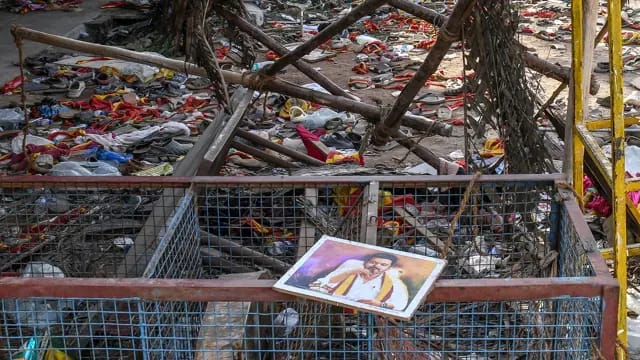
Witnesses described a sudden cascade of events: supporters who had climbed a tree for a better view lost their grip, tumbling down onto the densely packed crowd below. The domino effect was instantaneous. People were pushed, crushed, and trampled. There was “absolutely no space to move,” as survivor B. Kanishka recounted before he fainted, overcome by the pressure.
The rally descended into chaos. Vijay’s speech was halted as the scale of the disaster became apparent. What was meant to be a triumphant campaign stop for his newly launched party had turned into a scene of tragedy.
By Sunday, the grim tally was clear. Senior district official M. Thangavel confirmed at least 40 people were killed in the stampede, including nine children. It was an “irreparable loss,” as Vijay himself stated, saying he was “at a loss for words” and promising 2 million rupees ($22,000) in compensation to each victim’s family.
The response from authorities was swift. Police filed a case against three of Vijay’s senior aides—Bussy Anand, G.R. Nirmal Kumar, and V.P. Mathiyazhagan—charging them with culpable homicide not amounting to murder and negligent conduct endangering human life.
State police chief G. Venkataraman pointed to the fatal delays and poor planning. “The people lacked sufficient food and water under the hot sun,” he stated, highlighting the chasm between the expected and the actual crowd size. Survivors echoed this, blaming the disaster on being “forced to wait for hours together” and a critical lack of police personnel to manage the unprecedented numbers.
This tragedy in Karur is a stark reminder of a grim pattern in India, where mass gatherings frequently end in disaster due to lax safety measures. From religious fairs in Uttar Pradesh to cricket celebrations in Bengaluru, the story is often the same: a massive, expectant crowd, insufficient planning, and a trigger that leads to catastrophic loss of life.
As senior police officer S. Davidson Devasirvatham promised a thorough investigation, a community was left to mourn, and a nation was left questioning when the lessons from past crushes would finally be learned.
About The Author