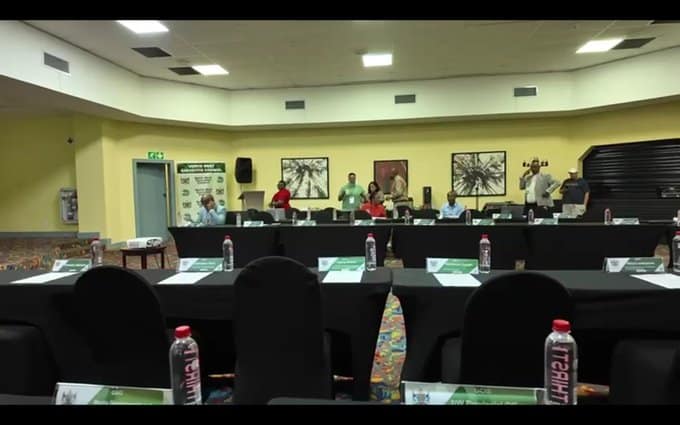
Mahikeng – In the corridors of power, policy is often discussed in abstract terms: frameworks, mandates, and deliverables. But for the families in the dusty villages of the North West, government is not an abstraction. It is the pothole that swallows a taxi. It is the clinic without medicine. It is the silence from those who are supposed to serve. This disconnect between the governors and the governed was the focus of a high-level engagement in Mahikeng this week, as Deputy Minister in the Presidency Kenny Morolong sat down with the North West Provincial Executive Council (EXCO) to hammer out a new way of talking to the people.
The meeting, held at the Mmabatho Palms hotel, was formally about “socialising the Government Communication Policy.” But beneath the bureaucratic language lay a far more urgent mission: to restore faith in a system that millions of South Africans no longer trust.
Morolong, accompanied by senior officials from the Government Communication and Information System (GCIS), addressed the EXCO with a message that was equal parts directive and plea. He acknowledged what every politician knows but few admit publicly: that a chasm has opened between the state and its citizens, and that chasm is filled with anger, apathy, and alienation.
“People feel disconnected,” Morolong told the assembled MECs and directors-general. “They see government as a distant entity that makes decisions in rooms they will never enter, about lives they are living every day. That must change. We are here to ensure that communication is not an afterthought, but a central pillar of how we govern.”
A Policy for the People
The Government Communication Policy, which Morolong is championing across the provinces, is designed to be more than just a manual for press releases. It seeks to embed communication into every level of government decision-making, ensuring that communities are not merely informed after the fact, but consulted and engaged throughout the process.
At its core is a simple principle: transparency. The policy mandates that government departments must proactively share information about budgets, projects, and service delivery timelines. It demands that officials speak in plain language, not bureaucratic jargon. And it insists on feedback mechanisms, so that when a community raises a grievance, it is logged, addressed, and responded to.
During the Mahikeng meeting, GCIS presented key insights from recent research into public perceptions. The findings were sobering. Across the province, from the townships of Jouberton to the rural stretches of Taung, citizens reported feeling ignored. They pointed to broken promises, uncompleted projects, and officials who were unreachable. The data confirmed what Morolong already suspected: that the failure to communicate is not just a public relations problem; it is a governance failure.
The North West Context
The choice of the North West for this engagement was significant. The province has endured years of political turmoil, from the violent protests that erupted during the tumultuous tenure of former Premier Supra Mahumapelo to the subsequent periods of administrative intervention. Public trust in institutions has been severely eroded, and the task of rebuilding is monumental.
Yet, amidst the challenges, there are signs of a government trying to find its feet. The current EXCO, led by Premier Lazzy Mokgosi, has made stabilizing the administration a priority. Morolong’s visit was framed as a partnership in that effort—an offer of support from the national government to help the province communicate better with its long-suffering citizens.
“We welcome this engagement,” said Premier Mokgosi. “The Deputy Minister is correct. We cannot deliver services in a vacuum. We must carry the people with us. If they do not know what we are doing, if they do not understand why there are delays or where the money is going, then we have already failed. Communication is not a luxury; it is a necessity.”
From Mahikeng to the Living Room
For Morolong, the ultimate test of the policy will not be measured in cabinet memos or strategy documents. It will be measured in the lived experience of ordinary families.
“When a mother in a village sees a tap being installed, she must know who installed it, when it will work, and who to call if it breaks,” Morolong said. “When a young person is looking for a job, they must know where the opportunities are and how to access them. That is what people-centred governance means. It means bringing government to the kitchen table.”
The Deputy Minister’s call for better communication comes at a critical juncture. With national elections on the horizon, the ruling party is acutely aware that disillusionment with service delivery translates into disillusionment at the ballot box. But Morolong insisted the initiative was not about politics; it was about principle.
“We are not here to sell a party. We are here to serve a nation,” he said. “And serving means talking, listening, and acting. If we can get the communication right, everything else becomes easier.”
As the meeting concluded, the EXCO members departed with a clear mandate: return to your departments, open the lines of communication, and remember that the people are watching. In the North West, where hope has often been in short supply, the promise of a government that actually talks to its citizens is a small but significant step toward rebuilding a broken bond.
About The Author