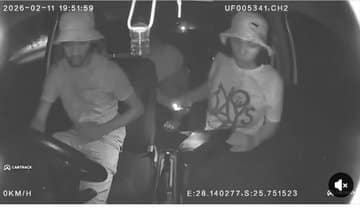
The footage is 4 minutes and 37 seconds long. It was recorded on a modest dashcam mounted behind the rearview mirror of a Toyota Corolla, the kind of device thousands of e-hailing drivers install as a defensive measure against the unpredictable hazards of their profession. The camera was meant to protect the driver, to document accidents, to provide evidence in disputes. It did all of these things. It also captured his murder.
The video begins at 7:48 PM on February 11, 2026. The Corolla is parked on a residential street in Pretoria West, a neighborhood of modest houses and quiet intersections. The driver, a 34-year-old man whose name authorities have not yet released pending family notification, sits behind the wheel. His face, visible in the rearview mirror’s reflection, shows the fatigue of a long shift but nothing more remarkable. He is waiting, presumably, for a passenger to emerge from one of the houses or to arrive at a pre-arranged pickup point.
The passenger never arrives. Instead, two figures approach the vehicle from opposite sides. The dashcam captures their approach with the particular clarity of security footage: a woman in a beige bucket hat and a white T-shirt bearing a prominent “NO” logo, and a man whose features are partially obscured by the camera angle and the gathering dusk.
What follows is brief, brutal, and now permanently preserved in digital form. The woman opens the front passenger door. The man opens the driver’s door. There is no conversation, no negotiation, no opportunity for the driver to defend himself or flee. The attack begins immediately.
The man punches the driver repeatedly, his fists connecting with the side of the driver’s head with the particular force of someone who has done this before. The woman joins the assault, kicking from the passenger side, her bucket hat remaining improbably in place throughout the violence. The driver’s hands rise in a futile attempt at protection, but there is no protection against two attackers in the confined space of a vehicle.
Within seconds, the driver is unconscious. His body slumps against the steering wheel, then slides sideways toward the passenger seat. The attackers do not pause to check whether he is alive. They begin rummaging through the vehicle, opening the glove compartment, searching beneath the seats, gathering whatever valuables they can find.
The dashcam continues recording throughout. It captures the woman’s face in clear profile as she leans across the center console. It captures the man’s hands as they pull items from the driver’s pockets. It captures the final moments of a life ended by violence, preserved in digital amber for investigators, for prosecutors, for a family that will never unsee what the camera saw.
At 7:52 PM, the attackers exit the vehicle. The man slides into the driver’s seat. The woman re-enters from the passenger side. The Corolla pulls away from the curb and disappears into the Pretoria West night, leaving behind only the silence of a residential street that has just witnessed a murder.
The Discovery
The body was found approximately three hours later, dumped near the Atteridgeville police station. The choice of location was either extraordinarily brazen or deliberately symbolic—leaving a murder victim on the doorstep of law enforcement, a taunt delivered in the language of violence.
Patrol officers conducting a routine check of the area discovered the body at approximately 11:15 PM. The victim had been beaten beyond immediate recognition, his features swollen and distorted by the force of the attack. His identification documents were missing, stripped from his pockets along with his wallet, his cellphone, and whatever else the attackers had deemed valuable.
It would take several hours to establish his identity. E-hailing platforms maintain records of their drivers, but accessing those records requires coordination with company security teams, legal processes, and the careful verification that prevents mistaken identification. By the morning of February 12, his name had been confirmed. His family had been notified. The investigation had begun.
The dashcam footage, recovered from the vehicle when it was later located abandoned in a different part of the city, provided investigators with evidence that murder victims rarely offer: a complete visual record of the crime, including clear images of the perpetrators.
“We have the faces,” said a police spokesperson during a brief press conference on February 12. “We have the vehicle. We have the timeline. We have everything except the identities and locations of the suspects. We are asking the public to assist us in providing that missing information.”
The Activist’s Amplification
Yusuf Abramjee, South Africa’s most prominent anti-crime activist, received the dashcam footage within hours of its recovery. His network of contacts within law enforcement, community policing forums, and the media ensures that he is often among the first to learn of crimes that shock the national conscience. His decision to share the footage publicly was neither hasty nor casual.
“We have to balance the public interest against the privacy and dignity of the victim and his family,” Abramjee explained in a subsequent interview. “In this case, we determined that the public interest in identifying and apprehending the suspects outweighed the considerations of privacy. The footage provides the clepossible possible images of the perpetrators. It needed to be seen.”
The clip, carefully edited to remove the most graphic moments of violence while preserving the identifying images of the suspects, was shared across Abramjee’s social media platforms at approximately 10:00 AM on February 12. Within hours, it had been viewed hundreds of thousands of times, shared across WhatsApp groups, Facebook pages, and Twitter feeds, and embedded in news articles across the country.
The response was immediate and overwhelming. Tips flooded into the SAPS hotline at 08600 10111. The images of the woman in the beige bucket hat and “NO” logo T-shirt became the most recognized fashion choices in South African social media. Armchair detectives analyzed every frame, searching for clues that might identify the suspects or the location of the attack.
“The public is our greatest asset in cases like this,” said the police spokesperson. “There are millions of eyes out there, and many of them belong to people who recognize faces, who notice anomalies, who remember details that might seem insignificant but prove crucial. We are grateful for every tip, every share, every moment of attention that this case receives.”
The Suspects
The woman in the beige bucket hat has become the primary focus of the public manhunt. Her face, captured in multiple frames of the dashcam footage, is clearly visible. Her distinctive headwear and T-shirt provide additional identifying characteristics. Someone knows her. Someone has seen her. Someone will recognize her.
The man is more difficult to identify from the footage. His face is partially obscured by the camera angle and the shadow cast by the vehicle’s roof. His clothing is unremarkable—dark pants, a dark jacket, nothing that would distinguish him from thousands of other men in Pretoria on any given evening. Investigators are relying on the woman to lead them to him, operating on the assumption that the two are connected and that identifying one will identify both.
“We are pursuing multiple leads,” the police spokesperson said. “We have received information that is being evaluated and followed up. We are confident that arrests will be made. It is a matter of time, resources, and the continued cooperation of the public.”
The confidence is carefully calibrated—enough to reassure, not enough to promise. Investigators know that public manhunts can generate overwhelming volumes of tips, many of them useless, some of them deliberately misleading. They know that the suspects may have fled Pretoria, may have crossed provincial borders, may have left the country entirely. They know that the window for apprehension is narrow and closing.
The Victims
The driver’s family spent the night of February 11 unaware that he would never return home. They waited, as families of e-hailing drivers often wait, for the message that never came, for the call that always arrives too late. When the police finally made contact, the words were the words that no family ever forgets: “We regret to inform you…”
His identity has been protected in media reporting, but fragments of his life have emerged through interviews with friends and colleagues. He was a husband. He was a father of two young children. He had been driving for e-hailing platforms for approximately three years, ever since the manufacturing company where he worked as a machine operator closed its Pretoria plant and relocated to the Eastern Cape. He was reliable, hardworking, and well-liked by colleagues who remember him as quiet but friendly, always willing to cover a shift or offer advice to newer drivers.
“He was doing this to feed his family,” said a fellow driver who worked the same Pretoria West routes. “He had no choice. The manufacturing jobs are gone. The formal economy does not employ people like us. We drive because we have to drive. We accept the risks because the risks of not driving—no income, no food, no future—are even greater.”
The risks are real and rising. E-hailing drivers operate in an environment of increasing vulnerability: alone in their vehicles for extended hours, navigating unfamiliar neighborhoods, handling cash transactions, and depending on platforms that offer minimal protection and limited support. They are targeted by criminals who recognize their vulnerability—the isolation, the lack of security infrastructure, the presumption that they carry cash and valuables.
“Every time I start my shift, I wonder if this will be the night,” the fellow driver said. “I wonder if I will be the one whose face appears on social media, whose family receives that call, whose children grow up without a father. It is not paranoia. It is reality. It happens. It happened to him.”
The Industry Response
The e-hailing platforms operating in South Africa have responded to the murder with the standard repertoire of corporate crisis management: expressions of condolences, offers of cooperation with law enforcement, reminders of existing safety features, and commitments to review policies and procedures.
“We are deeply saddened by this tragic loss of life,” read a statement from one of the major platforms. “Our thoughts are with the family and loved ones of the driver. We are cooperating fully with law enforcement authorities and are providing any assistance we can to support their investigation. We remain committed to the safety of all users of our platform and will continue to invest in features and partnerships that enhance that safety.”
The statement, like most such statements, offers comfort to no one. Drivers who have long advocated for stronger safety measures—panic buttons that work, real-time monitoring of unusual vehicle behavior, better screening of passengers, insurance that actually covers violent incidents—see the familiar pattern of sympathy without action, concern without commitment, words without follow-through.
“They will say the right things,” said Thabo Ndlovu, who has driven for multiple platforms over five years. “They will issue statements. They will attend meetings. They will promise reviews. And then, in a few weeks, they will move on to the next crisis, and we will still be alone in our cars, still vulnerable, still waiting for protection that never arrives.”
The platforms note that they have implemented numerous safety features over the years: trip tracking, share-my-ride functionality, anonymous phone numbers to protect privacy, and partnerships with security companies in some areas. They acknowledge that no system is perfect and that determined criminals will always find ways to exploit vulnerabilities.
“We are not law enforcement,” a platform representative said. “We cannot prevent every crime. We can provide tools that enhance safety, we can cooperate with authorities, and we can support our drivers in the aftermath of incidents. We are doing all of these things. We will continue to do them. But we cannot guarantee that no driver will ever be harmed. No one can.”
The Community’s Response
In Pretoria West, the neighborhood where the attack occurred, residents have responded with a mixture of fear, anger, and determination. Community policing forums have increased patrols. Neighborhood watch groups have expanded their hours of operation. Residents who previously paid little attention to the e-hailing vehicles that passed through their streets now scrutinize every unfamiliar car.
“This could have been any of us,” said Maria van der Merwe, who lives three houses from the location where the attack occurred. “It was a quiet street, a normal evening, a man waiting in his car. Nothing unusual. Nothing suspicious. And then, in seconds, everything changed. It makes you realize how fragile safety is, how quickly violence can arrive.”
The realization has not paralyzed the community. If anything, it has mobilized it. The images of the suspects have been shared through every available channel. The phone numbers of the investigating officers have been distributed to every household. The determination to identify and apprehend the killers has become a collective project, transcending the usual divisions of race and class and politics that fragment South African communities.
“We will find them,” van der Merwe said. “Not because the police will find them—though we hope they will. But because we will find them. Someone in this city knows who that woman is. Someone recognizes that bucket hat, that T-shirt, that face. That someone will come forward. They always do. And when they do, justice will follow.”
The Dashcam Debate
The decision to release the dashcam footage has reignited debate about the ethics of sharing violent content in the service of crime prevention. Critics argue that the footage, even in edited form, subjects the victim’s family to additional trauma and risks desensitizing the public to violence. Supporters counter that the public interest in apprehending dangerous criminals outweighs these concerns and that the footage provides investigative value that cannot be replicated through other means.
Abramjee, who has faced similar criticism in previous cases, defends the decision with characteristic directness.
“I understand the concerns,” he said. “I share some of them. We do not release footage lightly. We consider the impact on families, the dignity of victims, the potential for trauma. But we also consider the alternative: suspects remaining at large, committing more crimes, endangering more lives. In this case, the balance clearly favored release.”
The victim’s family, through a spokesperson, has indicated that they support the release of the footage and hope it leads to the apprehension of the killers. Their position reflects a calculation that many families of murder victims must make: the choice between privacy and justice, between shielding their grief from public view and leveraging public attention to achieve accountability.
“They want these people caught,” the spokesperson said. “They want them off the streets. They want them to face justice for what they did. If sharing the footage helps achieve that, they are willing to bear the additional burden. They have already borne the worst. Nothing can exceed that.”
The Investigation Continues
As of February 13, 2026, no arrests have been made in connection with the murder. The investigation continues across multiple fronts: forensic analysis of the recovered vehicle, examination of cellphone tower data, interviews with potential witnesses, and the ongoing evaluation of tips received through the SAPS hotline.
The dashcam footage has been enhanced and analyzed by forensic imaging specialists. Additional details have emerged: a distinctive tattoo on the man’s left hand, partially visible in one frame; a logo on the woman’s T-shirt that may identify a specific brand or event; the make and model of the vehicle used by the suspects, visible in the background of one shot.
“We are building a profile,” the police spokesperson said. “Every piece of information brings us closer. Every tip is evaluated. Every lead is pursued. We are confident that we will make arrests. It is a matter of time and persistence.”
The persistence is not in doubt. The case has captured national attention in a way that few crimes do. The footage provides evidence that investigators rarely possess. The public is engaged and motivated. The suspects, however careful they may have been in the execution of the crime, cannot have anticipated that their faces would be broadcast to millions within hours.
“They made a mistake,” Abramjee said. “They thought they could commit this crime and disappear. They did not count on the dashcam. They did not count on the footage being shared. They did not count on millions of South Africans becoming investigators. They are not as smart as they think they are. They will be caught.”
The Drivers’ Vigil
On the evening of February 12, approximately 200 e-hailing drivers gathered in Pretoria West for a vigil honoring their murdered colleague. They parked their vehicles in a long line along the street where the attack occurred, their hazard lights flashing in unison, a silent tribute to a life ended by violence. They stood together in the cooling autumn air, speaking in low voices, sharing memories and fears and determination.
“We are here because he cannot be here,” said organiser Bongani Khumalo. “We are here because we are his brothers, his colleagues, his community. We are here because what happened to him could happen to any of us. We are here because we refuse to be silent, to be invisible, to be forgotten.”
The vigil was both mourning and protest. Mourning for a man who left behind a wife and children, who died alone in his vehicle, who was robbed and beaten and dumped like refuse. Protest against the conditions that make e-hailing drivers vulnerable: inadequate protection, insufficient support, a society that tolerates violence against those who perform essential services.
“We demand better,” Khumalo said. “Better from the platforms. Better from the police. Better from the government. Better from each other. We demand that our lives matter, that our safety matters, that our families do not have to wonder every night whether we will return home.”
The demands are unlikely to be met quickly. The structural vulnerabilities that enable crimes like this one are deeply embedded: economic inequality that forces people into dangerous work, inadequate policing that allows criminals to operate with impunity, social fragmentation that erodes community solidarity. These are not problems that can be solved by better dashcams or more safety features. They require transformations that South Africa has not yet achieved.
But the drivers who gathered in Pretoria West on the evening of February 12 are not waiting for transformation. They are waiting for justice for their murdered colleague. They are waiting for the suspects to be arrested. They are waiting for the next shift to begin, the next ride to accept, the next risk to take.
“We will continue,” Khumalo said. “We have no choice. We have families to feed, bills to pay, futures to build. We will continue, and we will remember. We will remember him. We will remember what happened here. And we will hope that someday, somehow, things will be different.”
The Unanswered Questions
The dashcam footage ends at 7:52 PM on February 11, 2026. The Corolla drives away. The street falls silent. The camera, still recording, captures nothing but the empty space where violence occurred.
The questions multiply in the silence. Who were the attackers? Where are they now? Will they be caught? Will they face justice? What drove them to kill a man for his car and whatever cash he carried? What did they think as they drove away, leaving his body behind? What did they feel—if they felt anything—when they saw their faces on television, on social media, on every screen in the country?
The questions extend beyond the immediate crime. Why are e-hailing drivers so vulnerable? Why does violence against them continue despite repeated incidents, repeated warnings, repeated calls for action? What does it say about South Africa that a man cannot sit in his car without risking his life? What does it say about us that such crimes are met with brief outrage and then forgotten?
The answers, like the suspects, remain at large. They hide in the shadows of a society that produces violence as reliably as it produces poverty and inequality. They hide in the gaps between law and enforcement, between outrage and action, between the world as it should be and the world as it is.
But the dashcam footage remains. The faces remain. The investigation continues. And somewhere in South Africa, someone knows the woman in the beige bucket hat. Someone recognizes the “NO” logo on her T-shirt. Someone remembers seeing her with a man whose features match the partial images captured by the camera.
Someone will call 08600 10111. Someone will provide the tip that leads to arrests. Someone will help deliver justice for a man who died alone in his car, killed by strangers for reasons that will never justify the violence that ended his life.
It is not enough. It will never be enough. Nothing can restore what was taken on that Pretoria West street on the evening of February 11. Nothing can bring back a husband, a father, a son, a colleague, a man who was simply doing his job when violence found him.
But it is something. And in the long, slow calculus of grief and justice, something is all that ever arrives.
About The Author