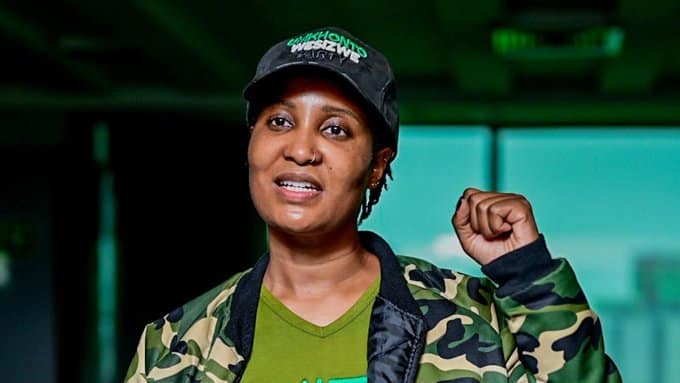
In a move that has ignited a fierce political and diplomatic firestorm, the Democratic Alliance (DA) has formally laid criminal charges against uMkhonto weSizwe (MK) Party Member of Parliament, Duduzile Zuma-Sambudla. The charges, filed at a Cape Town police station, allege that the daughter of former President Jacob Zuma used her social media platform to actively recruit and encourage South African citizens to fight for Russia in its ongoing war against Ukraine.
The Core of the Allegation: Incitement and Violation of Neutrality
The DA’s case hinges on a series of social media posts and public statements made by Zuma-Sambudla, which they argue constitute a clear violation of South African law. The party has cited specific legislation in their complaint, including:
- The Regulation of Foreign Military Assistance Act (1998): This act, commonly known as the “mercenary law,” prohibits any person within South Africa from recruiting, soliciting, or engaging in any activity aimed at supporting a party to an armed conflict. The DA alleges that Zuma-Sambudla’s public endorsements and sharing of recruitment channels for the Russian military fall squarely under this prohibition.
- The Constitution: The DA argues that by encouraging South Africans to participate in a foreign war where they could be killed, her actions potentially violate the constitutional right to life.
The opposition party presented a dossier of evidence to the police, which includes screenshots of tweets and Instagram posts where Zuma-Sambudla reportedly praised South Africans who had joined the Russian forces, shared links to a Russian embassy recruitment portal, and framed the participation as a “fight against Western imperialism.”
A Diplomatic Quagmire and a Test of State Policy
The charges place the South African government in an acutely difficult position. South Africa has officially maintained a stance of non-alignment and neutrality regarding the Russia-Ukraine conflict. However, this position has been frequently criticized in the West, particularly following the controversial “Lady R” incident and high-level engagements with the Kremlin.
The DA’s legal action directly challenges this official policy. By prosecuting a sitting MP for allegedly supporting one side of the conflict, the state would be forced to actively enforce its own laws on neutrality, potentially straining its relationship with Russia. Conversely, a failure to investigate the serious allegations would be seen as implicit endorsement of the pro-Russia stance and a politicization of the National Prosecuting Authority (NPA).
Political Repercussions and the MK Party’s Defense
For the nascent MK Party, the charges represent a significant crisis. Duduzile Zuma-Sambudla is not just any MP; she is a prominent and vocal figure, deeply connected to the party’s core identity and its leader, Jacob Zuma. The party has swiftly rallied to her defense, dismissing the charges as a “politically motivated witch-hunt” orchestrated by a “desperate DA” to undermine a popular black-led party.
“They are trying to criminalize a political opinion,” an MK Party spokesperson stated. “Our comrade has expressed solidarity with a global anti-imperialist struggle, which is her right. This is an attack on our sovereignty and our right to choose our international friends.”
The DA, however, remains resolute. “This is not about political opinion; it is about the illegal act of recruiting South Africans to die in a foreign war,” said DA leader John Steenhuisen. “No one, not even an MP, is above the law. We are demanding that the SAPS and the NPA do their duty without fear or favor.”
As the police open a docket and begin their investigation, the case has become a lightning rod for the nation’s deep political divisions and its contentious foreign policy stance, with the integrity of its legal system now thrust squarely into the international spotlight.
About The Author