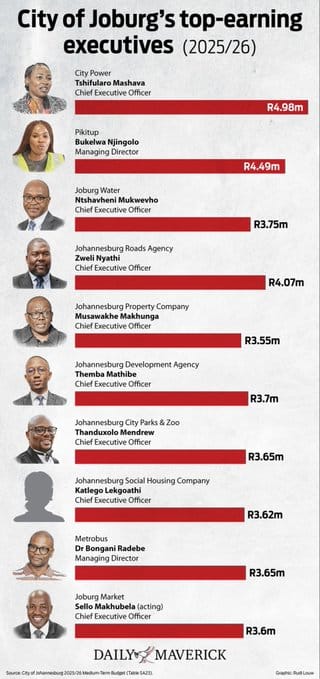
In a city where the constant hum of generators has become the soundtrack of daily life and the sight of residents queuing for water with plastic containers is a common tableau, the revelation of top municipal executives earning annual salaries reaching nearly R5 million has ignited a firestorm of public outrage and a fierce debate about value, equity, and leadership.
Johannesburg’s recently tabled 2025/26 budget has laid bare a stark contradiction. While the document outlines plans to tackle a litany of service delivery crises, it also details the remuneration of the city’s most senior administrators, with packages that place them firmly in South Africa’s top 1% of earners. The CEO of City Power, the entity grappling with relentless blackouts and cable theft, is slated to earn R4.838 million. The managing director of Johannesburg Water, under whose watch large swathes of the city endure days-long water outages, will receive R3.551 million. In total, several dozen top executives within the city’s corporatized entities fall within the R3 million to R5 million bracket.
The Public Outcry: “Reward for Failure”
For millions of Johannesburg’s 5.8 million residents, these figures are not just numbers on a page; they are a direct insult. The salaries have been branded as “obscene” and “a reward for failure” by civic organizations, opposition parties, and frustrated citizens.
“How can you justify earning R400,000 a month when the people you serve don’t have water coming out of their taps?” asked a community activist from Soweto, where water shortages have sparked repeated protests. “We are told there is no money for infrastructure maintenance, yet there is always money for these massive salaries. It feels like we are funding their luxury while our city crumbles.”
The criticism is sharpened by concurrent announcements of above-inflation tariff hikes for electricity, water, and rates, forcing residents to pay more for increasingly unreliable services. The narrative of a bloated, self-serving bureaucracy insulated from the consequences of its own performance has gained potent traction.
The Defense: The “Market Rate” for Talent
In defense of the pay scales, city officials and some industry analysts argue that running utilities as complex as City Power and Johannesburg Water requires a rare and specialized skill set. To attract and retain individuals capable of managing multi-billion rand budgets, vast infrastructure networks, and thousands of employees, the city must compete with the private sector.
“A top engineer or finance executive with the experience to run a entity like City Power can easily command a similar, if not higher, package in the private sector,” argued a governance consultant. “If you pay peanuts, you get monkeys. The city is in a crisis, and it needs the best possible minds to navigate it. Undercutting their market value would be a false economy, leading to even worse management.”
This perspective frames the high salaries not as a luxury, but as a necessary investment in the city’s recovery.
The Unspoken Element: Race and a Double Standard?
Beneath the surface of the debate, a more nuanced and contentious subplot has emerged. Some defenders of the salaries have pointed out that similarly high executive pay has existed in other major metros, including those run by opposition parties, without attracting the same level of sustained fury. They suggest that the current outcry carries undertones of racial bias, as many of Johannesburg’s top executives are black professionals occupying positions that were historically held by white incumbents.
A political commentator noted, “There is a discomfort in some quarters with seeing black professionals earn these levels of compensation in the public sphere. The question must be asked: is the criticism solely about service delivery, or is there an element of questioning the worth of these specific individuals?”
However, critics swiftly reject this framing, insisting that the issue is performance-based and colorblind. They argue that the focus should remain on the undeniable reality that the compensation is fundamentally disconnected from outcomes on the ground.
The Core Demand: Accountability for Delivery
Ultimately, the debate transcends the rand value of the paychecks. It has crystallized into a single, powerful public demand: demonstrate that you are worth it.
“Nobody would begrudge a high salary if our systems worked,” stated a talk radio host, capturing the prevailing sentiment. “If the lights stayed on, if the water was clean and reliable, and if the potholes were fixed, then a R5 million salary would be a point of pride—proof that we have a world-class leader. But when you earn a fortune amid a disaster, it’s not a salary; it’s a scandal.”
The controversy has placed the executives themselves in an unenviable spotlight. The luxury cars, the secure suburban homes, and the corporate lifestyles that their salaries afford now stand in jarring contrast to the lived experience of their constituents. For Johannesburg’s highly paid executives, the 2025/26 financial year will be a definitive test. They are no longer just managers of utilities; they are symbols of a broken compact, and their most pressing task is to rebuild not just infrastructure, but the rapidly eroding public trust that their compensation is, in any way, deserved.
About The Author