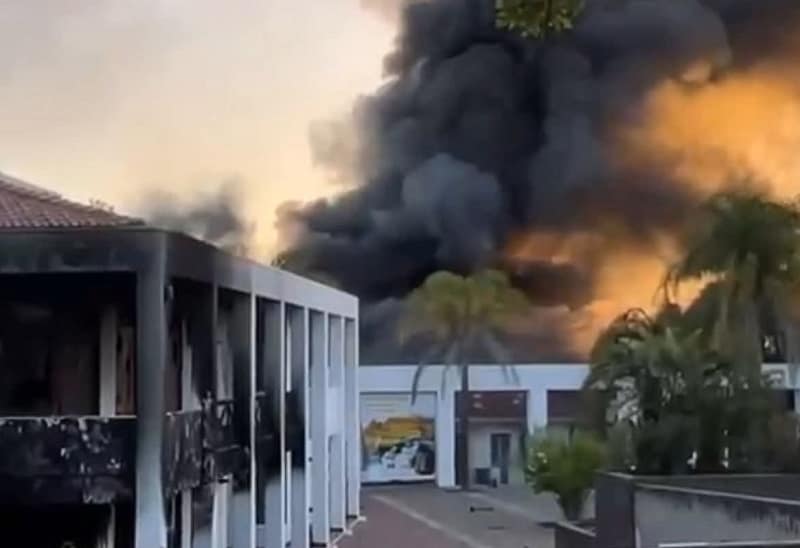
ALICE, EASTERN CAPE – The historic Fort Hare University campus has been plunged into chaos, with the situation remaining highly volatile after a day of violent protests that saw multiple key buildings set ablaze, security guards taken hostage, and police forced to intervene with rubber bullets.
The Alice campus now resembles a war zone, with the acrid smell of smoke hanging heavy in the air and the charred skeletons of administrative offices and student centres standing as a testament to the intensity of the unrest. Police and private security forces remain on high alert, patrolling the scorched grounds as university management has taken the drastic step of suspending all academic activities and ordering an immediate evacuation of student residences.
A Rapid Escalation into Arson and Hostage-Taking
The crisis escalated dramatically on Wednesday afternoon. According to police spokesperson Siphokazi Mawisa, at approximately 16:30, a group of protesting students intensified their actions, moving from demonstrations to outright arson.
“The students continued with the protest and set alight the Administration block, Student Centre, Auditorium and HIV Centre,” Mawisa confirmed. The torching of these buildings—the very heart of the university’s academic and student support infrastructure—signals a severe escalation in long-simmering tensions.
The arson followed an earlier, violent clash between students and a private security company deployed on campus. The confrontation reached a critical point when, during the protest, “several students held security guards hostage in a building,” Mawisa stated. Police units were required to storm the building to rescue the captive guards, an operation that further inflamed the situation.
In a bid to disperse the rioting crowds, police were forced to use rubber bullets. Despite the scale of the destruction and the violent nature of the clashes, authorities reported that no arrests have yet been made and, miraculously, no serious injuries or loss of life have been recorded.
University Management Declares Campus Unsafe, Orders Evacuation
In response to the unprecedented violence, the University of Fort Hare (UFH) management has declared the Alice campus unsafe for students and staff. In a statement, UFH Director for Marketing and Communication, JP Roodt, announced the immediate suspension of all campus activities and the evacuation of residences.
“The University Management expresses its deep disappointment and regret that the actions of a few have endangered the safety of the entire University community and disrupted the academic programme,” Roodt said.
This decision leaves hundreds of students in a state of uncertainty, forced to find alternative accommodation as the university grapples with the extensive damage to its facilities. The torching of the administration block is particularly devastating, likely destroying critical student records, financial documents, and institutional archives.
A History of Underlying Tensions
While the immediate trigger for Wednesday’s explosive violence remains unclear, Fort Hare University has a history of student protests rooted in longstanding grievances. These often include issues related to financial exclusion and historical debt, which prevent many students from registering or graduating; inadequate accommodation and living conditions in residences; and general dissatisfaction with administrative processes.
The deployment of a private security company, often seen by students as a heavy-handed measure, appears to have been the flashpoint that transformed peaceful protest into violent confrontation. The decision to take security personnel hostage suggests a deep-seated animosity and a breakdown in the relationship between the student body and the university’s security apparatus.
As fire-fighters work to fully extinguish the smoldering ruins and police maintain their tense vigil, the future of the academic year at the Alice campus hangs in the balance. The incident marks one of the most destructive episodes in the university’s recent history, raising urgent questions about the management of student discontent and the preservation of South Africa’s iconic institutions of higher learning.
About The Author