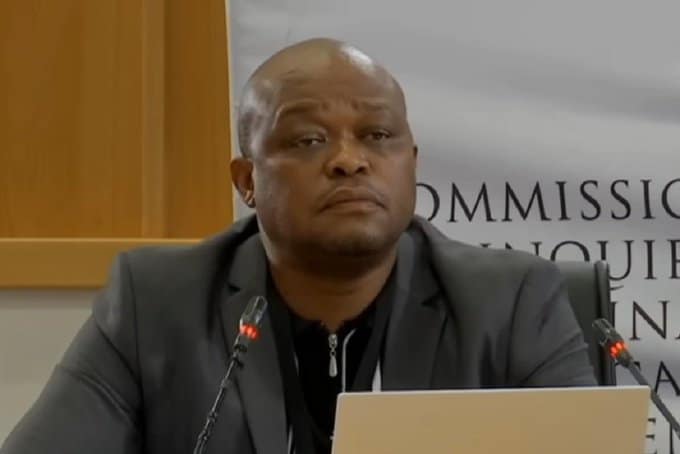
In a dramatic testimony that continues to peel back the layers on alleged criminal infiltration of South Africa’s justice system, North West businessman Oupa Brown Mogotsi has revealed to a parliamentary committee that he was acting on specific intelligence from alleged underworld figure Vusimuzi “Cat” Matlala before he embarked on a mission to infiltrate the Independent Police Investigative Directorate (IPID).
Mogotsi, appearing before Parliament’s Ad Hoc Committee probing corruption and political interference in the criminal justice system, dropped the latest bombshell on Tuesday, claiming that Matlala had pointed him toward a corrupt official within the police watchdog itself.
According to Mogotsi’s testimony, the information from Matlala was precise and damning. He alleged that Matlala told him about an employee within IPID who possessed the alarming ability to “hack” the justice system—not in a cyber sense, but by making criminal cases against favored individuals mysteriously disappear.
“The purpose of me there is to get the IPID guy,” Mogotsi told the committee, explaining his motivation for the infiltration operation. “I wanted to know who the man was… You see, the messages when he was attacked by the PKTT [Political Killings Task Team], he tried to open the case in Brooklyn, and so forth. This IPID guy was not around, and the case was open in Soweto”.
Painting a picture of a highly placed individual with the power to pervert the course of justice, Mogotsi continued: “He further told me that you see this IPID guy if there is a case with proper evidence, he can hack. And he can do this and these wonders to arrest where there is evidence. So I wanted this IPID guy”.
A Web of Allegations and a ‘Triple Identity’
Mogotsi’s latest revelation comes amid a broader and increasingly complex public portrayal of his own role. Before the same parliamentary committee, he has sought to clarify what he describes as his “triple identity”—operating simultaneously as a legitimate entrepreneur, a former police informant, and an active crime intelligence agent .
Dressed sharply and speaking with calm assurance, Mogotsi detailed his business interests, which include liquor outlets and a meat distribution company that caters to private events, stating pointedly, “None of them comes from government” . However, it is his clandestine life that has drawn the spotlight. He claims to have been involved in crime intelligence since 2009, working as a registered “contact agent” with a structured relationship with a professional handler .
His testimony has not gone unchallenged. Committee members, particularly Economic Freedom Fighters (EFF) leader Julius Malema, have pressed him on the practicalities of his role, questioning the lack of documentary evidence and the apparent contradictions in his various titles . Mogotsi has parried these questions by citing the inherent dangers of his work, arguing that operational secrecy is a matter of life and death. “If one operater come and I say I am this, there is no way you can survive,” he told the committee, dismissing the notion of a public database for undercover agents . He later added, “The honourable member and myself, we are in two different worlds,” when challenged on the specifics of police standing orders .
The Madlanga Commission’s Parallel Unraveling
The parliamentary inquiry is running parallel to the ongoing Madlanga Commission of Inquiry, where an even more intricate web of relationships is being exposed. It is there that the full extent of Matlala’s alleged influence—and Mogotsi’s interactions with him—has been laid bare through a trove of WhatsApp messages extracted from Matlala’s phone upon his arrest.
The chats, read into the record by crime intelligence head Lt-Gen Dumisani Khumalo, depict a relationship far more transactional than Mogotsi’s description of a simple intelligence-gathering mission. They reveal a series of requests from Mogotsi to Matlala for payments covering flights, event tables, and even “membership for regions,” ostensibly to secure political support. In return, Mogotsi appeared to be peddling his influence with high-ranking police officials, including former police minister Senzo Mchunu.
Most strikingly, the messages showed Mogotsi feeding Matlala what Lt-Gen Khumalo described as classified information. On January 1, 2025, Mogotsi messaged Matlala to inform him that the Political Killings Task Team, which had raided Matlala’s home, had been “Dissolved/Disbanded!” . The following day, he went further, forwarding a copy of the confidential ministerial letter ordering the disbandment—a document he should not have possessed.
This revelation prompted commission chair Justice Mbuyiseli Madlanga to ask directly: “So are you saying Mr Mogotsi was in possession of classified information?” to which Khumalo replied, “That is correct, commissioner”.
A Tangled Network at the Top
The unfolding testimony paints a picture of deep and troubling connections. Alleged criminal kingpin Matlala, who is currently in jail awaiting trial for attempted murder, had secured over R300 million in police tenders and was seemingly embedded in the upper echelons of the SAPS.
The Madlanga Commission has heard how suspended Deputy National Police Commissioner Shadrack Sibiya invited Matlala to his son’s engagement party—a gathering attended by at least three other police generals. While Sibiya has denied a close relationship, evidence of WhatsApp messages, including one where he asks his sergeant to tell “Cat” to “make a turn” to fetch his wife from the party, suggests a level of familiarity that commissioners found difficult to accept as purely coincidental.
Furthermore, the commission has heard evidence that KwaZulu-Natal Hawks head Major-General Lesetja Senona allegedly shared a sensitive affidavit and other personal information with Matlala, claims Senona has disputed .
What Lies Beneath?
As Mogotsi continues his testimony, insisting he is a patriot doing dangerous work, and as the commissions of inquiry peel back the layers, a stark picture is emerging. It is a portrait of a justice system where the lines between law enforcement and the underworld have become perilously blurred, where classified information flows freely, and where the hunt for a corrupt official within IPID is just one thread in a much larger, more troubling tapestry.
The question of who the mysterious “IPID guy” is, and how high the rot may go, remains unanswered. For now, the inquiries continue, sifting through the messages, the testimonies, and the denials, in search of the truth.
About The Author