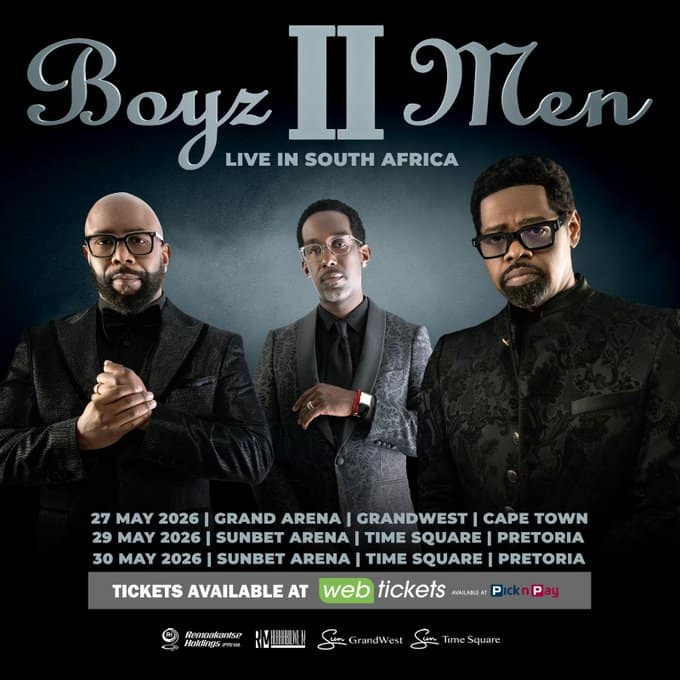
The news traveled first through WhatsApp groups, those digital villages where middle-aged professionals reconnect with the soundtrack of their youth. It spread through workplace email chains with subject lines like “GUYS GUYS GUYS” and family chat threads where uncles who never expressed enthusiasm for anything suddenly posted crying-laughing emojis. By the time the official announcement landed in media inboxes, the announcement had already achieved liftoff: Boyz II Men, the most successful vocal group in popular music history, would return to South Africa in May 2026 for three exclusive performances.
The dates were etched into calendars with the solemnity of religious observance. May 27: GrandWest’s Grand Arena, Cape Town. May 29 and 30: SunBet Arena, Pretoria. Three nights, three opportunities for a generation to reconnect with the songs that had scored their first dances, their long drives, their heartbreaks, and their reconciliations.
“I literally screamed,” admitted Thandi Mokoena, a 43-year-old marketing executive from Midrand, her voice still carrying the incredulity of someone who had waited twenty-seven years for news that arrived at 10:47 on a Tuesday morning. “My children thought something terrible had happened. I showed them the announcement and said, ‘This is the opposite of terrible. This is the most wonderful thing that could possibly happen.’ They did not understand. How could they understand?”
The Architects of Harmony
To understand the intensity of the response, one must understand what Boyz II Men represented at the moment of their ascent. Formed at the Philadelphia High School for the Creative and Performing Arts in 1988, Nathan Morris, Wanya Morris, Shawn Stockman, and Michael McCary assembled a vocal alchemy that had not been heard since the heyday of Motown’s great ensembles. They did not rely on choreography or spectacle. They stood, often in simple formation, and sang. Their instruments were their voices, their arrangements were their architecture, and their harmonies were cathedral-like in their complexity and resonance.
“End of the Road,” released in 1992, spent thirteen weeks at number one on the Billboard Hot 100, breaking the record previously held by Elvis Presley’s “Don’t Be Cruel/Hound Dog.” “I’ll Make Love to You” matched the feat in 1994. “One Sweet Day,” their collaboration with Mariah Carey, remained at number one for sixteen weeks—a record that would stand for nearly twenty-five years.
These were not merely commercial achievements. They were cultural monuments. The songs became the lingua franca of romance for an entire global generation. They were played at weddings and funerals, at school dances and anniversary celebrations. They provided the vocabulary for emotions that otherwise defied articulation.
“They taught us how to feel,” said Sipho Dlamini, a 47-year-old educator from Soweto. “That sounds dramatic, but it is true. We grew up in a culture that did not encourage men to express vulnerability. And here were these four young Black men, standing on stages around the world, singing about love and loss and longing with absolute emotional honesty. They gave us permission.”
The South African Love Affair
The relationship between Boyz II Men and South African audiences has always possessed a particular intensity. The group first toured the country in 1995, arriving in a nation still drunk on the miracle of its recent transition to democracy. Nelson Mandela had been president for less than a year. The Rugby World Cup victory was three months in the future. The Truth and Reconciliation Commission had not yet begun its work. South Africa was, in every sense, a country learning to hope.
Boyz II Men performed at the Standard Bank Arena in Johannesburg, at the Good Hope Centre in Cape Town, at venues that no longer exist or have been repurposed for conferences and exhibitions. They sang “Water Runs Dry” and “On Bended Knee” to audiences that sang every word back to them, the harmonies of the crowd merging with the harmonies on stage.
“We did not understand, at the time, what it meant that they came here,” recalled veteran music journalist Bongani Madondo. “International acts bypassed South Africa during the boycott years, and even after the boycott was lifted, many remained cautious. Boyz II Men came anyway. They came at the moment when we most needed confirmation that we had rejoined the world.”
The group returned in 1998 and again in 2002. Each visit deepened the connection. Michael McCary, whose bass vocals provided the foundation for the group’s signature sound, departed in 2003 due to health challenges related to multiple sclerosis. The group continued as a trio, their harmonies adapting to the new configuration, their repertoire expanding to incorporate material from subsequent albums.
But for South African fans of a certain generation, the memory of the four-man formation remains indelible. It is the memory of youth, of possibility, of a moment when the future seemed to open like a flower.
The 2026 Announcement
The promoter, Remoakantse Holdings, understood the weight of the announcement. Their press release did not merely list dates and venues. It invoked legacy. It spoke of “timeless artistry” and “generational resonance.” It positioned the May 2026 performances not as a concert tour but as a homecoming.
“This is not merely a commercial venture,” said Tumi Remoakantse, the company’s founder and chief executive. “This is a cultural event. These are the voices that defined romance for millions of South Africans. To bring them back, to give our audiences the opportunity to hear these songs performed live by the artists who created them—this is a privilege and a responsibility.”
The ticketing strategy reflected the anticipated demand. Webtickets, the primary digital platform, would open its queues on a date to be announced. Pick n Pay stores across the country would serve as physical ticketing outlets, their customer service desks transformed into pilgrimage stations for fans who preferred tangible proof of attendance.
“We are preparing for extraordinary demand,” Remoakantse acknowledged. “Three shows, approximately 20,000 seats total. The universe of South African Boyz II Men fans is substantially larger than 20,000. Some people will not get tickets. That is regrettable, but it is also a measure of the depth of feeling this group inspires.”
About The Author