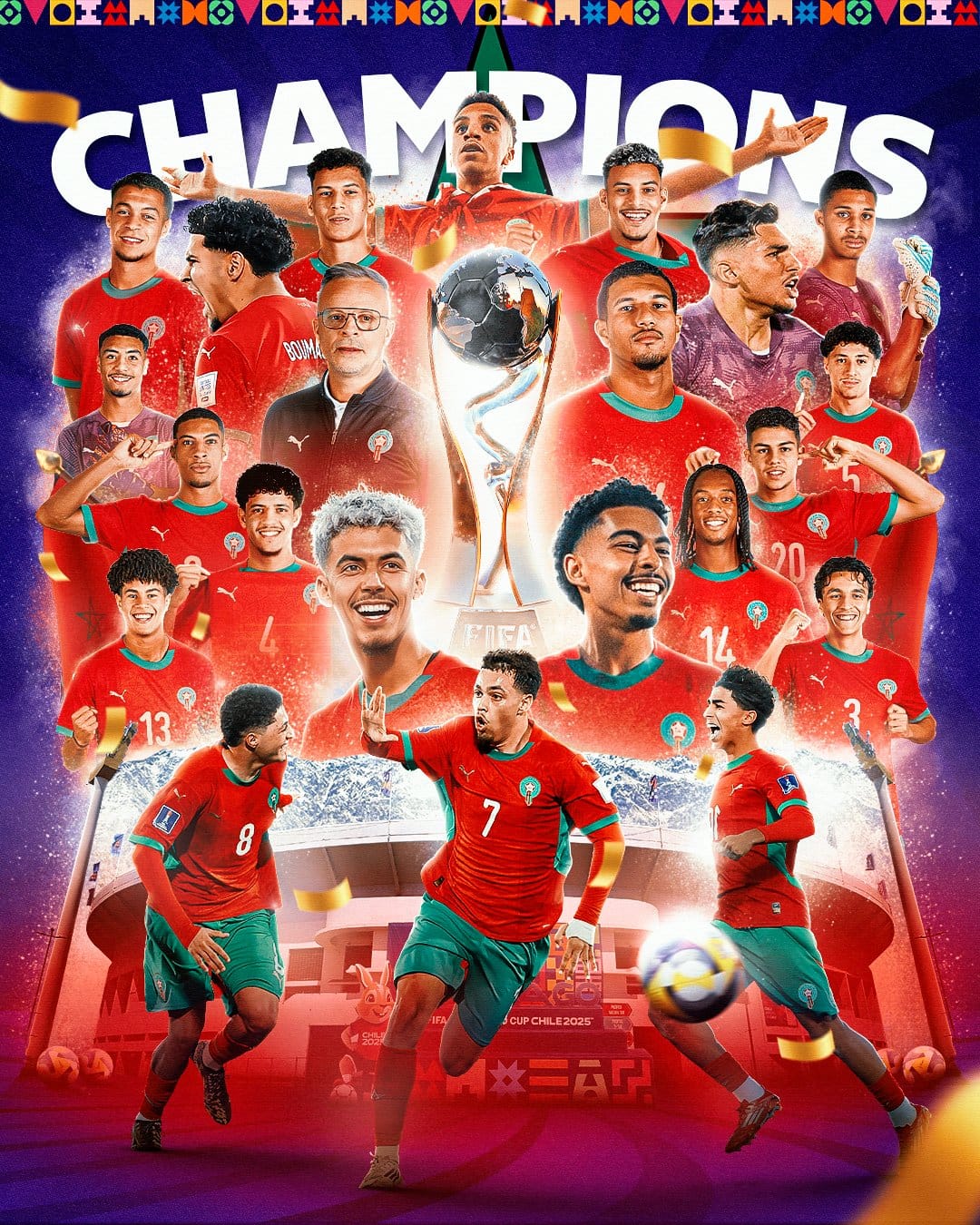
SANTIAGO, Chile – On a cool Sunday evening under the bright lights of the Estadio Nacional, a new chapter was written in the annals of world football, not by a traditional powerhouse, but by a nation whose investment in its future is now yielding golden returns. Morocco’s Under-20 team, with a performance of breathtaking discipline and lethal efficiency, dethroned pre-tournament favorites Argentina 2-0 to claim their first-ever FIFA U-20 World Cup title.
In a stunning display that echoed their senior team’s heroic run in Qatar just a few years prior, the young Atlas Lions did not merely defeat Argentina; they outclassed them, silencing a pro-Albiceleste crowd and announcing the arrival of a formidable new generation on the global stage. This victory marks only the second time an African nation has won the tournament, following Ghana’s triumph in 2009, and signals a seismic shift in the footballing landscape.
From the first whistle, it was clear this would not be a story of Moroccan resistance, but of Moroccan ambition. While Argentina, buoyed by their rich history in this competition, saw more of the ball in the opening exchanges, it was Morocco who carried the sharper edge. Their pressing was organized, their transitions were swift, and their belief was palpable.
The breakthrough came not from a moment of individual brilliance, but from a perfectly executed team move. In the 23rd minute, a swift counter-attack sliced through the Argentine midfield. The ball found its way to the tournament’s eventual standout, Othmane Maamma, whose vision and weighted pass released Yassir Zabiri into the box. With the composure of a veteran, Zabiri slotted the ball coolly past the onrushing goalkeeper, sending a wave of stunned silence through the Chilean capital.
The goal did not deter Argentina, but it emboldened Morocco. Just as the Albiceleste began to push for an equalizer, the Lions struck again with a devastating sucker-punch five minutes before halftime. Once more, it was the dynamic duo of Maamma and Zabiri that carved open the defense. Maamma, dropping deep to receive the ball, turned and delivered a defense-splitting pass that found Zabiri’s intelligent run. With impeccable timing, the striker stayed onside and finished with ruthless precision, doubling the lead and sending Morocco into the break with one hand firmly on the trophy.
The second half was a masterclass in game management. Argentina, desperate and throwing bodies forward, found a Moroccan wall in front of them. Led by a colossal defensive unit and a commanding goalkeeper, Morocco repelled everything La Albiceleste could muster. Every cross was claimed, every through-ball intercepted, and every shot was met with a desperate, last-ditch block. The discipline was immaculate, the focus unbreakable.
When the final whistle blew, the scenes were ones of pure, unadulterated joy. The Moroccan players, draped in their national flag, collapsed to the turf in tears and disbelief before erupting in celebration. The victory was more than just a single match; it was the culmination of a carefully crafted footballing project.
The individual accolades followed the team glory. The architect of the victory, Othmane Maamma, whose two assists in the final capped a tournament of consistent dominance, was rightfully awarded the Golden Ball as the best player of the competition. His partnership with the two-goal hero Yassir Zabiri proved to be the most potent weapon in Chile.
This historic win is not an isolated phenomenon. It is the glittering peak of a pyramid built on a foundation of profound youth development. In recent years, Morocco has emerged as a continental force at every age level: winners of the U-23 Africa Cup of Nations, qualifiers for the Olympic Games, and champions of the U-17 AFCON. This U-20 World Cup triumph is the ultimate validation of the vision implemented by the Royal Moroccan Football Federation, a commitment to technical academies, a unified playing philosophy, and a belief in homegrown talent.
On the pitch in Santiago, a new dynasty announced its arrival. The message from Morocco’s golden generation is clear: the future of football is here, and it is painted in red and green. The world has been put on notice; the Atlas Lions are not just passing through, they are here to stay.
About The Author