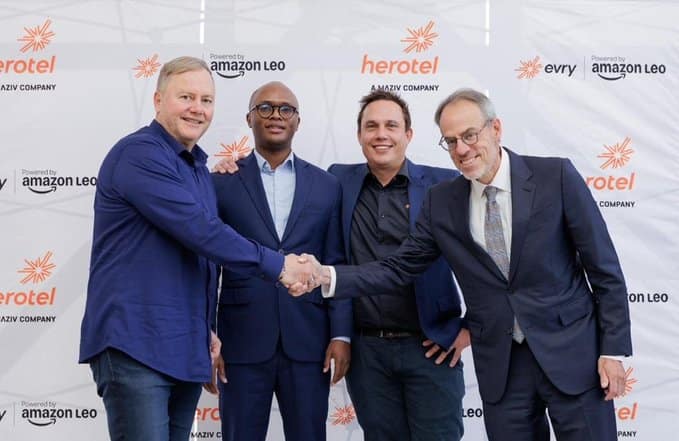
Amazon has confirmed it will launch its low-Earth-orbit satellite internet service, known as Project Kuiper—rebranded for the African market as Amazon Leo—in South Africa later this year, setting the stage for a high-stakes battle with Elon Musk’s Starlink and raising expectations of a connectivity revolution for the country’s rural and underserved communities.
The announcement, made during a virtual briefing with African telecommunications stakeholders on Thursday, positions Amazon as a direct competitor to Starlink, which has been aggressively expanding its footprint across the continent since its South African launch in late 2024. Amazon Leo, which will utilize a constellation of over 3,000 satellites currently being deployed in low-Earth orbit, promises to deliver high-speed, low-latency broadband to areas where traditional fibre and mobile networks have proven economically unviable.
According to Amazon executives, the service will initially target enterprise customers, schools, health clinics, and agricultural operations in remote areas, with a consumer offering expected to follow once the constellation achieves sufficient global coverage. Pricing details have not yet been finalized, but Amazon has indicated that it will adopt a competitive model aimed at making satellite broadband accessible to a broad segment of the population. “We are committed to closing the digital divide in South Africa,” said a senior Amazon official. “No community should be left behind because of geography. Amazon Leo will bring the same high-quality connectivity to the Karoo and the Eastern Cape that is available in Sandton.”
The entry of Amazon into South Africa’s satellite internet market is widely viewed as a positive development for consumers, who have long complained about the dominance of a few telecommunications giants and the slow pace of infrastructure rollout in rural areas. Starlink, which has gained a loyal following among off-grid households and businesses, currently offers speeds of up to 250 Mbps but has faced criticism over its relatively high hardware and subscription costs, placing it out of reach for many lower-income households. Analysts expect Amazon Leo to drive prices down through competition while also pushing both companies to improve service reliability and customer support.
The timing is significant, as South Africa’s communications regulator, ICASA, has been under pressure to streamline licensing processes for satellite services and to ensure that spectrum is allocated fairly between terrestrial and space-based operators. Amazon has confirmed that it is in the final stages of securing the necessary regulatory approvals, with a launch targeted for the fourth quarter of 2026. The company has also indicated that it will partner with local internet service providers to distribute and support the service, creating potential opportunities for small businesses to resell connectivity in their communities.
However, challenges remain. Both Starlink and Amazon Leo rely on user terminals—satellite dishes that must be installed at customer premises—and the cost of these devices remains a significant barrier in low-income markets. Amazon has hinted at the possibility of leasing models or subsidized terminals for public institutions, but details have been sparse. Additionally, the effectiveness of satellite internet in South Africa’s often harsh weather conditions—particularly in regions prone to heavy thunderstorms—has yet to be fully tested.
The competition between Amazon and Starlink is also part of a broader geopolitical and commercial rivalry between Jeff Bezos and Elon Musk, two of the world’s wealthiest individuals, both vying for dominance in the rapidly expanding space-based internet sector. Their contest is playing out not only in South Africa but across the globe, with each company racing to build the most extensive and reliable satellite network. In Africa alone, the potential market is enormous, with hundreds of millions of people currently without reliable internet access.
As Amazon Leo prepares for its South African debut, the message to consumers is clear: the era of limited choices and high prices for internet connectivity is coming to an end. Whether the new competition will deliver on its promise of affordable, accessible, and reliable broadband for all remains to be seen, but for millions of South Africans languishing on the wrong side of the digital divide, the arrival of another global player offers a glimmer of hope that the future may finally be within reach.
About The Author