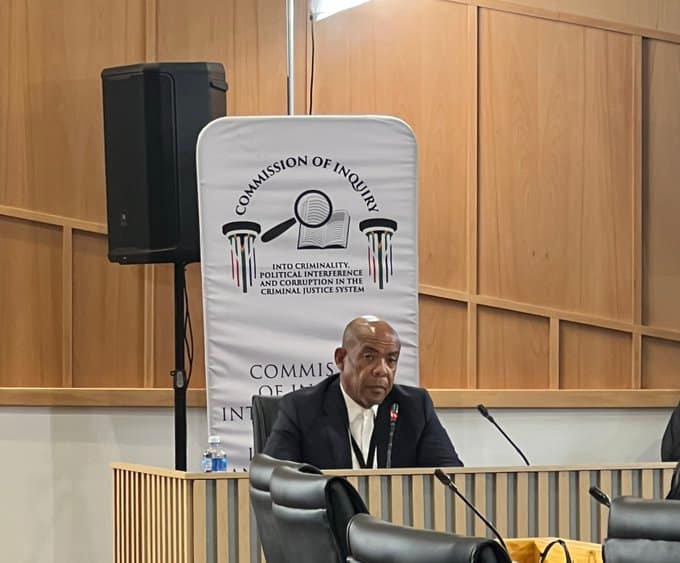
In a session marked more by its silence than its revelations, Hawks Captain Dail Christian Nortjie offered a brief and tightly controlled testimony before the Madlanga Commission of Inquiry, leaving the high-profile probe into police conduct with more questions than answers.
Captain Nortjie, a key figure in the controversial arrest of Katiso Molefe on December 6, 2025, took the stand amidst significant anticipation. The arrest, which has been shrouded in allegations of procedural irregularities and potential rights violations, is a central focus of the commission, established to investigate the conduct of the Hawks’ specialized units.
However, the Captain’s time before the commission was strikingly succinct. His testimony, described by observers as “perfunctory” and “deliberately circumspect,” lasted only a fraction of the allocated time. He provided a basic, chronological account of his role in the events of December 6, sticking strictly to operational formalities and avoiding any narrative that could be construed as subjective or expansive.
A Wall of Silence and a Lack of Pursuit
The most telling moment of the proceedings came not from what Captain Nortjie said, but from what happened after he finished his initial statement. The evidence leaders and commission members, surprisingly, had no further questions for the witness. The lack of cross-examination, a standard tool for probing inconsistencies and uncovering deeper truths, was conspicuous.
This failure to press for details has raised eyebrows among legal analysts watching the inquiry. It suggests one of two scenarios: either the commission’s legal team possesses all the information it needs from other sources and deemed his testimony a mere formality, or they are strategically choosing their battles, perhaps to avoid alerting the Captain to the specific lines of their investigation.
“The lack of questioning is deafening,” noted a legal commentator present at the hearing. “It either means his testimony was so anodyne it was irrelevant, or that the commission is playing a much longer game and did not want to show their hand. Inquiries like this thrive on the tension of cross-examination; its absence here is a significant narrative in itself.”
The Anonymous Witness: A Shift to the Shadows
Following Captain Nortjie’s departure, the commission announced a dramatic shift in strategy for its next phase. The subsequent witness will testify under a cloak of anonymity, identified only as a “field officer” currently engaged in an “on-investigation.”
This move underscores the highly sensitive and potentially dangerous nature of the commission’s work. Shielding the identity of an active operative is a rare step, typically reserved for cases involving deep-seated corruption, organized crime, or threats of intimidation. It signals that the commission is now delving into the operational heart of the Hawks, where whistleblowers may fear reprisal.
The promise of an “on-investigation” suggests this field officer may provide evidence not just about the Molefe arrest, but about ongoing, live operations, potentially revealing systemic issues within the unit.
A Tale of Two Testimonies
The contrast between the two witnesses could not be starker. First, a high-ranking captain, visible and named, who offered a minimalist account and faced no challenge. Next, an anonymous shadow operative, whose testimony is considered so potentially explosive that it requires state protection.
This juxtaposition highlights the central challenge facing the Madlanga Commission: penetrating the wall of silence that often surrounds elite police units. Captain Nortjie’s brief and unquestioned appearance represents the official, polished version of events. The upcoming anonymous testimony promises to reveal the grittier, more complex reality from the ground.
As the commission prepares to hear from its secret witness, the pressure mounts. The public and the political establishment are waiting to see if this inquiry can cut through the procedural fog and uncover the truth behind the arrest of Katiso Molefe and the broader conduct of the Hawks.
About The Author