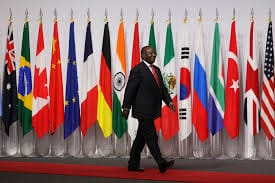
In a defining moment for South Africa’s diplomatic standing, President Cyril Ramaphosa has firmly committed to hosting the nation’s inaugural G20 summit on November 22-23, even as a notable bloc of Western Hemisphere powers confirms their absence. The boycott, led by the United States and joined by Argentina and Mexico, casts a shadow over the gathering but also sharpens the geopolitical lines of a forum intended to foster global cooperation.
The most significant snub comes from Washington, where the White House confirmed that President Donald Trump will not attend. Officials cited long-debunked grievances regarding South Africa’s land reform policies, a justification that analysts view as a thin veneer for deeper strategic rifts. “The land issue is a convenient, albeit factually challenged, pretext,” remarked Dr. Aneshree Naidoo, a senior political analyst at the Global Insight Group. “The core issue is a growing divergence in global vision. The current U.S. administration is disengaging from multilateral forums it perceives as challenging its unilateral interests, and South Africa’s independent foreign policy, including its ties with Russia and China, is a direct irritant.”
The absence is compounded by Argentina and Mexico. Newly elected Argentine President Javier Milei, a libertarian who has openly clashed with left-leaning governments, will send a lower-level representative. Similarly, Mexican President Claudia Sheinbaum, grappling with a domestic economic crisis, has also delegated her attendance, signaling prioritization of home affairs over a summit perceived as peripheral to immediate national concerns.
Pretoria’s Diplomatic Gambit: Pivoting East and Forging a New Consensus
Undeterred, the South African government is mounting a confident diplomatic counter-offensive. Officials in Pretoria are downplaying the boycotts, framing the summit not as a gathering of the entire G20, but as a pivotal moment for a “coalition of the committed.”
“We are witnessing a natural re-alignment in global politics,” stated a senior official from the Department of International Relations and Cooperation, who spoke on condition of anonymity. “The full and enthusiastic participation from other major economies will ensure the summit’s success. Our focus remains on the substantive agenda of global solidarity, equality, and a just sustainability transition.”
This strategy hinges on robust participation from other key players. Confirmations from economic heavyweights like China, Brazil, and the European Union are being touted as evidence of the summit’s enduring significance. South Africa aims to leverage this platform to amplify the voice of the Global South, pushing for reforms in international financial institutions and championing a climate finance framework that does not penalize developing economies.
A High-Stakes Test for South African Diplomacy
The Johannesburg summit has thus become a high-stakes test for Ramaphosa’s government. On one hand, it is an unparalleled opportunity to showcase South Africa as a competent and influential leader on the world stage, capable of steering complex global conversations. A successful event, defined by substantive outcomes and strong attendance from the majority of invitees, would be a significant diplomatic coup.
Conversely, the high-profile boycotts risk painting a picture of a fractured gathering and could be exploited by domestic opponents to question the efficacy and cost of Ramaphosa’s foreign policy. The government is now under pressure to ensure that the deliverables from the summit—whether in the form of joint declarations, new trade partnerships, or climate commitments—are tangible enough to overshadow the narrative of division.
As world leaders begin to confirm their travel to Johannesburg, the stage is set for a summit that may ultimately be remembered less for who was in the room, and more for the new global alliances it solidifies and the clear geopolitical fissures it exposes.
About The Author