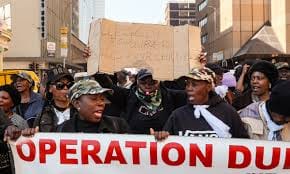
In a landmark judgment that delivers a stern defense of the South African Constitution, the Gauteng High Court in Johannesburg has unequivocally declared the tactics of the controversial movement Operation Dudula to be unlawful, unconstitutional, and rooted in xenophobia. The ruling, handed down on Tuesday, represents the most significant legal setback to date for the group, whose campaign to forcibly exclude foreign nationals from public life has heightened social tensions and sparked international concern.
The court issued a final interdict (injunction) prohibiting Operation Dudula, its leaders, members, and supporters from any form of interference with the access of foreign nationals to essential public services, including healthcare and education.
The Legal Challenge and the Court’s Reasoning
The case was brought by the Helen Suzman Foundation (HSF), which argued that Operation Dudula’s activities constituted a dangerous form of vigilante action that undermined the rule of law and violated the fundamental rights of both documented and undocumented migrants. The HSF presented evidence of members blockading hospital entrances, intimidating patients and staff, and conducting “inspections” at schools to identify and target children believed to be foreign.
In his ruling, the judge condemned these actions not merely as illegal, but as antithetical to the foundational values of post-apartheid South Africa. The court affirmed that the Bill of Rights applies to “everyone” within the Republic, a term deliberately chosen by the constitution’s framers to be inclusive and not limited to citizens.
“The Constitution does not permit a ‘locals-first’ approach when it comes to basic human rights and essential services,” the judgment stated. “To deny a child education or a sick person medical treatment based on their nationality is not only unlawful, it is a direct assault on their human dignity. Such actions, which seek to assign second-class status to a group of people based on their origin, are correctly characterized as xenophobic.”
A Blow to Operation Dudula’s Ideology and Methods
The interdict is comprehensive and specific, explicitly prohibiting Operation Dudula and its prominent leader, Nhlanhla ‘Lux’ Mohlauli, from:
- Intimidating, harassing, or assaulting any person seeking to access public services.
- Blocking entry or exit to hospitals, clinics, and schools.
- Demanding documentation from individuals at these facilities.
- Inciting violence or hatred against foreign nationals.
Founded in 2022, Operation Dudula (meaning “to push back” or “force out” in isiZulu) has gained traction by channeling widespread frustration over poverty, unemployment, and government service delivery failures into a narrative that blames undocumented migrants. The group’s protests and “operations” have often been marked by confrontational rhetoric and have been linked to a spike in anti-foreigner sentiment and violence.
Broader Implications in a Tense Climate
The ruling arrives amid South Africa’s ongoing and deeply complex immigration tensions. While the court’s decision is a clear victory for constitutionalism, it also highlights the state’s perceived failure to humanely and effectively manage migration and address the legitimate grievances of its citizens.
For the government, the judgment is both a vindication and a challenge. It reinforces the state’s monopoly on law enforcement and border control, but it also places pressure on authorities to more visibly tackle the issues of corruption, undocumented immigration, and service delivery that groups like Operation Dudula exploit.
For civil society and international observers, the ruling is a powerful reaffirmation of South Africa’s democratic institutions. It sends an unambiguous message that vigilante justice and xenophobic scapegoating will not be tolerated by the courts, even when they resonate with a segment of the populace.
While the interdict may curb the most public-facing tactics of Operation Dudula, it is unlikely to extinguish the underlying discontent. The judgment sets a critical legal precedent, but the larger battle for social cohesion and a functional immigration policy in South Africa remains fiercely contested.
About The Author