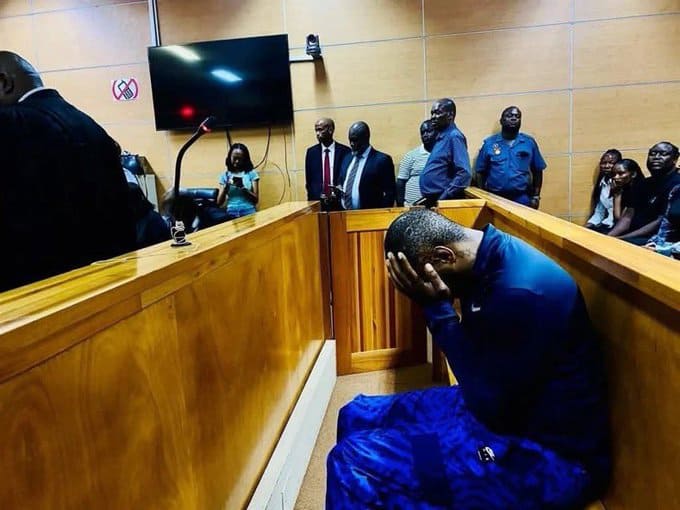
Three months ago, Sean “Diddy” Combs experienced what felt like a deliverance. Falling to his knees in a Manhattan courtroom, he turned to his family after a jury acquitted him of sex trafficking and racketeering—charges that carried a life sentence—and uttered the hopeful words, “I’m coming home.” That moment of triumphant relief made the scene on Friday all the more stark, as a subdued and motionless Combs sat in the same courtroom, his fate now sealed not by acquittal, but by a judge’s gavel.
There were no dramatic falls, no outbursts. As Judge Arun Subramanian finished imposing a sentence of 50 months in federal prison, the hip-hop mogul, once a symbol of unparalleled success and extravagance, simply turned in his chair. His eyes found his family, a large entourage of over thirty supporters who had packed the courtroom. In a quiet, poignant moment that contrasted sharply with the eight-week trial’s graphic and chaotic testimony, he appeared to mouth four words to them: “I love you, I’m sorry.”
This silent apology marked the somber finale of a legal saga that has irrevocably shattered the public persona of one of music’s most formidable figures. The trial had exposed a dark underbelly to his empire, featuring graphic videos of his orchestrated “freak-offs” and the already-public footage of him assaulting his ex-girlfriend, Cassie Ventura, in a hotel hallway. Though the jury convicted him only on the lesser charge of transportation to engage in prostitution, the judge made it clear that the totality of his actions informed the sentence.
A Day of Pleas and Confrontation
The all-day hearing was a rollercoaster of emotional appeals. Combs’s legal team presented a portrait of a reformed man, showcasing video compilations of him as a devoted father and mourning the loss of Kim Porter. His children, six of the seven taking the podium, huddled together and wept as they begged the judge for leniency, stating they needed their father.
Combs himself addressed the court for the first time, reading a prepared statement with glasses. After a heavy sigh, he pleaded for “mercy,” stating, “I have nobody to blame but myself.” His composure broke only when he turned to his mother, his voice cracking as he told her, “I failed you as a son.”
Yet, the day was also marked by confrontation. The court did not hear directly from victims after the defense sent a letter discrediting a planned speaker, a move the judge called “inappropriate.” Instead, Judge Subramanian gave the victims a voice by reading their prior testimony into the record, telling Combs, “These were serious offences that irreparably harmed two women.”
The Judge’s Final Word: Accountability and a Glimmer of Hope
In his 20-minute speech, Judge Subramanian was unmoved by the spectacle of fame, telling a downcast Combs that he had used his power to “subjugate” his victims. He noted the brazenness of the crimes, which continued even after a federal investigation was underway and the assault video had leaked. “A history of good works can’t wash away your record,” he declared.
But as Combs tilted his head back in dismay, the judge offered a final, humane assurance. “Mr. Combs, you and your family, you are going to get through this,” he said. With that, the proceeding was over. After a quick, acknowledging nod to his family, Sean Combs turned and slipped quietly through the door, not to go home, but to be transported back to a federal jail in Brooklyn, his empire now dwarfed by the confines of a prison cell.
About The Author