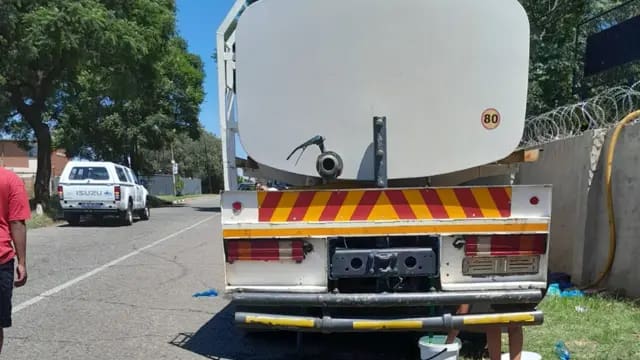
In a powerful challenge to the City of Tshwane’s service delivery model, the civic movement Soil of Africa has issued an urgent call for the metro to abandon its “unsustainable” reliance on water tankers and redirect hundreds of millions of rands towards building permanent water and sanitation infrastructure for its most marginalized communities.
The organization is demanding full transparency and accountability, arguing that the municipality is pouring vast sums into a temporary stopgap while thousands of residents in disadvantaged areas continue to live without the basic dignity of fixed taps and proper sanitation systems.
According to Soil of Africa, the metro’s dependence on tankers has reached a critical and financially draining point. The organization cites a staggering annual expenditure of R450 million on tanker services meant to compensate for failing and absent infrastructure. This figure is bolstered by municipal records from the last half of 2024, which show the city spent approximately R300 million on water tanker operations between just July and December.
The movement’s chairperson, Bongani Ramonjta, pointed to a recent budgetary decision as evidence of misplaced priorities. “The opposition has criticised a recent adjustment budget in which Tshwane increased its water tanker allocation by over R240 million, while water infrastructure capital works remain backburdened,” he stated.
This critique highlights a fundamental tension in the city’s approach: continually funding a costly emergency response instead of investing in a long-term cure. Soil of Africa is now demanding a radical shift in strategy. The core of their demand is that these millions be systematically redirected from tanker contracts to the actual installation of taps, pipelines, and sanitation systems in historically neglected townships and informal settlements.
Furthermore, the movement is insisting that the municipality “adopt a clear plan and timeline to phase out reliance on water tankers as a primary supply method.” This positions the issue not just as a matter of finance, but as a question of political will and a commitment to ending the apartheid-era spatial inequalities that still deny countless citizens a reliable and dignified water supply. The call reframes the debate from one of temporary crisis management to a fundamental right to permanent, equitable infrastructure.
About The Author