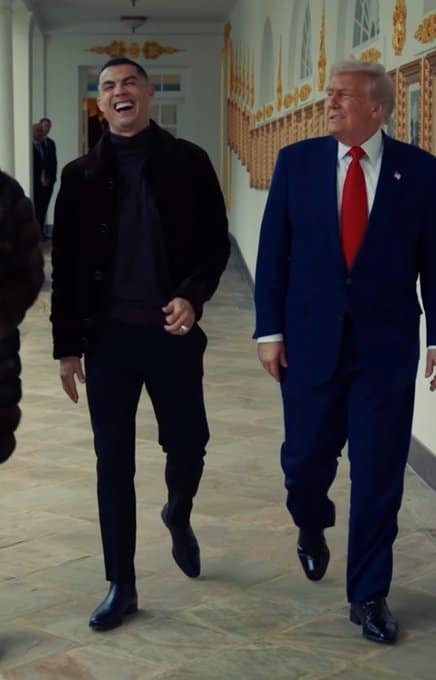
In a striking convergence of global celebrity, political power, and ambitious statecraft, Portuguese football icon Cristiano Ronaldo arrived at the White House on Tuesday for an unexpected meeting with former President Donald Trump. The high-profile encounter was strategically timed to coincide with Trump’s official discussions with Saudi Crown Prince Mohammed bin Salman, weaving a powerful narrative of “sports diplomacy” that underscores the deepening ties between American politics and Saudi Arabia’s monumental investment in global athletics.
The meeting, described by White House officials as a “casual sidebar” on international relations and sports investments, was anything but ordinary. Ronaldo, the captain of Saudi Pro League’s Al-Nassr, flew directly from Riyadh to Washington, symbolically bridging the two capitals at a pivotal moment.
The Interview That Paved the Way
The gathering was facilitated by recent public mutual admiration. In a widely circulated interview, Ronaldo had offered effusive praise for Trump, describing him as “an amazing president” and “a great person.” This public endorsement opened a direct channel, with Trump’s team reportedly extending the invitation to leverage the footballer’s global stardom and his central role in Saudi Arabia’s sporting vision.
A source close to the planning stated, “It was a perfect storm of aligned interests. The Crown Prince is here, Ronaldo is the face of his nation’s football project, and the President values the star power and the message it sends.”
The 2026 World Cup Shadow
While officially informal, the talks were heavily shadowed by the looming 2026 FIFA World Cup, to be hosted across the United States, Canada, and Mexico. For the Trump administration, aligning with Saudi Arabia—a nation aggressively pursuing a future World Cup bid of its own—and one of the sport’s most recognizable athletes, is a strategic move to cement influence within global football’s governing bodies.
“For President Trump, this is about soft power,” commented a political analyst. “Having Ronaldo at the White House, alongside MBS, projects an image of a revitalized U.S.-Saudi partnership that extends beyond oil and into the realm of global culture and sport. It’s a powerful visual ahead of 2026.”
Saudi Arabia’s “Sportswashing” Strategy Takes Center Stage
For Crown Prince Mohammed bin Salman, Ronaldo’s presence was a crowning validation of his “Vision 2030” initiative, which aims to diversify the Saudi economy and elevate its global profile through massive investments in sports, including LIV Golf, Formula One, and now, world football. By positioning Ronaldo—a figure with over half a billion Instagram followers—as a de facto cultural ambassador at a meeting with the U.S. President, the Kingdom achieves a level of legitimacy and media attention that money alone cannot buy.
Critics, however, were swift to label the event as a blatant act of “sportswashing,” intended to divert attention from the Kingdom’s human rights record. “This meeting is a carefully staged spectacle designed to launder reputations through the universal appeal of sport,” said a spokesperson for a human rights watchdog.
As the three men—the politician, the prince, and the player—posed for photographs in the Oval Office, they created an indelible image of a new, unconventional alliance. It was a moment that transcended a simple photo-op, signaling a future where the lines between athletic prestige, geopolitical strategy, and personal brand-building are increasingly and irrevocably blurred.
About The Author