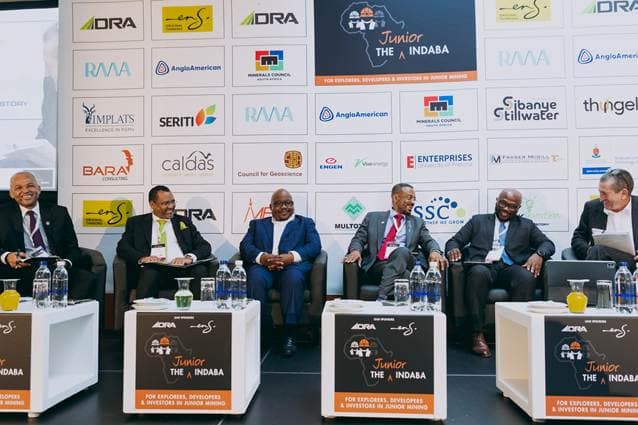
For more than a century, South Africa’s mining fortune has been built on the back of its geological endowment—the Witwatersrand gold fields, the Bushveld Complex’s platinum and chrome, the manganese fields of the Northern Cape. But according to Council for Geoscience (CGS) CEO Mosa Mabuza, the country has only scratched the surface. Speaking to a packed auditorium at the Junior Indaba 2026, Mabuza delivered a powerful message: high-quality geological data is not a scientific luxury—it is the single most important key to unlocking South Africa’s next mining boom.
“The days of picking visible minerals off the surface are long gone,” Mabuza told delegates, many of whom represented junior exploration companies struggling to attract capital in a risk-averse market. “The next generation of discoveries lies beneath cover—under younger rocks, under sediments, under old mine tailings. You cannot find what you cannot see unless you have the data to guide your drill bit.”
Mabuza’s central argument was both simple and urgent. Junior miners, unlike their major counterparts, lack the balance sheets to absorb failed exploration campaigns. Every dry hole is a potential death knell. By providing freely available, high-resolution geophysical and geochemical maps—including airborne magnetic surveys, radiometric data, and digitized historical drill logs—the CGS can dramatically reduce exploration risk, allowing juniors to target prospects with scientific confidence rather than gut instinct.
“We are sitting on decades of under-analyzed data,” Mabuza said. “Our job is to digitize, modernize, and democratize that information. A junior miner with limited budget should not have to guess where to explore. They should be able to download the answers from our portal.”
He also announced a new public-private partnership pilot program aimed at co-funding high-priority regional surveys in under-explored terranes, including the Northern Cape and the Eastern Limb of the Bushveld Complex. If successful, the initiative could trigger a new wave of grassroots exploration, creating jobs, attracting foreign investment, and positioning South Africa once again as a global exploration destination. “The rocks haven’t changed,” Mabuza concluded. “Only our willingness to read them properly.”
About The Author