
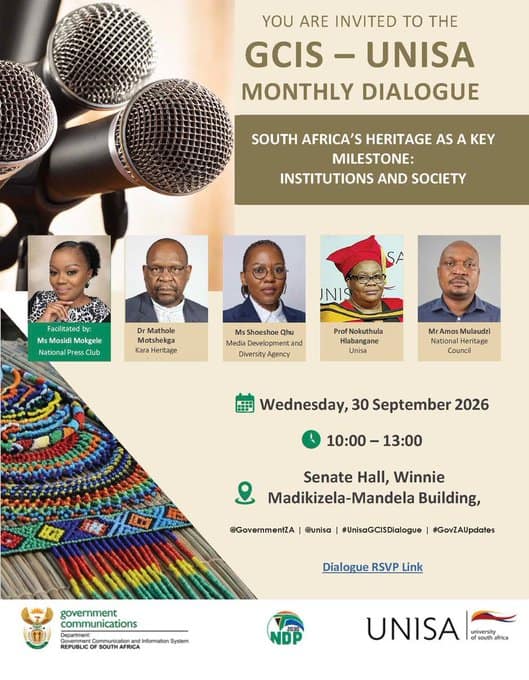
The Government Communication and Information System (GCIS) and the University of South Africa (Unisa) are hosting a public dialogue this morning focused on South Africa’s heritage as a living, breathing resource rather than a static museum exhibit. The event forms part of the country’s Heritage Month commemorations, which take place annually in September to celebrate the nation’s diverse cultural and historical legacy.
The dialogue, held at Unisa’s Muckleneuk Campus, brings together academics, cultural practitioners, heritage activists, and government representatives to explore how South Africa’s heritage can be leveraged for social cohesion, economic development, and nation-building. The discussion challenges the notion that heritage is confined to archives, monuments, and museums, arguing instead that it is a dynamic force that shapes identity, informs contemporary culture, and contributes to community resilience.
Key themes on the agenda include the preservation and promotion of indigenous knowledge systems, the role of heritage in fostering social cohesion, and the economic potential of cultural tourism. Participants will also examine the challenges facing heritage preservation, including funding constraints, urban development pressures, and the need for greater community involvement in decision-making processes.
The GCIS has emphasised that Heritage Month is not merely a ceremonial occasion but an opportunity to reflect on the country’s journey and to celebrate the contributions of all South Africans to its rich cultural tapestry. “Our heritage is not just about the past, it is about who we are today and who we aspire to be tomorrow,” a GCIS spokesperson said.
Unisa, as the host institution, has a long-standing commitment to research and community engagement in the field of heritage studies. The university’s involvement underscores the importance of academic institutions in documenting, interpreting, and promoting South Africa’s cultural legacy.
The dialogue is expected to produce recommendations that will inform government policy and community initiatives aimed at protecting and promoting heritage. For attendees, it is an opportunity to engage with pressing questions about identity, memory, and the role of culture in shaping the future. For South Africa, it is a reminder that heritage is not a relic to be admired from a distance, it is a living resource to be nurtured, shared, and celebrated.
About The Author