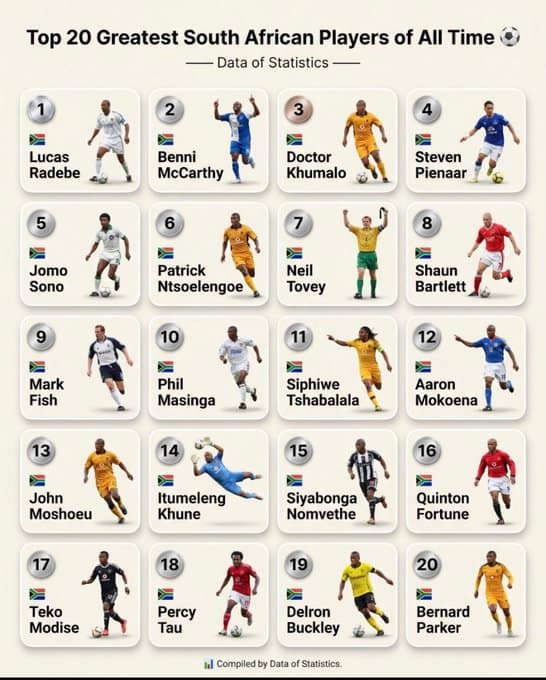
A recent ranking of South Africa’s top 20 football greats, published by the data aggregation platform Data Of Statistics on 19 August, has ignited a fierce and passionate debate among local fans, with the list sparking both celebrations and outrage across social media and football forums. The ranking places former Leeds United and Bafana Bafana captain Lucas Radebe at the coveted number one spot, followed by all-time top scorer Benni McCarthy at number two, and midfield maestro Doctor Khumalo rounding out the top three. However, the list dips to Bernard Parker at number 20, a placement that has left many scratching their heads.
While Radebe’s position at the summit was widely accepted, the rest of the list drew heavy criticism. Fans were quick to point out glaring omissions, including the absence of Sibusiso Zuma, whose trickery and flair lit up the early 2000s, and Steve “The Black Prince” Mokone, a pioneer of South African football abroad in the 1950s. The ranking also featured a heavy Kaizer Chiefs bias, with seven Amakhosi legends making the cut, while only three Orlando Pirates players were included—a statistic that did not sit well with the Buccaneers’ faithful.
Contentious placements also surfaced for modern stars. Percy Tau, South Africa’s current poster boy and Champions League winner, was ranked lower than many expected, while Teko Modise, a beloved figure of the late 2000s, was placed in a position that fans argued did not reflect his impact on the game. The debate underscores the deeply subjective nature of such rankings—where statistics, sentiment, and club loyalties collide.
Ultimately, the list may have been algorithmically generated, but the reaction it produced is unmistakably human. In a country where football is religion, any attempt to crown a definitive hierarchy of greatness is bound to be met with passionate dissent. The debate rages on—and that, perhaps, is the real victory for South African football.
About The Author