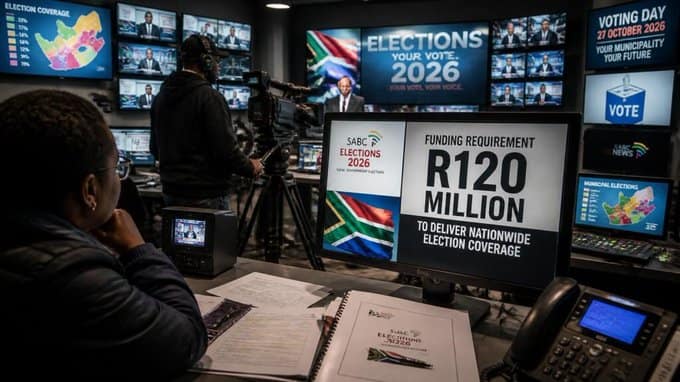
The South African Broadcasting Corporation’s (SABC) urgent request for R120 million in public funding to bankroll its coverage of the upcoming Local Government Elections has taken centre stage in Parliament, where the Portfolio Committee on Communications and Digital Technologies convened on Wednesday for a high-stakes briefing with Communications and Digital Technologies Minister Solly Malatsi. The meeting, which was attended by committee members and senior SABC officials, laid bare the deepening financial pressures facing the public broadcaster as it gears up for one of the most politically consequential events on the national calendar.
The SABC has argued that the substantial allocation is essential to ensure comprehensive, impartial, and nation-wide coverage of the November elections, including live debates, news bulletins, and real-time results reporting across its television, radio, and digital platforms. Without the injection, the corporation warns that its ability to fulfill its public service mandate—particularly in reaching remote and underserved communities—would be severely compromised. However, the request has drawn pointed questioning from committee members, who have pressed the SABC on its cost structures, internal efficiencies, and whether the funds would be subject to rigorous oversight and reporting.
Minister Malatsi, who has previously expressed concerns about the sustainability of the SABC’s business model, reiterated that any financial support must be tied to clear performance indicators and structural reforms. “We are not writing a blank cheque,” Malatsi stated. “The taxpayer deserves to know that every rand is spent wisely and accounted for.”
Opposition parties have also weighed in, with some questioning why the SABC cannot redirect existing resources, while others have suggested alternative funding mechanisms. As the committee deliberates on the request, the SABC’s financial future—and the integrity of election coverage—now hangs in the balance, with a decision expected before the end of the month. The outcome will not only determine the broadcaster’s capacity to cover the polls but also test the government’s commitment to a free and independent media.
About The Author