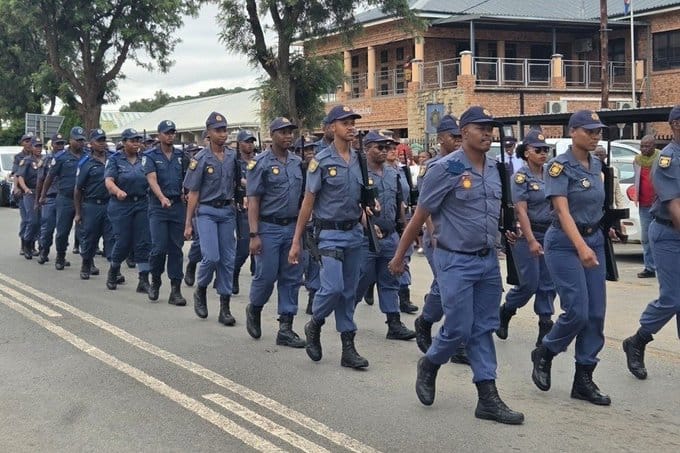
The clock is ticking toward 30 June 2026, and in the corridors of police headquarters in Pretoria, a quiet but urgent mobilization is underway. The South African Police Service (SAPS) has taken the extraordinary step of placing officers with critical skills on full standby, canceling approved leave for personnel in specialized units to ensure that the nation’s security apparatus is primed for what many fear could be a volatile and unpredictable day. The decision, confirmed by senior police officials, underscores the gravity with which law enforcement is treating the planned anti-immigration protests that are set to sweep across Gauteng and potentially beyond.
Behind the scenes, a meticulously coordinated operation is being fine-tuned. Officers from the Public Order Policing (POP) unit, forensic experts, negotiators, and intelligence analysts have been recalled from their planned breaks, their leave requests abruptly rescinded as the police service pivots to a posture of heightened readiness. “This is not a decision we took lightly,” a senior SAPS commander confided, speaking on condition of anonymity. “But when you have intelligence suggesting that opportunistic elements may seek to exploit these protests for criminal ends, we cannot afford to be understaffed. Every skilled officer is needed on deck.”
The cancellation of leave has not been without its grumblings among rank-and-file members, many of whom had made personal plans for the end of the month. Yet there is also a grudging acknowledgment of the necessity. The lessons of past xenophobic flare-ups—the looting, the arson, the heartbreaking scenes of foreign nationals fleeing their homes—are seared into the institutional memory of the police. The decision to deploy critical skills personnel, from hostage negotiators to explosive ordnance disposal experts, reflects a recognition that the protests could spiral into scenarios far beyond routine crowd management.
Police management has been careful to frame the move as a proactive measure rather than a reactionary panic. In a briefing to parliamentary committees, National Police Commissioner General Fannie Masemola stressed that the standby order was designed to ensure “rapid response capabilities” in the event of multiple simultaneous incidents. “We are not anticipating violence,” he said, “but we are planning for every eventuality. Our duty is to protect all South Africans—and all those who are lawfully within our borders—regardless of their nationality.”
The decision has also drawn attention to the broader intelligence picture that prompted such drastic staffing measures. Reports have emerged of social media chatter calling for “spontaneous” marches in multiple municipalities, alongside whispers that certain community figures are planning to use the protests as a platform to press political agendas unrelated to immigration. In response, SAPS has activated its Joint Operational Centre (JOC), which will coordinate with metropolitan police departments, the National Intelligence Agency, and private security providers to ensure seamless communication on the day.
Yet even as the police bolster their ranks, civil society organizations have expressed concern that the heavy-handed deployment of specialized officers could escalate tensions rather than defuse them. Human rights groups have called on SAPS to exercise restraint and avoid the kind of aggressive crackdowns that have marred previous protests. “There is a fine line between maintaining order and provoking confrontation,” warned one activist. “The police must remember that their primary duty is to protect, not to intimidate.”
As 30 June draws nearer, the eyes of the nation will be fixed on the men and women in blue who have been called away from their families and their rest. For them, it is another chapter in the relentless cycle of duty—a reminder that in a country still wrestling with its demons, the price of stability is often paid in personal sacrifice. The streets of Gauteng may well determine whether that sacrifice was worthwhile, or whether the storm they are preparing for will prove too powerful even for the most skilled among them.
About The Author