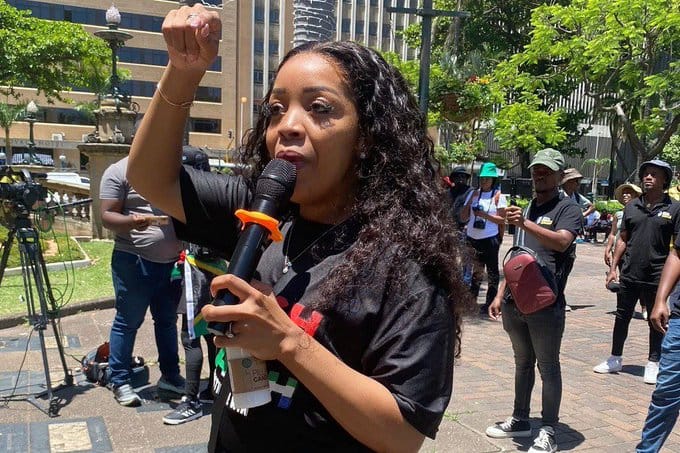
The figure landed like a thunderclap in a room already thick with tension: R600 million. For Jacinta Ngobese-Zuma, leader of the burgeoning March and March movement, it was not just a number on a treasury spreadsheet—it was an indictment, a provocation, and a rallying cry all rolled into one. Standing before a cluster of microphones in the heart of Johannesburg, her voice trembling not with fear but with righteous indignation, she unleashed a blistering critique of the government’s decision to allocate half a billion rand to police the planned nationwide protests on June 30. “Six hundred million rand,” she repeated, letting the figure hang in the air like smoke. “That is what they are willing to spend to silence us. To intimidate us. To turn our cities into militarized zones. And yet, when we ask for decent housing, for functional clinics, for schools that don’t collapse on our children—suddenly, the coffers are empty.”
The March and March movement, which has swelled from a grassroots Twitter hashtag into a formidable coalition of disaffected youth, struggling workers, and civil society organizations, has called for June 30 to be a day of mass action against what they term “government paralysis.” Their grievances are as varied as they are urgent: crippling unemployment that has left nearly half of young South Africans without hope, rolling blackouts that have strangled small businesses, a healthcare system on life support, and a political elite that seems increasingly detached from the daily desperation of the townships. But Ngobese-Zuma, a firebrand organizer with a talent for distilling complex frustrations into searing soundbites, has framed the protests not as mere complaint, but as a moral reckoning. “We are not asking for handouts,” she declared. “We are demanding accountability. And they are responding with armored vehicles and tear gas.”
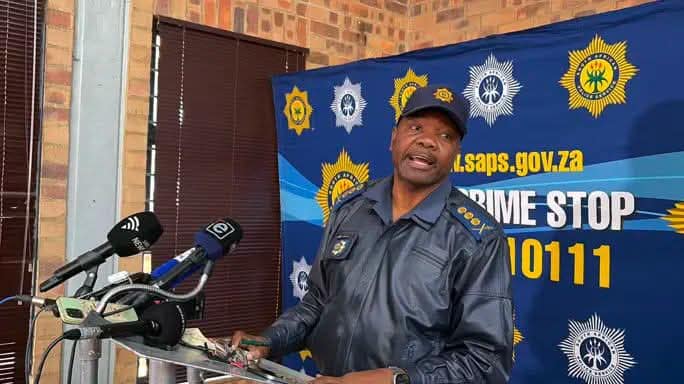
The R600 million security bill, as detailed in a cabinet memorandum that somehow found its way into the public domain, covers an extraordinary deployment of resources: thousands of police officers pulled from routine duties, specialized riot control units placed on standby, surveillance drones, helicopter patrols, and the pre-positioning of water cannons and barbed wire at strategic flashpoints across all nine provinces. Government spokespersons have defended the expenditure as necessary and proportionate, citing the specter of violence that has marred previous protests, including the July 2021 unrest that claimed over 300 lives and left a trail of looting and arson in its wake. “We have a constitutional obligation to protect life and property,” a senior police official insisted, speaking on condition of anonymity. “The cost of prevention is always less than the cost of chaos.”
But Ngobese-Zuma would have none of it. Her rebuttal was scalding, personal, and deeply rooted in the lived experience of millions of South Africans who have never seen R600 million of government money touch their lives in any meaningful way. “That money could have built six new hospitals,” she calculated, her voice rising. “It could have employed 5,000 young graduates for a year. It could have fixed every pothole in Soweto, bought textbooks for every under-resourced school in Limpopo, and still left change for a community feeding scheme. Instead, they are spending it on shields and batons—on preparing to fight their own people.” She paused, allowing her words to settle, then delivered the line that would dominate evening news bulletins: “They are not protecting us. They are protecting themselves from us.”
The political fallout was immediate and predictable. Government ministers scrambled to justify the allocation, pointing to intelligence reports suggesting that the June 30 protests could be infiltrated by opportunistic elements seeking to replicate the mayhem of 2021. Opposition parties, sensing blood, rallied behind Ngobese-Zuma’s rhetoric, with the EFF accusing the ANC-led government of “militarizing poverty” and the DA calling for a full parliamentary debate on the security budget. Meanwhile, on social media, the hashtag #R600MillionShame trended with viral ferocity, as ordinary South Africans shared stories of crumbling infrastructure and neglected communities, juxtaposed against the staggering cost of state repression.
Yet beneath the political theater, a deeper question gnawed at the national psyche: Was this the new normal for South Africa—a country where the state budgets more for crowd control than for human development? As June 30 approaches, the streets are bracing for a confrontation that feels almost inevitable. Ngobese-Zuma, for her part, has vowed that the protests will go ahead, peacefully but unapologetically, regardless of the security apparatus arrayed against them. “They can spend R600 million,” she concluded, her gaze steady. “They can send every officer in the country. But they cannot arrest an idea. They cannot silence a generation that has nothing left to lose.” The clock ticks toward the last day of June, and the nation holds its breath, caught between the hammer of state power and the anvil of popular discontent.
About The Author