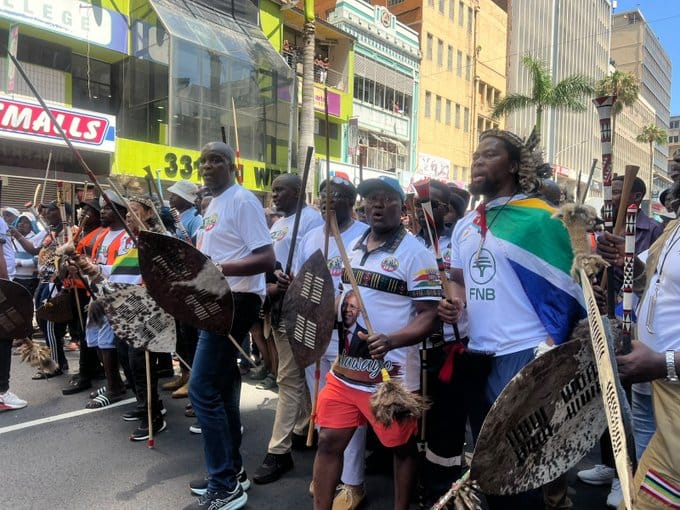
Inkatha Freedom Party (IFP) supporters in eThekwini, joined by anti-illegal immigration activists, marched through the streets of Durban on Thursday in a demonstration against gender-based violence and undocumented foreign nationals. Men from various groups across KwaZulu-Natal participated in the IFP-organised procession, calling for stronger protection of women and children while demanding stricter enforcement of immigration laws.
The march reflected the complex and often overlapping tensions in South African society, where concerns about crime and gender-based violence are frequently intertwined with anti-immigrant sentiment. Participants carried placards denouncing gender-based violence and calling for the removal of undocumented foreign nationals, whom some blame for criminal activity and economic competition. The IFP has positioned itself as a champion of both community safety and stricter border controls.
On the same day, and in the same city, the refugee reception centre was shut and 14 vehicles were torched on Dr Pixley KaSeme Street. The juxtaposition of the peaceful march and the violent incidents elsewhere in Durban highlighted the volatility of the situation and the potential for tensions to escalate into unrest. Police were deployed across the city to maintain order and prevent clashes between different groups.
The IFP has defended the march as a legitimate expression of community concerns, emphasising that the focus was on protecting women and children and addressing the strain that undocumented immigration places on already stretched public services. Critics, however, warned that such marches risk inflaming xenophobic sentiment and targeting vulnerable people who have fled conflict and persecution.
The events in Durban are part of a broader national conversation about immigration, crime, and social cohesion, one that has become increasingly polarised in the lead-up to the local government elections. For the residents of Durban, the day’s events served as a stark reminder of the deep divisions that run through South African society. For the authorities, the challenge is to uphold the rule of law while ensuring that legitimate grievances are addressed without resorting to violence or scapegoating.
About The Author