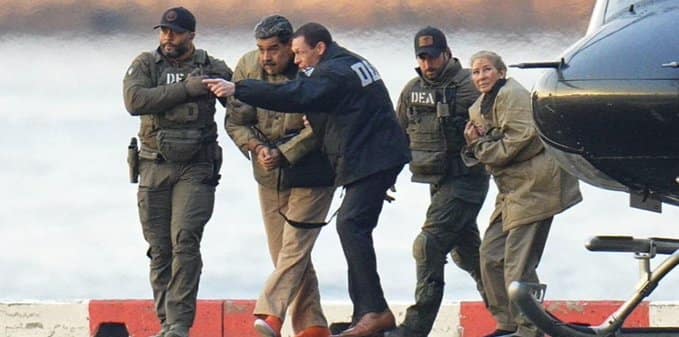
In a scene of extraordinary political and legal theater, former Venezuelan President Nicolás Maduro stood before a packed Manhattan federal courtroom on Monday, transforming his arraignment into a defiant political platform. The deposed leader, facing a sweeping indictment for narco-terrorism, drug trafficking, and weapons offenses, entered a resounding plea of not guilty while rejecting the very legitimacy of the proceedings.
Dressed in a sober dark suit rather than the revolutionary red familiar to his supporters, Maduro nonetheless delivered a performance of unwavering defiance. When afforded the opportunity to speak, he did not address the specific charges but instead made a sweeping declaration to U.S. District Judge Sarah L. Crane.
“I stand before you not as a defendant, but as the constitutional President of the Bolivarian Republic of Venezuela,” Maduro stated through a Spanish interpreter, his voice steady. “I am a prisoner of war, captured in an illegal extraterritorial operation that violates international law. This court has no jurisdiction over a foreign head of state, and these charges are a political fabrication by an empire desperate to steal our nation’s resources.”
His proclamation as a “prisoner of war” is a calculated legal and rhetorical maneuver, aimed at framing the U.S. military operation that led to his detention as an act of international aggression, rather than a law enforcement action. Legal experts suggest his defense team will use this to challenge the court’s jurisdiction and petition international bodies, arguing the proceedings constitute a politicized show trial.
The Charges: A ‘Narco-State’ Accusation
The U.S. Department of Justice’s indictment, unsealed following Maduro’s dramatic arrest, alleges that for more than two decades, Maduro and top members of his government and military transformed Venezuela into a “narco-state,” collaborating with the Revolutionary Armed Forces of Colombia (FARC) to “flood the United States with cocaine” and using drug profits to enrich themselves and fund violent repression at home. The charges carry mandatory minimum sentences that could amount to multiple life terms in prison.
Prosecutor Damian Williams, in stark, clinical terms, outlined the core of the government’s case before the judge, stating, “The defendant led a criminal enterprise that corrupted an entire nation’s institutions for personal and political gain, directly contributing to a drug crisis that has claimed thousands of American lives.”
A Global Diplomatic Earthquake
The courtroom drama sent immediate shockwaves through diplomatic circles. The Venezuelan government-in-exile, led by interim President Juan Guaidó and operating from Washington D.C., hailed the proceedings as a “historic step toward justice.” Conversely, nations aligned with Maduro, including Russia, China, Cuba, and South Africa, issued blistering condemnations. The Russian Foreign Ministry called the trial “legal banditry” and a “gross violation of the UN Charter,” promising “consequences.”
Back in Caracas, the situation remains tense. The remaining Chavista leadership, now headed by Vice President Delcy Rodríguez, has declared Maduro the “legitimate commander-in-chief” and labeled the U.S. action an “act of war.” Pro-Maduro militias and military units have staged shows of force in the capital, while opposition supporters have taken to the streets in cautious celebration, sparking sporadic clashes.
The Road Ahead: A Protracted Legal and Political Battle
Judge Crane set a tentative trial date for early next year, acknowledging the unprecedented complexity of the case. Maduro’s high-powered defense team, led by a former U.S. Attorney General, immediately signaled they would file a barrage of motions, starting with a challenge to the court’s jurisdiction and a motion to dismiss based on “outrageous government conduct” regarding his capture.
Analysts say the case represents one of the most significant tests of universal jurisdiction and the reach of U.S. law in history. “This isn’t just a criminal trial,” said Dr. Elena Moreau, a professor of international law at Georgetown University. “It is a direct confrontation between two diametrically opposed visions of sovereignty and justice. Maduro’s ‘prisoner of war’ claim is the opening salvo in a battle that will be fought as fiercely in the court of global public opinion as in the federal courthouse.”
As marshals led Nicolás Maduro—who raised a clenched fist to a small group of supporters in the gallery—back into custody, the stage was set for a legal marathon with profound implications. The case promises to dissect the inner workings of a crippled petro-state, redefine the limits of international justice, and keep the turbulent future of Venezuela hanging in the balance, all from a courtroom in lower Manhattan.
About The Author