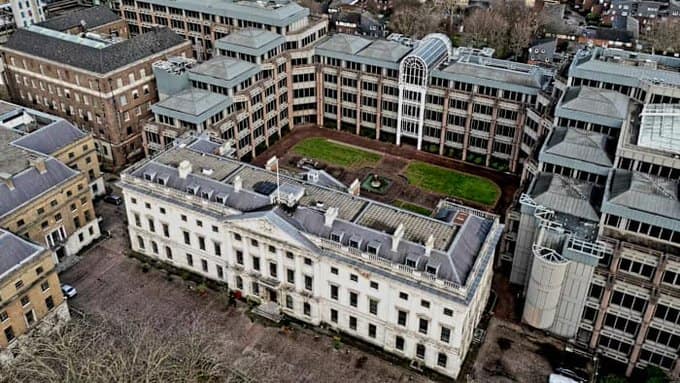
In a decision freighted with geopolitical symbolism, the British government has granted final planning permission for the People’s Republic of China to construct its largest diplomatic compound in Europe, a sprawling complex set to rise on the prime riverfront site of the historic Royal Mint Court, adjacent to the Tower of London. The approval, confirmed on Tuesday, concludes nearly a decade of fraught negotiations, security reviews, and political wrangling, and marks a pivotal moment in the UK’s delicate balancing act between economic pragmatism and national security concerns.
The Scale and the Site: A Statement in Steel and Stone
The approved plans, valued at an estimated £750 million, envision a transformative redevelopment of the 5.2-acre Royal Mint Court, a former coinage production site owned by Chinese developer Guangzhou R&F Properties since 2018. The design, by a consortium of British and Chinese architects, proposes a state-of-the-art diplomatic campus that will consolidate China’s currently dispersed London operations.
The compound will feature a new, imposing chancery building, extensive consular services quarters, ambassador’s residences, and dedicated cultural exchange pavilions. Its scale—significantly larger than China’s existing embassy in Paris—will physically cement Beijing’s diplomatic footprint in the heart of the British capital, a stone’s throw from landmarks like Tower Bridge and the financial powerhouse of the City of London.
A Decade of Delays: Security vs. Diplomacy
The path to approval has been anything but smooth. The project first entered planning stages in 2017 but quickly became ensnared in escalating tensions between the West and China. Key objections centred on profound national security anxieties:
- Surveillance & Espionage Fears: UK intelligence agencies, notably MI5, repeatedly raised alarms about the potential for the compound to house advanced signals intelligence and cyber-espionage capabilities. Concerns focused on the risk of electronic surveillance against British political, financial, and military institutions in the vicinity.
- “Zone of Control” Concerns: Critics, including a vocal cross-party group of MPs, argued that such a large, sovereign-controlled territory could operate as an extra-territorial “zone of influence,” complicating British law enforcement and security oversight.
- The Hong Kong and Uyghur Shadow: The planning process paralleled a sharp deterioration in relations over China’s policies in Hong Kong and Xinjiang. Parliamentary motions condemning human rights abuses repeatedly threatened to derail the embassy talks, with activists vowing to make the site a permanent flashpoint for protest.
The Government’s Calculus: “Managed Engagement”
In granting approval, the Conservative government, led by Prime Minister Keir Starmer, has signaled a philosophy of “managed and robust engagement.” Officials cite several key rationales:
- Economic Realism: With post-Brexit Britain aggressively seeking foreign investment and trade deals, a public rejection of China’s flagship European diplomatic project was deemed economically detrimental. The construction itself is projected to create over 2,000 jobs.
- Diplomatic Channels: Proponents within the Foreign, Commonwealth & Development Office (FCDO) argued that having a centralised, modern facility could facilitate more structured and effective high-level dialogue, crucial for managing an inherently adversarial relationship.
- Conditional Approval: Sources indicate the approval came with a dense, confidential appendix of stringent security mitigations negotiated with Chinese authorities. These are believed to include restrictions on certain construction materials, agreed protocols for British security vetting of some technical contractors, and limitations on communications hardware.
Reaction: A Spectrum from Hope to Alarm
The decision has ignited a fierce debate:
- The Business Community: The Confederation of British Industry (CBI) struck a cautiously optimistic note, welcoming the “clarity” and hoping it would “stabilise a crucial trading relationship.” Financial institutions in the City expressed relief at the resolution of long-standing uncertainty.
- Security Hawks & Parliamentarians: The reaction was scathing from China-sceptic quarters. Sir Iain Duncan Smith, a leading critic, called it “a monumental error of judgement that privileges short-term commercial illusion over long-term security reality.” The Chair of the Intelligence and Security Committee announced an immediate inquiry into the safeguards.
- Human Rights Groups: Organizations like Amnesty International UK condemned the move as “a reward for impunity,” arguing it normalises relations amid ongoing rights abuses. They pledged sustained demonstrations at the site.
- Local Residents & Heritage Bodies: While welcoming the regeneration of a derelict site, groups like the Tower of London World Heritage Site board have expressed concerns about the visual impact on one of the world’s most iconic historic landscapes and the practical issues of increased security zones and traffic.
A New Geopolitical Landmark on the Skyline
Construction is slated to begin in late 2026, with completion expected before the end of the decade. When finished, the embassy will stand as more than just a diplomatic office. It will be a permanent, physical manifestation of China’s global power and the UK’s complex, contested strategy for navigating the 21st century’s defining great-power rivalry. It is a bet that open channels, even with an adversary, are preferable to severed ones—a bet that will be tested every day on the banks of the Thames. The compound will not just house diplomats; it will embody the tensions and calculations of a new era, its very presence a daily question about the price of engagement and the contours of national sovereignty in an age of assertive autocracies.
About The Author