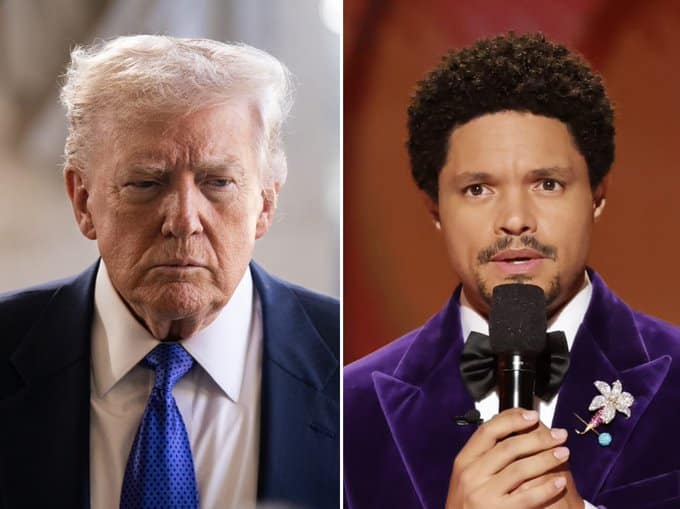
The afterglow of the star-studded 2026 Grammy Awards has been abruptly eclipsed by a rapidly escalating legal and political drama, with comedian Trevor Noah at its center. The former Daily Show host and acclaimed South African comedian finds himself the target of a promised defamation lawsuit from former U.S. President Donald Trump, following a joke that aired during Noah’s widely-praised hosting monologue.
The controversy stems from a segment in which Noah, known for his global perspective and incisive commentary on American politics, addressed the recent unsealing of court documents related to the late financier and convicted sex offender, Jeffrey Epstein. In a carefully timed punchline, Noah quipped, “The music industry has its own controversies, sure. But looking at these Epstein client lists trending everywhere, it really makes you wonder… I’m just saying, it’s interesting who isn’t on some of these playlists. For instance, have you ever noticed Donald Trump and R. Kelly never collaborated? Missed opportunity for a truly shocking duo.”
The joke, which drew a mix of roaring laughter and audible gasps from the celebrity audience, was a classic Noah maneuver—using implication and cultural reference to skirt direct accusation. Its target, however, did not receive it as mere comedy.
The Presidential Retort: “Legal Action is Coming”
Within hours of the broadcast, Trump responded on his social media platform, Truth Social, in a characteristic and fiery post. He did not quote the joke directly but issued a broadside against Noah and the awards ceremony.
“The Grammys are RIGGED and FAILING, just like everything else the Radical Left touches! Disgusting little Trevor Noah, a third-rate comedian from a third-world country, told a vicious, defamatory, and completely false ‘joke’ about me last night, linking me to the disgusting Epstein. I never knew him, other than throwing him out of my club for being a creep. Noah is a desperate, unfunny puppet of the Fake News Media. My lawyers will be filing a Defamation lawsuit—this is SERIOUS LIBEL, and legal action is coming. He will regret this!”
Legal experts are immediately divided on the viability of such a lawsuit. “Defamation cases against comedians and satirists in the United States face an incredibly high bar, especially for public figures like Trump,” explained First Amendment attorney Liana Pressman. “Courts have consistently ruled that parody, exaggeration, and humorous commentary are protected speech. Noah’s joke, while clearly pointed, was framed as comedic speculation, not a statement of fact. Proving ‘actual malice’—that Noah knew it was false or recklessly disregarded the truth—would be a steep, likely impossible, climb.”
However, other analysts note that the threat itself may be the point. “This isn’t necessarily about winning in court; it’s about political mobilization and creating a narrative of victimhood by the ‘elite’ media,” said political communications professor Dr. Arjun Patel. “It energizes his base, dominates news cycles, and puts Noah and any platform that supports him in the crosshairs of his most fervent supporters. The legal process itself can be a form of punishment and intimidation.”
Industry Reaction and the Comedian’s Silence
The entertainment industry has reacted with a mixture of concern, defiance, and weary recognition. Several major networks and production companies, speaking off the record, expressed anxiety over the “chilling effect” such high-profile legal threats could have on satirical programming. Meanwhile, many of Noah’s peers have rallied to his defense online, using hashtags like #ComedyIsNotACrime and #ProtectSatire.
Notably, the Recording Academy and CBS, which broadcast the Grammys, have so far issued only a standard statement: “The Grammy Awards are a celebration of music and artistic expression. The views expressed by hosts or performers are their own.” Trevor Noah himself has remained uncharacteristically silent across all his public platforms, a move insiders suggest is strategic, allowing his legal team to assess the formal threat once—and if—papers are actually filed.
A Global Spotlight on the Limits of Satire
The incident has sparked a broader, international conversation about the boundaries of political satire in an increasingly polarized and litigious era. In South Africa, where Noah is a national icon, the reaction has been one of defiant support, with many commentators noting the nation’s own robust tradition of political humor in the post-apartheid era. “Trevor learned to joke about power in a context where the stakes were life and death,” noted a columnist for a major Johannesburg paper. “A lawsuit from an American former president is a different kind of pressure, but the principle is the same: holding the powerful to account through laughter.”
As of now, the world watches and waits. Will a formal lawsuit materialize, setting up a landmark First Amendment battle? Or will the threat remain a potent political tool in the media sphere? One thing is certain: Trevor Noah’s joke, meant to last a moment in a three-hour show, has ignited a firestorm that questions the very power of a punchline in the face of power. The next move, legally and comically, is his to make.
About The Author