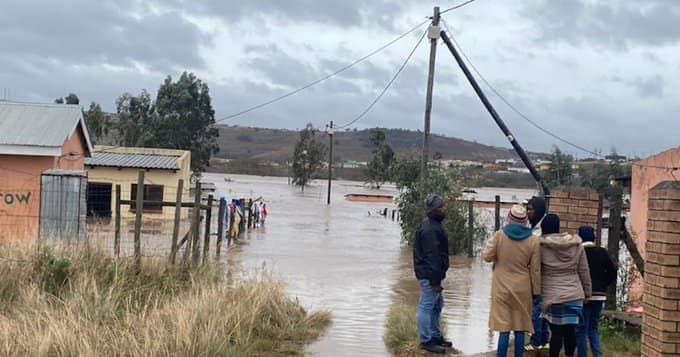
For hundreds of residents of the Mthatha region, the trauma of the devastating floods that swept away their homes and possessions months ago has been cruelly extended by a new, man-made disaster: the utter failure of the state to deliver on its most basic promises. Despite repeated assurances from provincial and local officials, the promised temporary residential structures (TRUs) have failed to materialise, leaving families crammed into the makeshift, dehumanizing confines of a local church hall with no end in sight.
The floods, triggered by relentless rains earlier this year, transformed neighbourhoods like Zimbane, Fort Gale, and parts of Mthatha central into swirling rivers of mud and debris. While the waters have long since receded, the human tide of displacement shows no sign of abating. The community hall of a local church, once a place of solace, now serves as a stark dormitory of despair. Mattresses line the floor wall-to-wall, personal belongings are stashed in tangled piles, and the air hangs heavy with the smell of damp, crowded humanity and the palpable fog of broken promises.
A Litany of Broken Promises
In the immediate aftermath of the disaster, officials from the OR Tambo District Municipality and the Eastern Cape Provincial Government conducted high-visibility assessments. They stood before cameras and grieving residents, pledging swift action. The plan was clear and repeatedly communicated: while permanent housing solutions would take time, the immediate priority was to erect Temporary Residential Units—basic, serviced structures—on identified land to give people privacy, dignity, and a semblance of stability as they rebuilt their lives.
“They came with their notebooks and their cameras. They told us we would not be forgotten, that help was coming,” says Nosipho Mbane, a mother of three who has spent the last four months in the hall. “They even pointed to the field nearby where the ‘temporary homes’ would go. We watched that field every day. Nothing. Only grass and empty words grow there.”
Officials now cite a familiar cocktail of delays: bureaucratic hurdles in securing land, protracted procurement processes for the units, and disputes over service provision like water and electricity connections. For the victims, these explanations ring hollow, sounding like excuses crafted in comfortable offices far from the reality of communal living without privacy, security, or adequate sanitation.
The Hall of Hopelessness
Life in the church hall is a daily erosion of dignity. There is no space for children to study, no quiet for the elderly, and no security for personal belongings. Tensions flare easily in the pressured environment. The lack of partitions means there is no privacy for changing clothes, for couples, or for grieving.
“We are living like animals in a pen,” says an elderly man, Sipho Kula, who lost the small house he had spent a lifetime building. “My wife and I have not had a moment alone together since the flood. We sleep next to strangers, we listen to each other’s cries at night. The government’s failure is a second flood—a flood of neglect that is drowning our spirit.”
Official Response: A Chorus of Blame and Re-assurance
When confronted, municipal spokespersons provide assurances that the process is “at an advanced stage” and that “all stakeholders are working tirelessly.” The provincial Department of Human Settlements acknowledges the delay but shifts blame, citing challenges with “uncooperative landowners” and the need to follow “due process to ensure compliance.”
This bureaucratic ping-pong offers no comfort on the ground. Civil society organisations, including the Mthatha-based Social Justice Coalition, have condemned the inertia. “This is a profound failure of moral and constitutional obligation,” says a coalition spokesperson. “The right to dignity and adequate shelter is being violated daily. These delays are not administrative; they are a form of violence against people who have already lost everything.”
As the Eastern Cape winter approaches, bringing the threat of cold and illness, the desperation in the church hall intensifies. The field meant for temporary shelters remains empty, a silent monument to promises unmade. For the flood victims of Mthatha, the abandonment they feel is now a heavier weight than the floodwaters ever were. Their plea is simple: either help us, or stop making promises that you have no intention of keeping.
About The Author