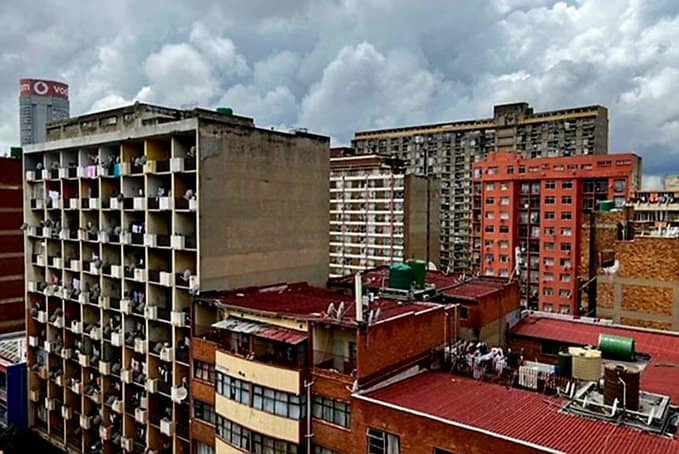
Johannesburg’s Member of the Mayoral Committee for Public Safety, Mgcini Tshwaku, has issued a stark and urgent warning: a violent, escalating turf war between criminal syndicates for control of the city’s hijacked buildings has turned entire inner-city blocks into tinderboxes of potential catastrophe. The conflict, centered on the lucrative and illicit rental income from these properties, is no longer a hidden underworld dispute but a clear and present danger to public safety, threatening to spill over into tragedies of fire, structural collapse, or mass violence.
In a charged briefing at the Metro Centre, MMC Tshwaku painted a grim picture of a shadow economy metastasizing into open warfare. “We are not talking about isolated incidents of petty crime,” he asserted. “We are witnessing a coordinated, armed struggle for territorial control of buildings that house thousands of vulnerable residents. These criminal landlords—these slumlords—are fighting over profits extracted from human desperation, and they are doing so with a brazenness that endangers every life in and around those structures.”
The Anatomy of a Criminal Enterprise
The “hijacked building” ecosystem is a multi-layered crisis. Criminal syndicates, often with ties to broader networks involved in drug trafficking and protection rackets, seize control of abandoned or poorly managed properties. They then illegally install basic utilities through dangerous, unauthorized connections to city grids and rent out space, often by the room, to a captive market of migrants, students, and Johannesburg’s working poor. The cash-based, off-the-books revenue streams are immense and tax-free.
The current violence, according to intelligence reports cited by Tshwaku, stems from newer, more aggressive syndicates attempting to muscle in on the territories of established operators. These clashes involve intimidation, arson attacks on rival-controlled properties, and, as evidenced by recent shootings, armed confrontations.
A Multiplicity of Impending Disasters
MMC Tshwaku detailed how this turf war directly translates into an imminent public safety emergency:
- The Fire Trap: The illicit electrical connections are haphazard and overloaded, creating constant fire hazards. A conflict-driven act of sabotage—such as tampering with these already deadly connections—could trigger a blaze in a building with blocked fire escapes, no alarms, and combustible informal internal structures, leading to a loss of life on a horrific scale.
- Structural Mayhem: The buildings, many of which have had no official maintenance for decades, are often structurally compromised. Fighting over them includes damaging infrastructure, while the weight of unauthorized internal partitions and the strain of over-occupancy further weakens them. A collapse, whether triggered by conflict or neglect, is a “when, not if” scenario, Tshwaku warned.
- Crossfire and Community Terror: As gangs fight for control, residents live in a state of terror, caught between extortion from their current “landlords” and violent incursions from rivals. Stray bullets, forced evictions, and general lawlessness have turned neighborhoods into no-go zones, even for police, who face ambush risks in the dense, unfamiliar warrens of the buildings.
A Call for Coordinated, Decisive Action
Tshwaku’s warning is a direct call to escalate the city’s response beyond periodic raids. He advocated for a permanent, multi-departmental “Hijacked Building Task Force” combining the city’s Group Forensic and Investigation Service (GFIS), JMPD, SAPS, Home Affairs, and Disaster Management.
“We need a sustained surgical strategy, not sporadic skirmishes,” he stated. “This means permanently disconnecting and securing utilities to make these buildings uninhabitable for profit, followed by systematic evacuations and humanitarian relocation of legitimate, vulnerable tenants. Simultaneously, we must pursue the financial trails of these syndicates and their enablers with asset forfeiture and racketeering charges.”
The MMC’s alarming assessment underscores a critical juncture for Johannesburg’s inner city. The battle for its soul is being literalized as a violent struggle for its most derelict assets. Containing this turf war is no longer just about urban management; it is, as Tshwaku framed it, a preventative operation to avert a major humanitarian disaster playing out in the heart of South Africa’s economic capital. The time for intervention, he concluded, is not tomorrow, but today, before the city is forced to count the dead.
About The Author