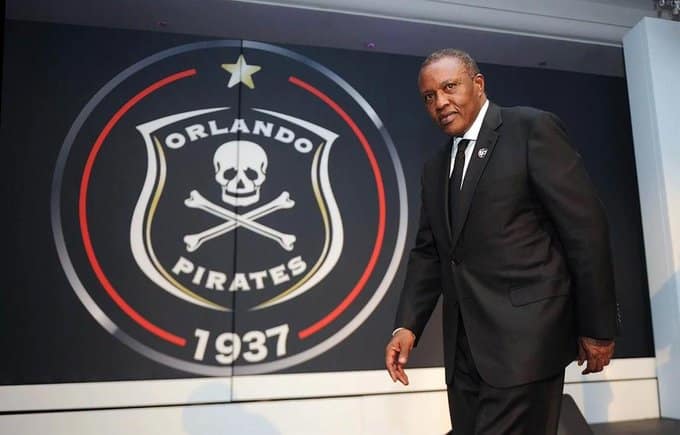
The tributes began not with the sunrise, but in the quiet hours before dawn, as if the footballing universe could not wait for the day to officially begin. On social media, in boardrooms, and across the bustling training grounds of South Africa, a singular name trended, adorned with cake and black-and-white emojis: Dr. Irvin “The Iron Duke” Khoza. Today, the architect of modern South African football celebrates 78 years, a milestone that is less a measure of time passed than a monument to a vision forged in iron will and executed with relentless precision.
For the legion of Orlando Pirates faithful, the “Happy Birthday” messages carry the weight of history. Since taking the helm of a struggling Buccaneers ship in 1991, Khoza has been more than a chairman; he has been a custodian of a soul. Under his stewardship, the club transformed from a popular giant into a polished institution, clinching nine Premier Soccer League titles and, most gloriously, the 1995 African Champions League crown—a victory that did not just belong to Pirates, but to a newly democratic nation hungry for heroes. The tweets from the club today were not mere formalities; they were love letters from a family, hailing the “Father of the House” whose leadership is as synonymous with the skull and crossbones as the Jolly Roger itself.
Yet, Khoza’s legacy, while anchored in Orlando, stretches far beyond the walls of Houghton or the roar of the Orlando Stadium. His true, nation-altering project began in 1996 when he was elected Chairman of the Premier Soccer League. Then, the landscape was a patchwork of semi-professional outfits plagued by disorganization, sparse crowds, and financial peril. Khoza, with the foresight of a strategist and the grit of a street fighter, saw not chaos, but potential. He wielded his gavel not as a ceremonial tool, but as a hammer, forging a truly professional league from the fractured parts.
The sponsors who today line up to pay tribute—SuperSportBet, Vodacom, and others—are not just well-wishers; they are partners in a kingdom he built. He convinced corporate South Africa that football was not a charity case but a premier marketing vehicle, securing unprecedented broadcast deals with SuperSport that beamed the PSL into living rooms across the continent. He professionalized administration, enforced stadium standards, and fought for financial fairness, turning players into professionals and clubs into sustainable businesses. The “Iron Duke” moniker, once a nod to his unyielding demeanor in boardroom battles, now speaks to the steel framework upon which the entire South African game rests.
The flood of accolades from current players, former legends, and rival executives paints a portrait of a complex icon. He is called a “visionary,” a “bastion of discipline,” and “the father of our modern game.” They speak of his intimidating presence, his legendary attention to detail—from the length of the stadium grass to the intricacies of a television contract—and his unwavering belief in the dignity of South African football. In a landscape often swayed by sentiment, Khoza has always been a figure of calculation and principle, his stern public facade rarely cracking, yet those close to him talk of a fierce loyalty and a dry, understated wit.
As the celebratory posts from the PSL, sponsors, and fans accumulate, they do more than mark a birthday; they compile a living testament. At 78, Dr. Irvin Khoza is not a figure receding into history, but a force still actively shaping it. He presides over a league he built, guides the club he loves, and continues to be the most formidable negotiator at any table he occupies. The story of South African football over the last three decades has countless authors, but it is written on a foundation he laid, line by line, contract by contract, trophy by trophy. Today, the nation raises a glass not just to the man, but to the enduring empire of will he created—a legacy as solid and lasting as iron.
About The Author