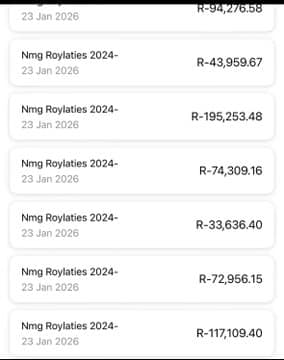
In an industry where whispers of unfair contracts and unpaid royalties are commonplace, superstar producer and hitmaker DJ Maphorisa has made a powerful public statement through sheer financial transparency. On January 24, 2026, the amapiano pioneer took to social media to share verified proof of a staggering R8 million payout in royalties distributed to artists affiliated with his influential label and collective, NMG (Never Give Up Music Group).
This landmark transaction marks his second major publicized payout, following a R5 million distribution last year, and serves as a bold contrast to the opaque financial dealings often criticized in the music business. “Another one… Making sure the family eats,” Maphorisa captioned the post, which featured a screenshot of a bank transfer overview with the monumental total. In a move addressing broader economic responsibilities, he pointedly added, “And yes, we pay our taxes too,” a statement welcomed by many as a nod to fiscal citizenship.
The announcement triggered a cascade of corroboration and celebration from within the NMG stable. Affiliate artists and producers began posting their individual receipts, turning social media into a ledger of gratitude. Screenshots flooded timelines showing substantial deposits, with figures like R555,128, R550,000, and R320,000 appearing, painting a clear picture of wealth being shared among creators. “This is what building together looks like! Thank you, Madumane,” posted one recipient, using Maphorisa’s real name, Madumane Isaac Moroe.
The public reaction from fans and industry observers was overwhelmingly positive, framing Maphorisa as a rare beacon of integrity. “Transparency on this level is revolutionary. He’s literally showing you the money other labels hide,” read one viral comment. Another noted, “He’s not just building a label; he’s building a sustainable ecosystem for amapiano.” The act was widely interpreted as a direct challenge to exploitative industry norms, where artists often sign away rights for advances and see little future income from their work.
However, the initial revelation was not without its skeptics. Some astute observers questioned the generic labels on the bank transfer, which listed descriptors like “Royalty Payment” without detailed breakdowns. This sparked a brief online debate about the specifics of the royalties being paid. Prompt clarifications from sources close to NMG, later echoed by Maphorisa in follow-up interviews, explained that this particular payout pertained specifically to master recording royalties—revenue generated from the streams and sales of the sound recordings themselves, which NMG controls.
This distinction is crucial in music finance. It separates these earnings from publishing royalties, which are generated from songwriting and composition and are typically administered separately. By clarifying this, Maphorisa highlighted a transparent, artist-friendly model for the master side of the business, while implicitly acknowledging that the publishing revenue stream—often a complex point of contention—operates separately for his collaborators.
The R8 million payout is more than a financial transaction; it is a strategic brand statement and a case study in modern artist-led business. It reinforces Maphorisa’s position not only as a hitmaker but as a trustworthy economic partner. In an era where artists are increasingly taking control of their masters, this public display of sharing the wealth from those assets sets a formidable precedent. It places immense pressure on other labels and collectives to demonstrate similar accountability and proves that in the booming amapiano economy, ethical business and massive success are not mutually exclusive, but can be, as Maphorisa is showing, the very foundation of a lasting empire.
About The Author