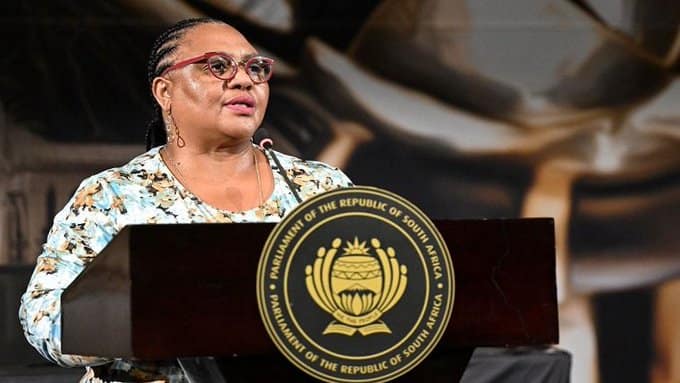
The African National Congress (ANC) Study Group on Parliament’s critical Ad Hoc Committee has mounted a full-throated defence of National Assembly Speaker Thoko Didiza, vehemently condemning what it labels as “politically motivated and misguided” attacks against her. The controversy stems from Didiza’s recent refusal to issue parliamentary subpoenas for forensic investigator Paul O’Sullivan and businessman Brown Mogotsi to testify before the committee investigating allegations of criminal networks within the South African Police Service (SAPS).
In a sharply worded statement released late Wednesday, the Study Group’s chairperson asserted that Speaker Didiza’s decision was not only procedurally sound but essential for upholding the integrity and legal standing of the parliamentary inquiry itself. The group accused opposition parties of attempting to undermine the committee’s work and bully the Speaker into overstepping her constitutional mandate for short-term political theatrics.
“The Office of the Speaker must operate without fear or favour, guided solely by the rules of Parliament and the Constitution,” the statement read. “The Speaker’s ruling was based on a careful consideration of the legal advice before her and the established procedures for summoning persons before Parliament. To portray this as obstruction is a deliberate and unfair distortion aimed at scoring political points and derailing a serious process.”
The Heart of the Dispute: Procedure vs. Urgency
The Ad Hoc Committee, racing against a looming deadline, has faced heated debates over how to gather evidence. Certain opposition members and some civil society groups have aggressively pushed for O’Sullivan and Mogotsi to be compelled to appear, arguing they possess crucial information on the alleged corruption networks. O’Sullivan, a private forensic investigator, has been involved in numerous high-profile cases, while Mogotsi has been named in prior testimony related to tender irregularities and political lobbying.
Speaker Didiza, in her ruling, reportedly emphasised that the committee had not yet exhausted all voluntary avenues to secure their testimony. Parliamentary legal advisors indicated that the threshold for issuing a subpoena—a significant coercive power—requires demonstrating that a person has unreasonably refused to cooperate after a formal request. The ANC Study Group argues this threshold was not met, and that the committee should first formally invite the individuals before escalating to a subpoena.
“This is about due process, not protection,” a senior ANC committee member, speaking on background, explained. “We want this inquiry to be watertight. Any finding or recommendation based on evidence gathered through an improper procedure could be challenged and dismissed in court, rendering the entire exercise useless. The Speaker is ensuring our work stands on a solid foundation.”
Opposition Fury and Stakes for the Inquiry
The decision has ignited fury from opposition quarters, particularly the Democratic Alliance (DA) and Economic Freedom Fighters (EFF). They have accused the ANC of using procedural technicalities to shield powerful individuals from scrutiny and to control the narrative of the investigation.
“Speaker Didiza’s ruling is a gift to those who wish to remain in the shadows,” charged DA MP and committee member Wendy Phillips. “When individuals central to allegations of state capture and police corruption can simply decline to appear, it makes a mockery of Parliament’s oversight role. This is not about procedure; it is about political will.”
The standoff places the Ad Hoc Committee at a crossroads. Its credibility hinges on its perceived independence and its ability to uncover uncomfortable truths. The ANC’s robust defence of Didiza signals a hardening of positions, suggesting that the path forward will be fraught with partisan conflict.
As the committee reconvenes, all eyes will be on whether a formal invitation is extended to O’Sullivan and Mogotsi, and if so, whether they will comply. The outcome will either validate the ANC’s call for procedural rigor or substantiate opposition claims of deliberate obstruction, ultimately determining whether this high-stakes inquiry can pierce the veil of secrecy it was established to dismantle.
About The Author